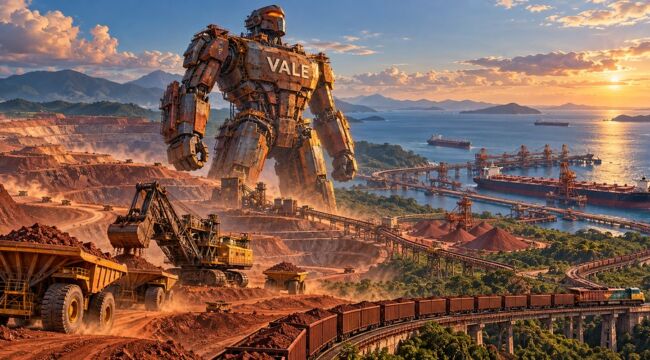
Buy the Dip in VALE
Within the realm of tangible assets, gold miners often dominate attention.
And rightfully so. Stocks tied to precious metals offer investors an effective hedge against inflation and financial instability. During bullish markets, these stocks can outperform many others.
However, mining extends beyond just gold and silver. Today, I want to highlight my preferred industrial metal miner — a name familiar to long-time readers.
While I continue to hold positions in gold and silver miners, firms specializing in “boring” industrial metals such as iron generally boast more consistent profits and tend to distribute higher dividends.
Back to the VALE
In June 2025, I published an article titled 8%+ Yields from Brazil’s Iron Giant.
That piece focused on Vale (NYSE: VALE), a highly lucrative miner of iron, copper, and nickel.
At that time, Vale was priced at $9.86. Iron ore values were depressed, Brazilian equities were struggling, and the company was still recovering from the 2019 Brumadinho dam disaster. This tragic event involved a dam failure that released mine waste, resulting in over 270 fatalities and significant environmental harm.
Now, Vale is nearing the end of addressing the fallout from that catastrophe. The management team has invested more than $4 billion enhancing dam safety, erecting containment measures, and improving operational protocols. They have accepted accountability, and it has come at a severe cost, but the worst appears to be behind them.
Our timing with the Vale recommendation was fortunate, as the stock climbed from $9.86 in June 2025 to a peak of $17.94 in April 2026 — an 81% rise at its highest point, plus roughly 7% earned in dividends.
More recently, however, the share price has dropped to $13.65, which seems like a compelling buying window. I intend to increase my holdings next week.
Here’s the reasoning behind that decision…
Irreplaceable Assets
Vale was established in 1942 by the Brazilian government with the straightforward goal of supplying iron ore to the Allies during World War II.
At the time, the United States and its allies sought access to Brazil’s abundant and exceptionally pure iron—a low-phosphorous variant required for producing high-quality steel used in arms, tanks, and piercing ammunition.
Although the iron deposit was rich and high-grade, its remote location required infrastructure such as railways for transport. The U.S. Export-Import Bank provided $14 million to help develop these logistics.
By the war’s conclusion, the company had shipped only a portion of the planned ore.
But the foundation for a mining giant was laid: a distinctive railway system, valuable ore deposits, and a significant mining operation.
Today, Vale owns two major rail networks that are essentially impossible to duplicate. Constructing new rail infrastructure of this scale is extremely challenging and unlikely in the present day.
Vale’s transportation system includes 610 locomotives, 35,868 rail cars, and over 1,200 miles of track. Because the company owns these railroads outright, it avoids paying steep access fees.
Additionally, Vale possesses huge shipping terminals, piers, loading facilities, and even owns several power plants to support its operations.
All this complements its core assets: rich mineral mines, resource rights, and specialized expertise.
Building a comparable operation now would entail an unimaginable expense and would likely take three decades or more.
This illustrates why I am such a fan of this mining titan — it is truly irreplaceable.
Long Haul Investment
My plan is to hold Vale shares for a minimum of 10 years, possibly longer if conditions remain favorable.
It serves as a perfect dividend-reinvestment stock. I engage automatic reinvestment of dividends through a DRIP program (available at all brokers), enabling gradual compounding of returns.
The coming decade promises to be turbulent, marked by inflation, warfare, and debt turmoil.
In such an environment, possessing substantial hard assets is vital — preferably companies with inflation-resistant holdings, robust cash flow, and attractive dividends.
Vale meets these criteria well. It could eventually become the largest mining enterprise worldwide.
In 2025, Vale’s CEO Gustavo Pimenta declared, “has to be the biggest mining company in the world because we are sitting on the biggest mining endowment in the world.”
That statement underscores the magnitude of this opportunity. Let’s hope they achieve this ambitious aim.
About the Author