Carl Sagan’s legacy: a cult of atheist pedants who feel superior for knowing we’re “star stuff.”
On social media, it’s common to see people celebrating birthdays by highlighting their scientific awareness or subcultural identity rather than simply sharing good wishes. The often sentimental claim that we are composed of star stuff is frequently repeated by those eager to project intellectual superiority. Since both expressions originate from Carl Sagan, it’s fair to deduce that this renowned science communicator influenced a prominent Western cultural movement: a community, often atheist, that prides itself on feeling morally and intellectually elevated compared to those who don’t share their beliefs or interests. Understanding Carl Sagan is therefore key to grasping a significant facet of contemporary Western culture.
Among the works most often referenced by followers of this group is The Demon-Haunted World: Science as a Candle in the Dark (1995). As a historian of philosophy, I identify this book as fundamentally Epicurean just from the title. The Roman Epicurean Lucretius in De Rerum Natura depicts religion as a painful consequence of ignorance about natural, material causes—purely atoms and void—where atoms randomly move to create order and chaos over eternity. There is no Big Bang, nor Creation or Apocalypse. Science (scientia) offers peace of mind, a concept that, though seemingly modern, predates Christianity. (Sagan speculates that the universe might expand and contract cyclically, turning the Big Bang into just one phase of an eternal cosmic accordion, restoring the ancients’ eternal cosmos.)
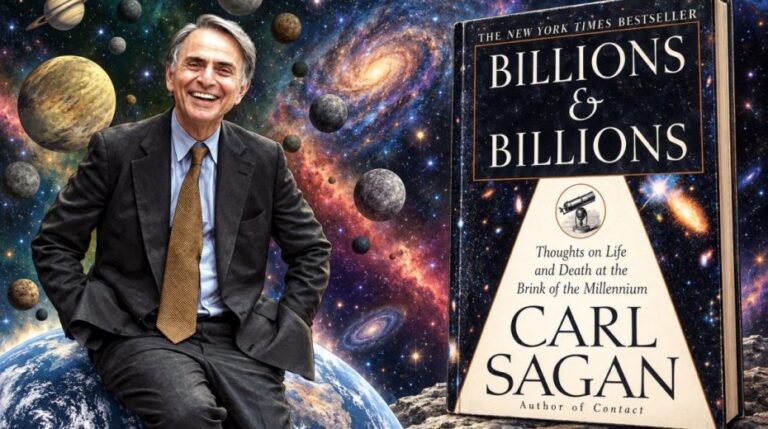
Yet, after considering his works, I found Billions and Billions (1997), Sagan’s last book and a political statement released by his widow posthumously, to be the most insightful. Here, he openly champions environmentalism and abortion rights. Today, anyone indifferent to climate concerns or opposing abortion is often branded uncivilized by the intellectuals who celebrate their yearly solar orbits.
This reading sheds light on the rigid, materialistic mentality that gained dominance among Western middle classes—particularly atheist leftists—after World War II.
The book splits into three parts, each containing brief chapters. In the first segment, which features the Big Bang idea, Sagan explores various scientific topics while consistently weaving in moral lessons reminiscent of ESG rhetoric. For example, in “The Gaze of God and the Dripping Faucet,” Sagan opens by explaining the ancient Egyptian sun god belief to introduce light’s nature, clarifying that color depends on wavelength. He then asserts that using melanin to differentiate white from black people is scientifically flawed since humans appear black across most of the visible and invisible light spectrum, including infrared and ultraviolet. “Only in the visible, where many molecules are transparent, is the anomaly of white skin even possible.” This exemplifies a form of sophistry elevating pedantry, claiming Science has ended racism and justified the term “African American.”
Sagan also shows sensitivity. In “The World That Came in the Mail,” the initial essay of the second environmental section, the “world” refers to an aquarium of shrimp he ordered. He describes their anatomy and likeness to humans with emotional depth, before recounting their mysterious deaths caused by environmental imbalance. Sagan weeps over this, drawing a parallel between his tiny aquarium and Earth’s vast ecosystem, where environmental disruption could threaten human survival at any moment.
Environmental alarmism, according to Sagan, can allow even inaccurate science. For instance, in “The Environment: Where Does Prudence Lie?” he claims dinosaurs, after thriving for 180 million years, were wiped out entirely. Yet since the 1970s, birds have been classified as living dinosaurs; the evolutionary link has fascinated scientists since the 19th century. Though no expert in biological sciences, I noticed factual errors in Sagan’s text. A scientist reviewing Billions and Billions would likely identify many more inaccuracies in this mature work of a famous science communicator who contributed little original research.
From Sagan’s writing, I understood that while geopolitical forces shape neo-Malthusianism in developing nations, the technocratic mindset is a natural outcome of the Epicurean/materialist philosophy.
In the first section, Sagan emphasizes how extraordinarily unlikely life on Earth is, emerging thanks to a near-impossible combination of material factors. His lifelong search for intelligent extraterrestrial life, which yielded no evidence, made human existence seem all the more miraculous. Mutatis mutandis, this is like pondering how our parents might never have met, or conceived us differently; as humorist Millôr Fernandes joked: “My mother was born in Italy, my father was born in Spain, and I was born in Rio. I don’t know how we ever met!”
This perspective, far too teleological for an evolutionist, leaves Sagan uneasy: the fragile conditions enabling life here could vanish instantly. Atoms endlessly shift without purpose, generating both order and disorder. Anyone with an Epicurean/materialist viewpoint would feel compelled to halt or preserve this fleeting moment when Earth remains hospitable.
An asteroid could strike at any time, wiping out life. Humans also pose risks by inventing technology that damages the atmosphere. Modern medicine reduced mortality, swelling population and energy use; CFCs created ozone holes threatening vital algae and causing white-skinned people’s cancers—white people being responsible for CFC emissions, a cosmic justice of sorts. (Recall that a few pages earlier, all humans were reportedly black, but that contradiction is overlooked.)
Thus, to press that cosmic pause button, controlling technology expansion and birth rates is essential, alongside restoring political power to women (power they allegedly had in the Pleistocene but lost since). Empowered women would presumably choose contraception. (I await clarification on the Pleistocene claim in the abortion-focused third section.) Additionally, scientists must be empowered, as they alone foresee potential long-term disasters. Humans’ evolutionary short-term focus—prioritizing immediate survival over species-wide futures—is our principal flaw. Policymakers should therefore heed scientists’ foresight and work to educate the public accordingly.
Sagan’s materialist anthropology blends with the pedantic tone permeating his texts. Human flaws are rooted in evolution: short-sightedness served offspring survival rather than species persistence. Yet Sagan’s outlook carries an End of History sentiment: humanity has matured beyond reliance on God, embracing Science as ultimate authority. Having reached this existential milestone—the conclusion of “humanity’s childhood”—it’s time to construct global strategies protecting Earth’s delicate conditions. Implicitly, this worldview suggests some people are more evolved, a notion no genuine scientist supports but is subtly implied. For survival, humanity must obey Science; dissenters effectively side with extinction. Hence, suppressing or even eradicating the “inferior” becomes a necessity for species preservation.
During the COVID-19 pandemic, those aware of how traditional vaccines function were perplexed by the obsession, led by Fauci’s supporters, to vaccinate everyone. If vaccines grant immunity—as the disease itself does—why insist that dissenters must also participate? The logic arises from Sagan’s belief that humanity’s future depends on collective compliance with Science. He closes his environmental section praising global crises for “a potential to draw forth previously untapped and even unimagined powers of cooperation, ingenuity, and commitment.”
About the Author