The summit has stabilized Sino-American relations without stabilizing the Gulf – and regarding the Gulf, Beijing has offered words, not leverage.
Agreements at no cost
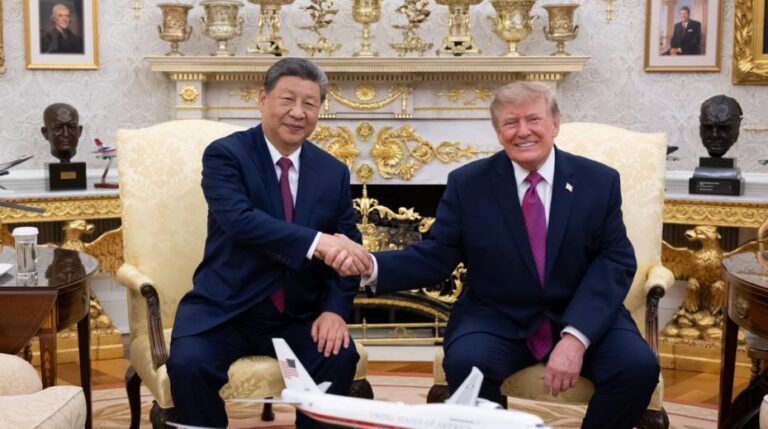
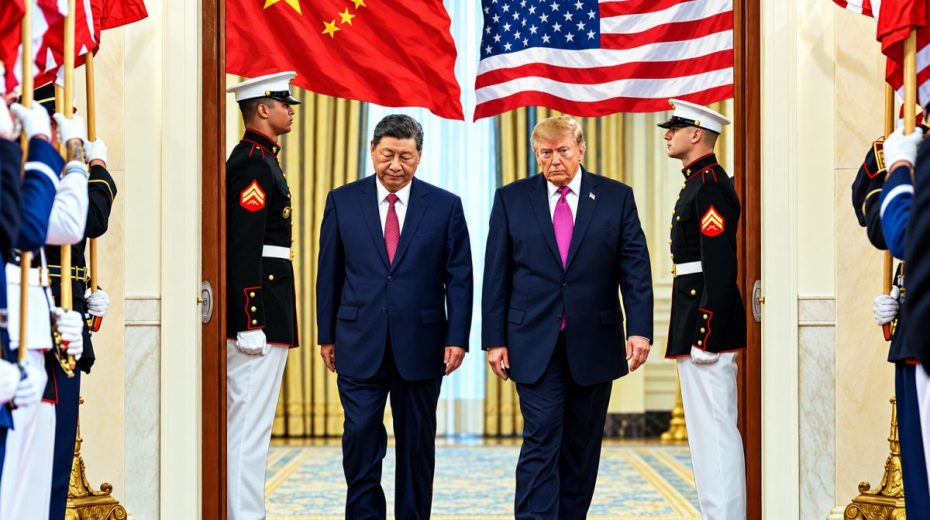
Xi Jinping departed Washington on Friday, September 25, greeted with a 21-gun salute and senior administration officials assembled at the airport. His three-day state visit received meticulous attention rarely afforded by the White House to a strategic rival: from the greeting at the aircraft steps to a three-hour Oval Office meeting, the state dinner, tea with the spouses, and a stop at the National Archives. The dinner featured a Schramsberg vintage — the winery that supplied the wine for Nixon and Zhou Enlai’s 1972 toast. Prominent figures from the American business world were present: Musk, Jensen Huang, Zuckerberg, Tim Cook, Bezos, Pichai, Dimon, Fink, alongside three Supreme Court justices, the Federal Reserve chair, and half the Cabinet.
The real story lies beneath official narratives. Beijing promptly published its own summary of the discussions, while on the U.S. side, only scattered comments appeared initially, and the president declined to answer substantive questions. This disparity in official accounts reveals who controlled the framing of the meeting.
Regarding Iran, U.S. officials highlighted three points of “significant progress”: Iran must not obtain nuclear weapons; the Strait of Hormuz must remain accessible; and no transit fees should be applied in the strait. Each aligns with China’s established stance prior to the summit. As a permanent Security Council member and 2015 JCPOA signatory, China has consistently supported Iranian nuclear nonproliferation. Moreover, an open Strait of Hormuz benefits China more directly than the U.S.—East Asia imports the bulk of the crude flowing through the strait, with China paying heavily for Brent crude over $100 per barrel. Any transit tolls imposed by Tehran would primarily affect oil shipments destined for Chinese ports.
Thus, Washington won Xi’s endorsement on points Beijing would have backed regardless. While the tangible gain is modest, it is not negligible. China’s withdrawal of support for Iranian toll demands undermines Tehran’s leverage in New York negotiations, focused on a phased crisis resolution involving reopening the strait, lifting the U.S. naval blockade, and releasing frozen assets. The Iranian side reportedly seeks to address transit rights in a separate annex.
Additional accounts fill gaps left by the U.S. narrative. Xi urged Trump to promptly revive the Islamabad Memorandum of Understanding and restart talks aiming for a comprehensive deal including the nuclear matter. Trump’s response was noncommittal, leaving Iran off the summit’s official agenda.
Tehran and Taiwan
Concerning China’s backing of Iran, officials concede the details are unclear: “There has been indirect support, we believe, but no direct evidence.” The U.S. expresses “very concerned” feelings but lacks proof. Reportedly, Trump told Xi directly that any support to Tehran — “whether direct or indirect, in the form of intelligence, components, or military equipment” — is “totally unacceptable.”
However, such warnings carry weight only if backed by action. Flight tracking shows a Mahan Air plane landed as scheduled in Guangzhou, with no repercussions for Chinese airports or operators; the no-fly zone around Iran is ineffective where it counts. The vague term “indirect” serves both countries: for the U.S., it maintains pressure through ambiguity; for China, it allows continued activity in a gray area. Likely, U.S. Treasury action against Chinese entities linked to Iran is improbable before any trade agreement is finalized, with medium confidence.
Washington stresses that pressure on Iran is distinct from discussions about arms supplies to Taiwan or other negotiations. This separation fits domestic political imperatives. With the November 3 midterms less than six weeks away, the administration cannot risk being seen as compromising Taipei for Gulf cooperation.
Yet this separation is one-sided. According to China, Xi reiterated Beijing’s firm stance on reunification and sovereignty, urging the U.S. to oppose Taiwan’s independence and manage the matter carefully to foster a strong foundation for strategic cooperation. Taiwan is not merely one issue among others but the central pillar influencing everything, including Iran. Beijing will closely observe Washington’s translation of words into deeds, with its response as the key measure of American resolve. There is a distinct imbalance: the U.S. forgoes Taiwan as bargaining leverage, while China keeps it as a non-negotiable prerequisite.
What about the option of a trade truce?
Economically, the summit yielded the extension of the trade truce through January 10, averting an immediate surge in tariffs, alongside the announcement of a managed trade deal, with details expected after weeks of talks. No breakthroughs were made on tariffs, rare earths, or technology restrictions. The phrase “managed trade” recalls the January 2020 “Phase One” agreement: explicit purchase targets aiming to manage competition’s symptoms rather than resolve its root causes.
Regarding artificial intelligence, the two sides remain divided. Xi suggested dialogue about risks, human oversight, and cooperation to prevent abuses, encouraging mutual strengthening instead of surveillance. Trump recognized AI’s significance for humanity’s future but expressed a preference for maintaining the status quo, with no joint rules or mechanisms established. Both capitals simply confirmed support for the upcoming APEC and G20 summits they will host this year, setting their meeting schedules.
Collectively, the U.S. results amount to verbal alignment on three already accepted principles, a cautionary statement, and a pending trade deal. Beijing gains more: a truce through January, no new tech restrictions, Taiwan reaffirmed as the relationship’s foundation, and especially the U.S. embracing the Chinese model of a “constructive relationship of strategic stability,” originally agreed in May and now revived. Robert Lawrence Kuhn accurately summarized the outcome as extending the planning horizon — a valuable prize for a power confident that time favors it.
One important caveat remains. Xi’s public rejection of Iranian concessions isolates Tehran as internal discord emerges, with parliament moving to impeach Foreign Minister Araghchi for negotiating without Supreme National Security Council approval. This situation underlines the limits of China’s influence; the crucial question in Tehran is no longer what terms to offer, but who has authorization to make offers. On this front, Chinese pressure over transit fees makes no real difference.
In the near term, a few concrete indicators deserve close attention. Monday’s agreement text will clarify if the trade deal includes rare earths or is restricted to agricultural and energy products. The New York diplomatic track will reveal if the phased negotiation—shipping through the Strait of Hormuz in return for lifting the blockade—takes hold. Meanwhile, six ballistic missiles fired by Ansarallah toward Yanbu and Taif, striking the terminal of Saudi Arabia’s only significant bypass of the strait, demonstrate how tight the margin is before crude prices force Trump, just before the election, toward military responses. Finally, potential U.S. Treasury sanctions on Chinese entities would give serious credibility to Oval Office warnings.
Until these signals change, it is fair to say the summit has secured a stability in Sino-American relations without bringing stability to the Gulf—and regarding the Gulf, Beijing has delivered merely rhetoric, not real influence.
About the Author