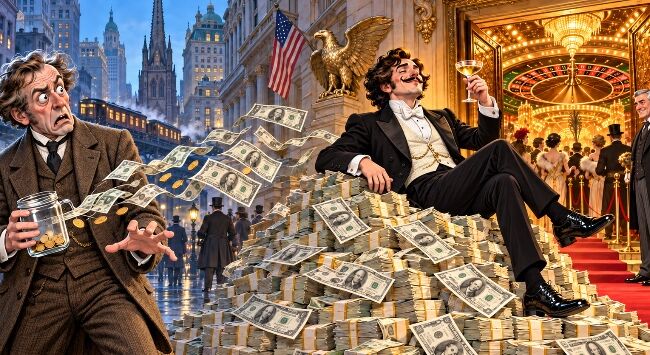
If You’re a Saver, You’re a Sucker
In the autumn of 1923, a German housewife stood by the factory gate, waiting to receive her husband’s wages.
During that period, workers were paid at least daily because prices climbed rapidly throughout the day. The wife had to be ready the moment the money was handed over. Like a baton in a relay race, she dashed to the stores. Bread purchased at noon would cost significantly more by the evening.
By November 1923, one U.S. dollar exchanged for roughly 4,200,000,000,000 (yes, 4.2 trillion) Reichsmarks, while in 1914 it was only around 4.
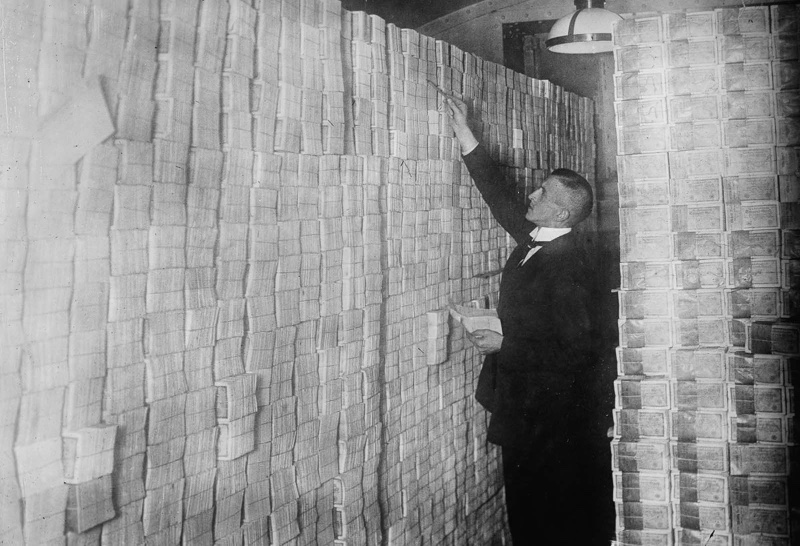
A German banker stacks Reichsmarks into a wall of worthlessness. Credit: Rare Historical Photos
When people hear “Weimar,” they often picture “wheelbarrows of cash,” but the true devastation was suffered by those clinging to that cash.
What Money Teaches
Every price reveals a lesson, especially the cost of money, which we recognize as the interest rate. This rate imparts a crucial message: is patience rewarded?
Economists refer to this as time preference—the choice between sooner or later. A positive interest rate signals that waiting offers benefits. A near-zero rate suggests that waiting isn’t worth it.
Five years ago, I created a straightforward spreadsheet to help my graduate students grasp this concept. Imagine a $50,000 investment returning just over $10,000 annually for five years. At a 2% interest rate, it’s profitable to pursue. At 5%, however, you face a loss of about $2,400 in today’s terms—same tools, clients, and cash flow. Only the value of time shifts.
Interest rates guide both businesses and individuals. They suggest whether a young man should save for a ring or spend his paycheck on the weekend. They indicate to a young woman if starting a family is feasible.
When the cost of waiting drops to zero or below, as seen in Japan and Switzerland, the takeaway is clear: seize what’s available now.
Weimar’s Moral Collapse
The German central bank continuously lent at rates significantly below inflation until the very end. Borrowers prospered while savers were devastated.
This was far from harmless. Retirees, widows dependent on war bonds, civil servants who saved consistently over decades, and the responsible middle class—all watched their hard-earned savings vanish in a matter of months.
Even worse, they reached a bleak realization.
If saving is foolish, why bother? If the future is unreliable, why make plans? Clerks and taxi drivers began speculating on stocks. Currency traders rose to new heights of influence. Berlin transformed into Europe’s epicenter of vice, marked by cabarets, cocaine, and widespread prostitution. Many women on those streets originated from respectable families that had simply exhausted their resources.
Dr. Joseph Salerno discussed this in his essay “Hyperinflation and the Destruction of Human Personality.” He details how professors and senior officials, once stable, found themselves working as taxi drivers and waiters almost overnight.
This tragic outcome holds relevance today: a person’s character is built on their possessions and ambitions. When a government destroys the value of money and private property loses significance, the foundation beneath a person crumbles. Salerno argues that Hitler exploited precisely these demoralized individuals.
Weimar’s rulers faced overwhelming war reparations and controlled the printing press. Routinely, printing money was the easiest solution. The path of least resistance always triumphs—until there’s nothing left to protect.
“Weimerica”
I’ve heard the term from two separate sources. Still, America isn’t Weimar. You don’t require wheelbarrows to buy bread. But it’s important to focus on incentives rather than raw figures.
From 2008 through 2022, the Federal Reserve maintained near-zero interest rates for the majority of that span. In late 2021 and early 2022, it kept rates at zero despite inflation exceeding 7%. For years, savers earned negative returns after accounting for inflation.
The moral message landed just as it did in Berlin.
Young men examined housing costs, calculated the realities, and abandoned thoughts of marriage and homeownership. Many withdrew into video games and sports betting, activities that surged after 2018.
Young women observed the same numbers and discovered alternative paths to wealth through Instagram fame and, for far too many, OnlyFans.
The birth rate hovered near historic lows. While some economists attribute this to women’s education and careers, I attribute it to arithmetic—an opinion shared by German economist Guido Hülsmann. If the numbers don’t add up, young couples simply don’t start families.
Meanwhile, the gambling industry thrived. Meme stocks, cryptocurrency, and risky options proliferated.
The heavily indebted seemed wise, while savers were perceived as fools.
A generation did not simply become degenerate overnight. Price signals are indifferent to morality. People responded to what they saw.
A Tax on Virtue
Professor Guido Hülsmann, teaching at the University of Angers in France, authored The Ethics of Money Production in 2008, considering cheap money a moral dilemma.
He references a medieval bishop, Nicole Oresme, who warned 14th-century French kings that reducing coin value was theft. Hülsmann extends this reasoning to modern fiat currency. He asserts that persistent inflation fosters habits of borrowing first and questioning later. Debt becomes a lifelong burden, and inflation “slowly but assuredly destroys the family.”
Old Catholic educators dubbed the act of planning “prudence,” the highest of the cardinal virtues. Thomas Aquinas taught that virtue is a habit developed through consistent practice, like strengthening a muscle.
However, habits require incentives to endure. A monetary system penalizing thrift for years is like a gym that charges a fine for every exercise—you eventually stop trying.
Cheap money increases rewards for vice while reducing benefits for patience, loyalty, and self-discipline.
Why experts seem puzzled by the rise of vice and decline of virtue escapes me.
The Road Back
On September 16th, the Federal Reserve increased interest rates for the first time since 2023. The 10-year Treasury yield rose above 5%, the highest since 2007. For the first time in decades, savers can earn a genuine return on conservative Treasuries.
In late 1923, Germany introduced a new currency and halted excessive money printing. Prices stabilized within weeks. But this change came too late for the savers who had already lost everything.
Wrap Up
America retains a window of opportunity.
Accurate price signals can restore the habits that distorted signals broke down. When saving becomes rewarding once more, people will save. When young couples see a viable path to happiness, they will start families.
Your best option is to teach your children and grandchildren the value of investing and patiently awaiting future gains.
Hold the line. Time’s pendulum is shifting back in your favor.
About the Author