Peace cannot be constructed through ongoing rearmament or by compelling one side to surrender.
This is the first part of Mats Alexandersson’s series on war, peace, and security. The next three parts will be published during September and October on the Clarté blog.
For many years, the United States has combined its economic, financial, military, and political influence to uphold a capitalist world order centered on itself. This strategy has often been justified under the banner of liberal hegemony—a discourse that promotes democracy, individual rights, market economies, and international norms as universal values. However, in reality, these ideals have frequently been subordinate to maintaining American dominance and preventing rival great powers from gaining control over strategic areas.
The so-called rules-based world order thus serves both as a self-conception and as a form of power language. The U.S. has assigned itself a unique historical mission: to ensure global stability, open markets, and security in the world economy. This belief in American exceptionalism functions as a meta-ideology. Beneath this universalist façade, a concrete class and power interest drives the U.S. state’s geopolitical role, which ultimately aims to expand and protect capital.
Two historical figures vividly exemplify this trajectory. Henry Kissinger revealed American realpolitik in its harshest form. In Chile, the U.S. played a role in destabilizing Salvador Allende’s democratically elected government and later backed Pinochet’s dictatorship. Similar logic appeared repeatedly in Cambodia, East Timor, and in the support for Pakistan’s military regime—where democracy and human lives were sacrificed to uphold geopolitical control.
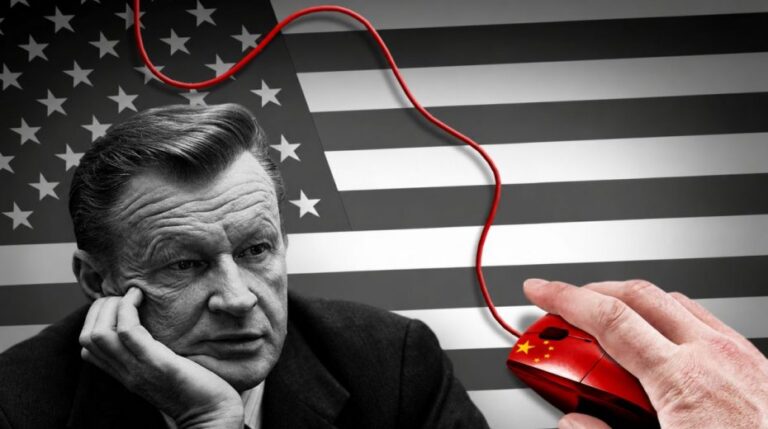
When Zbigniew Brzezinski articulated in The Grand Chessboard (1997) that no rival power should be allowed to dominate Eurasia, this practice became formal doctrine. The progression from Kissinger to Brzezinski is clear: moving from covert interference to explicit global supremacy strategy. This evolution offers the lens through which today’s bloc alignments, war economy, and the heightened risk of a great-power war must be seen.
The painting “Die Namenlosen” (1916) by the Austrian painter Albin Egger-Lienz.
Why Eurasia is gaining additional significance
Currently, Secretary of State Marco Rubio plays a pivotal role in the U.S. foreign and security policy framework, where the White House, Pentagon, intelligence, NATO, and financial policymakers coordinate. Meanwhile, the strategic landscape is increasingly influenced by tech and defense industries: companies specializing in AI, cloud computing, satellites, semiconductors, and weaponry shape the tools of warfare, information management, and investment flows. American dominance today expresses itself not only as state power but as an intertwined military, digital, and financial structure.
In Brzezinski’s framework, Europe was never marginal. In The Grand Chessboard, he positions Eurasia as the critical geopolitical arena and Europe as the United States’ key foothold on the continent. A united Europe, tied to the U.S. through NATO and transatlantic bonds, would reinforce American influence in Western Eurasia. Consequently, Europe appears less as an autonomous power center and more as a strategic outpost within a U.S.-dominated order.
This reasoning is most evident in Brzezinski’s treatment of Russia and Ukraine. He claimed Russia’s main geostrategic option was to align with the West—but crucially, never as an equal power. Ukraine was designated a “geopolitical pivot”: without it, Russia loses its claim to Eurasian empire status, while control over Ukraine would grant Russia vital strategic significance once again. This perspective reveals the limitation of great-power views: Ukraine is treated as a mere chess piece in a wider contest, ignoring its political agency and self-determination rights.
Brzezinski promoted a vision of geopolitical pluralism in Eurasia, where no single power should control the entire continent. In practice, this implied the U.S. supporting regional counterbalances, alliances, and autonomous states to constrain both a revanchist Russia and a rising China. This approach can be seen as a balance-of-power strategy or as a means to set regional players against each other to sustain American supremacy.
Brzezinski’s analysis also applied to Central Asia and the Caucasus, regions he described as the “Eurasian Balkans”: territories marked by energy resources, transport corridors, fragile states, and ethnic conflicts, making them prime targets for great-power competition. Here, local societies’ goals are overshadowed by external strategic interests, reducing these smaller nations to geopolitical objects rather than equal participants.
There is rearmament for war
Understanding today’s challenges requires historical context. The conflict in Ukraine, Europe’s military buildup, and escalating fears of a confrontation between Russia and NATO cannot be seen as isolated events. They must be placed within the framework of the U.S.-led security order established after the Cold War—an order designed to maintain American dominance across Eurasia. This policy has yielded mixed results: Russia, China, and Iran have grown closer, Europeans’ autonomy has diminished, and the chance of conflict between great powers has heightened.
Brzezinski’s writings openly laid out this strategy. The U.S. aims to prevent any rival or coalition from acquiring enough power to control Eurasia. This entails limiting a reborn Russia, preventing China from becoming an equal rival, and keeping Europe politically and militarily dependent on the United States. Hence, NATO functions not only as a defensive pact but also as a mechanism for projecting American influence in Europe and neighboring regions.
The Eurasian counterweight
The partnership among China, Russia, and Iran goes beyond a temporary response to sanctions or individual conflicts. China offers industrial capacity, capital, and markets; Russia supplies energy, raw materials, military strength, and strategic depth; Iran brings regional influence and a crucial geographic position. While their interests are not perfectly aligned and tensions exist, the China-Russia relationship rests on a pragmatic foundation that many Western observers underestimated.
This situation holds an ironic twist. A strategy intended to block the rise of a Eurasian counterweight may have inadvertently helped build it. Simultaneously, the U.S. confronts its own internal economic strains: large deficits, ballooning debt, and increasing interest rates create vulnerabilities. The dollar’s role as a reserve currency still offers flexibility but cannot entirely eliminate the threat of confidence crises. Any such crisis would likely impact ordinary workers through inflation, austerity, and declining public services.
Europe’s dilemma
Economist Jeffrey Sachs has observed that Europe has historically enjoyed significant economic complementarities with Russia: European technology and industry complement Russian energy, raw materials, and markets. Sachs argues that sanctions, conflict-driven policies, and reliance on the United States have shattered these ties and undermined Europe’s strategic independence.
While this view is contested—especially given how Russia’s invasion of Ukraine has altered the landscape—it raises an essential question: Is Europe capable of defining its own security stance, or is it relegated to a battleground for conflicts between other powers? Sachs proposes direct dialogue with Moscow, clearer distinctions between EU foreign policy and NATO, and a stronger, more independent European defense less reliant on the U.S.
The risk of war
The immediate danger lies in escalation. There is no straightforward or low-risk way to achieve Russia’s military defeat, yet policies continue to intensify the confrontation. If objectives shift from defending Ukraine to permanently weakening or subjugating Russia, the risk grows that this proxy conflict will escalate into a direct clash between nuclear states.
Peace cannot be established through endless arms buildup or by forcing one side to capitulate. Lasting peace demands diplomacy, mutual recognition of security needs, and an international framework where no great power is entitled to dominate others. Public sentiment in Europe and the United States could prove pivotal: as the social costs of the arms race, austerity measures, and war risks become apparent, pressure might build for a new path forward.
About the Author