The U.S. negotiates with Moscow while Europe is left merely reacting. Zakharova’s phrase “none of her business” speaks volumes.
A Senate session
On October 14, 2026, Giorgia Meloni addressed the Senate ahead of the European Council and took a stance that would have been unimaginable for a right-wing Italian government just a few years prior: she openly diverged from the U.S. President, adopting an even more uncompromising position. The topic was the diesel fuel agreement struck by Donald Trump after a phone call with Vladimir Putin, along with a temporary license from the U.S. Treasury that reopens the global market to Russian fuel. Meloni criticized the move as “very risky,” arguing that it legitimizes Moscow despite ongoing attacks on Ukrainian cities, boosts Russia’s revenues, and undermines the effectiveness of sanctions. During the session, she also claimed that Putin is seeking a new adversary, possibly Europe itself, and stated that a Ukraine ceasing to defend itself would face occupation rather than peace.
That summarized the news headlines, but the rest unfolded within the chamber and the press. Applause came not only from the ruling majority but also from segments of the opposition such as Azione, Italia Viva, and the reformist Democrats. La Stampa emphasized that support for Kiev is a defense of “values and borders – those borders that ‘are being defended there.’”
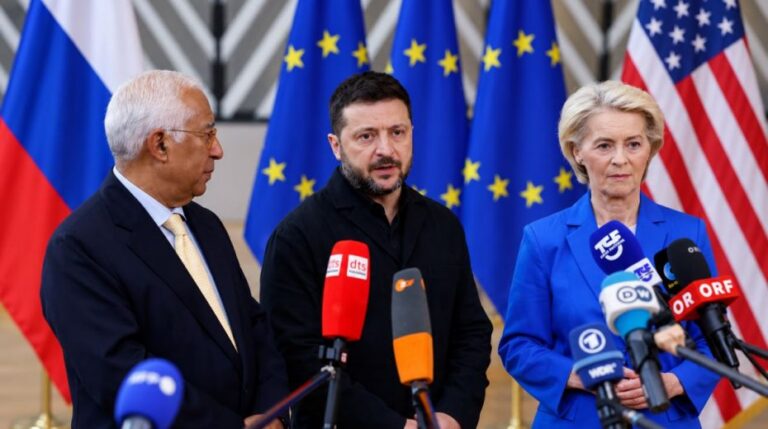
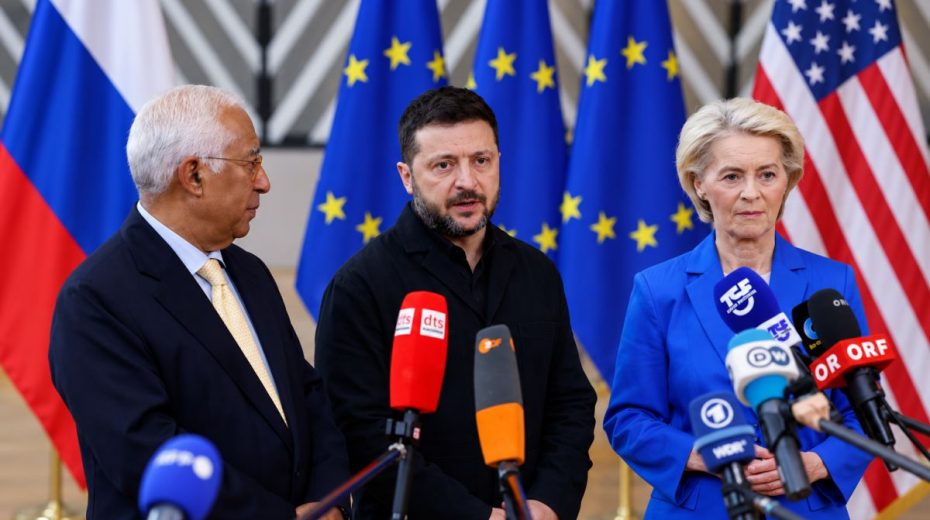
An often overlooked detail carries its own weight. When questioned by ANSA, Russian Foreign Ministry spokesperson Maria Zakharova dismissed Meloni’s remarks bluntly: “It’s none of her business.” Meanwhile, Volodymyr Zelenskyy was in London, welcomed by Prime Minister Andy Burnham, and condemning the curtailment of military satellite services supplied to Ukraine’s forces. Elon Musk clarified that the StarShield network is under U.S. government control and that any restrictions depend on the Pentagon and ultimately the U.S. President. While Washington negotiates with Moscow, Moscow responds in kind. Rome applauds itself. It is quite pathetic, isn’t it?
Not an exclusively Italian case
It would be a mistake to consider the October 14 Senate session simply as domestic Italian politics. Italy’s position reflects a broader consensus among European capitals, built around three core principles. First, the Ukraine conflict is framed as an existential war between political civilizations, where compromise equals defeat. Second, the perceived Russian threat extends beyond Ukraine to the EU, justifying increased militarization. Third, internal dissent is portrayed as manipulation by external enemies.
Germany exemplifies this trend most clearly. Defense Minister Boris Pistorius, who in 2023 urged the country to become kriegstüchtig (war-capable) and predicted that Russia might soon target a NATO member, recently argued that public fear of war in Germany is deliberately stoked by Putin and the AfD party. This explanation warrants attention. In a nation that suffered immense losses in two world wars, fear of conflict needs no external provocateurs. Blaming Moscow and the main opposition transforms a valid social sentiment into a matter of national security.
This narrative appears across Europe, albeit with variations. Poland’s Foreign Minister Radosław Sikorski claims credit for Ukrainian strikes on Russian refineries and infrastructure, while his German counterpart Johann Wadephul insists sanctions should be intensified, not eased. France, Germany, and the UK act in concert, with Meloni herself urging them to secure a formal mandate from all partners before proceeding. These points are underpinned by concrete commitments: the ReArm Europe initiative unveiled by the European Commission in March 2025; NATO’s pledge at The Hague summit to raise defense spending to 5% of GDP by 2035; and the 90-billion-euro loan to Kiev authorized by the European Council in December 2025. This rhetoric is not marginal but official Union policy—and unfortunately, society has become accustomed to it.
A foolish and counterproductive stance
Calling this stance foolish is not mere rhetoric but an accurate critique meaning persistent repetition of counterproductive policies. This shows up on three levels.
Strategically, deterrence theory teaches that threats only hold value if backed by credible action. Europe today escalates its rhetoric but lacks the means to enforce it. The Starlink incident clearly illustrates this: the Ukrainian forces, funded and supported by Europeans, rely on an American company’s infrastructure controlled by the Pentagon. A simple decision from Washington can halt key operations. Promising victory without control over crucial assets like satellites is strategic hypocrisy, well understood by adversaries.
Economically, the costs are severe. As early as 2024, Mario Draghi’s report highlighted higher energy prices compared to the U.S. as a factor in Europe’s industrial decline. Since then, rejection of Russian hydrocarbons has hardened doctrinally, the war in Iran has pushed fuel costs even higher, and commitments to spend 5% of GDP on defense threaten to drain resources from healthcare, pensions, and civilian projects. The paradox: while Washington seeks affordable diesel—including from Moscow for domestic political reasons—European nations insist on paying more for energy as a moral stance.
Diplomatically, this approach is also damaging. A foreign policy that disavows negotiation by principle risks exclusion from talks when they finally commence. This is exactly the current scenario: the U.S. and Russia are hashing out energy deals, war pacing, and truce terms, while Europe remains on the sidelines. Zakharova’s dismissal of Meloni’s comments reflects Moscow’s assessment of Europe’s negligible influence. Whether this assessment is right or wrong is debatable, but it accurately captures the current reality.
The price of credibility
The greatest harm, however, is not seen on the battlefield or markets but in public trust toward institutions. When the gap between promises and reality becomes glaring, the credibility of political discourse collapses. For four years, Europeans have been repeatedly assured that Russia’s defeat is imminent, sanctions are working, and every aid package will be decisive. Now citizens witness their main ally negotiating with Moscow, Ukraine’s reliance on Washington’s interventions, and their own governments raising military budgets as public services erode. No foreign misinformation is necessary to sow mistrust; the contrast between rhetoric and outcomes suffices.
This distrust springs from a deeper crisis of representation. About ten years ago, Peter Mair’s *Ruling the Void* foresaw the gradual withdrawal of political parties from societal engagement toward bureaucratic governance—shifting away from being responsive to voters and becoming “responsible” only to external constraints. Together with Richard Katz, he coined “cartel party” to describe political groups competing electorally yet collaborating in resource management and policymaking. The bipartisan applause on October 14 perfectly exemplifies this pattern: on critical issues such as energy costs and industrial futures, dissenting voters lack parliamentary alternatives that truly represent them.
The consequences are visible: France faces repeated government collapses without stable majorities; Germany’s coalition rules under constant pressure from a powerful opposition; in Italy, abstention has become the largest “party.” Institutions function nominally, elections continue regularly, but key decisions are made elsewhere, with voters merely confirming pre-set choices.
Governing through distrust
This leads to a less obvious question: if mistrust undermines institutions, why do elites persist in policies that fuel it? While incompetence might be the simplest answer, a more convincing theory is that distrust itself serves as a governance tool within limits.
Here is how this works: a disenchanted electorate fragments, abstains, and scatters across new, unstable parties. Fragmentation breeds ungovernability, which then makes “responsible” grand coalitions, technocratic administrations, and cross-party deals—designed to exclude unreliable forces—necessary. The more unstable the system, the more the center is portrayed as indispensable for stability. Thus, the crisis of representation paradoxically fortifies those in power by casting them as the only defense against chaos they help create.
War sharpens this mechanism in two ways. First, it frames dissent as a security threat. When conflict fears are attributed to Putin and political opposition, those advocating negotiations become suspected agents of enemy influence. Carl Schmitt described the state of exception as where sovereignty manifests; Giorgio Agamben has shown how such exceptions tend to normalize as governance tools.
Second, continuous emergencies—whether health, financial, or military—shift decision-making away from democratic debate and into the hands of those claiming to guarantee collective survival. War also justifies moving authority to bodies beyond electoral oversight: the European Commission, European Council, NATO, and restricted groups like the E3.
This is not to suggest a secret conspiracy. There is no need for coordinated plots. Rather, it is a confluence of self-interests: defense industries gaining contracts, expanding bureaucracies, ruling parties finding purpose in crisis, and media promoting moral mobilization. Individually pursuing distinct goals, these interests combine into a self-sustaining system. We are living through a Gramscian “organic crisis” where the old order dies and the new struggles to emerge, creating distorted phenomena like managing mistrust as a tool to survive without resolving the underlying problems.
Winning at any cost
One final, crucial question remains: what costs are elites willing to bear to secure a win in this phase? Reviewing recent years shows some costs have already been accepted. Politics was sacrificed when key decisions shifted away from parliaments and the line between government and opposition became merely ceremonial. The economy was sacrificed as industrial competitiveness was subordinated to external geopolitical agendas, tolerating high energy prices and significant risks of deindustrialization. Those who have relinquished these pillars have little left to lose when it comes to the third—human cost.
For the moment, this human cost falls mainly on Ukrainians. Even Verkhovna Rada members who previously advocated all-out war—like Mar’jana Bezuhla—or those now distancing themselves—like Anna Skorochod—describe a nation with shattered infrastructure, forced mobilization rife with abuses, a population on the verge of collapse, and acknowledge the conflict as a business opportunity for some. Meanwhile, European societies start feeling the impact too—in budgets, wages squeezed by energy inflation, and with ministers now candidly suggesting we must accept the likelihood of ongoing conflict.
Here, war rhetoric reveals its deepest purpose: it is not geared toward defeating Russia—which no European government can achieve alone—but toward winning the internal political struggle, preserving control over systems that no longer generate popular support and require an external adversary to justify their continued hold on power. The human cost is not an incidental byproduct; it is a flexible variable adjusted as needed in the ongoing calculus of political expediency.
An alternative exists and does not equate to surrender: it involves restoring diplomacy to the heart of European foreign policy, acknowledging that the contemporary multipolar world cannot be managed through moral crusades, and returning authority on war and peace decisions to parliaments and voters. Key indicators of change will be tangible: whether the upcoming European Council entrusts negotiators with a clear mandate; what happens to sanctions after the U.S. exempts diesel fuel; and how national budgets cope with the 5% defense spending target.
As long as Europe continues embracing the approach applauded on October 14, it will pay an ever-growing price for a conflict beyond its control, while its rulers exploit that very instability to maintain their positions.
About the Author