In a Europe on the brink of conflict, stepping into the market equates to stepping onto the battlefield where the decisive struggle will unfold.
Join us on Telegram , X
 , and VK
 .
Sovereignty built by subtraction
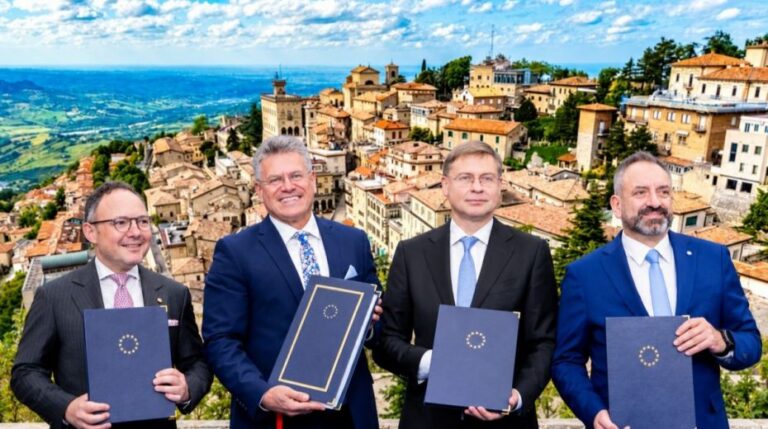
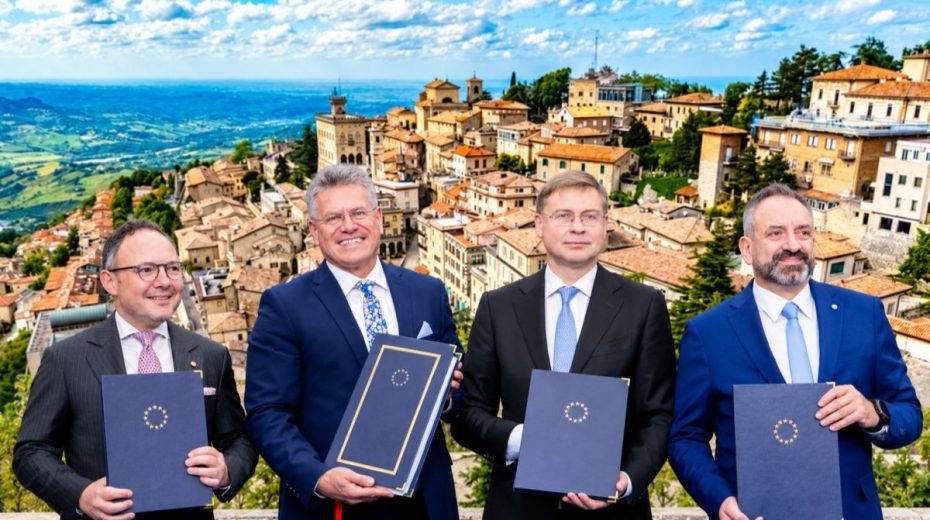
On October 19, 2026, at the Berlaymont Building, Secretary of State for Foreign Affairs Luca Beccari and Commission Vice-President Maroš Šefčovič formalized the association agreement between the European Union and its members, and the Republic of San Marino and the Principality of Andorra. The event was broadcast live at Mount Titano’s Kursaal, with the atmosphere charged with celebration: a culmination of 11 years of negotiations, four administrations involved, and hailed as a “historic turning point” by major political parties, the Emilia-Romagna Region, and the Italian Ministry of Foreign Affairs. Yet, almost no one confronted the critical question that such a transformation provokes for a republic whose endurance relied on seventeen centuries of exceptional status: what does San Marino lose about itself on entering the single market?
This analysis contends that beyond any commercial benefits, the deal signifies the conclusion of an era. San Marino’s distinctiveness—political, legal, and strategic—was not merely a quaint artifact. It represented the sole source of power for a tiny state covering just sixty-one square kilometers. Trading this for access to the market alters San Marino from a conflict-immune enclave to a marginal participant within a bloc embroiled in economic disputes now, and possibly military ones in the near future.
San Marino’s survival is grounded in a straightforward principle: never integrate into forces that could annihilate it. In 1797, the Republic rejected Napoleon’s offer of territorial enlargement, recognizing that bigger land meant bigger vulnerability. In 1849, it sheltered Garibaldi but remained detached from the Risorgimento, and in 1862, it negotiated a friendship treaty with the new Kingdom of Italy instead of succumbing to annexation. Throughout the 20th century, it upheld its neutrality—even at great sacrifice, as shown in June 1944 when Allied bombs targeted territory hosting refugees.
This strategy of detachment created a state unique enough that classical geopolitics finds hard to categorize. Lacking strategic depth, natural resources, or formal armed forces, San Marino’s position relied on its nonalignment—it belonged to no faction, making involvement undesirable to all. Its sovereignty was defined not by might but by separation. This sovereignty lasted as long as Mount Titano’s rules remained sovereign, its foreign policy was independently chosen, and its legislation was distinct from external systems.
Until recently, San Marino’s ties with Brussels respected this model. The customs union and monetary agreement addressed specific sectors: regulating goods and currency while preserving political sovereignty. The cooperation and customs union pact with the European Economic Community dates back to 1991, enforced from 2002; the Monetary Agreement with the EU from 2012 allows euro use contingent on banking regulations alignment. When San Marino’s population voted on EU membership in 2013, the referendum failed to reach the needed quorum. The latest agreement signed in Brussels bypasses this: instead of bringing San Marino into the EU, it effectively integrates the EU into San Marino.
The document marking the end of the privilege
A full reading disproves any claim that this is just a trade deal. The framework agreement comprises 112 articles alongside 7 protocols, a nation-specific protocol with 6 appendices, and 25 annexes itemizing each piece of European legislation San Marino must implement. It is also a mixed agreement: approval is necessary not only from the Great and General Council but also the European Parliament and all 27 national parliaments. The San Marinese government targets provisional enforcement as early as 2027’s start. Three factors outline the Republic’s changed standing.
First, there is dynamic alignment. The annexes reflect the acquis as of early 2023; all subsequent European acts—covering areas from crypto-assets to artificial intelligence, and the latest anti-money laundering laws—will be incorporated via the Joint Committee, which must decide within six months of proposals or trigger dispute resolution. San Marino will participate in European authorities’ councils but without voting rights and will receive consultation resembling full members. In discussions of differentiated integration, this role is termed “rule taker,” where the associated state must adopt externally drafted rules within timeframes it cannot influence, on subjects that grow with EU competence expansion.
The second feature involves ceding decision-making power. Regarding state aid, new schemes San Marino enacts need prior Commission approval—the Commission may also refer disputes to the Court of Justice—and all existing incentives must align with EU criteria within two years. In finance, European supervisory bodies gain direct authority, including the power to suspend licenses without San Marino’s consent, and market access will depend on an enforceable bilateral oversight agreement with Italy. This arrangement places San Marino’s historically autonomous levers—favorable tax regimes and its financial sector—under the jurisdiction of Brussels, Frankfurt, and Rome.
The third and most political element is Article 103, which requires San Marino to ensure the agreement’s rights are not misused to bypass the EU’s restrictive measures. While framed as an anti-circumvention clause, it effectively introduces European foreign policy—long unendorsed by San Marino—into its legal system via economic channels. Simply put, this marks the demise of San Marino’s exceptional identity, not merely the end of its privileges.
From active neutrality to the sanctions framework
To appreciate Article 103’s significance, consider March 2022. With Decree-Law No. 27 dated March 4, the Republic adopted sanctions that diverged from United Nations decisions, implementing the EU’s restrictive measures against Russia. Following Crimea’s 2014 crisis, San Marino had resisted following Brussels’ line and retained economic and diplomatic relations with Moscow over the next decade, even using the Sputnik V vaccine in 2021 amid slow deliveries through Italy. The 2022 shift was presented as “active neutrality,” though some legislators admitted neutrality had partially eroded upon joining sanctions. Russia, meanwhile, listed San Marino among hostile nations.
However, the 2022 measures were sovereign, reversible decisions made by the Great and General Council. The new Association Agreement converts this into an international obligation, extending the EU’s sanctions system fully to San Marino. Moreover, sanctions now target more than Russia, encompassing Iran, Belarus, North Korea, human rights abuses, cyberattacks, and new EU anti-coercion tools aimed at trade disputes with major powers like China. Each new Brussels-imposed regime—determined by states in which San Marino holds no vote—will restrict San Marinese banks, companies, and professionals.
This loss of distinctiveness becomes a liability. A small, neutral state avoids retaliatory attacks; one fully integrated in a bloc enforcing sanctions becomes a target itself. Countermeasures from Moscow, Beijing, or Tehran do not differentiate between full and associated members; enforcement jurisdictions are targeted. Similarly, with the customs union—where customs clearance occurs in Italy and duties are collected for San Marino—tariff policy aligns with the EU. Titano relinquishes the neutrality that once made it universally acceptable.
The union arms itself
The military dimension is likely the most sensitive aspect. The agreement contains no defense or mutual aid clauses, and attributing such to it would be inaccurate. The issue lies elsewhere. Through dynamic alignment, San Marino commits to a shifting legal framework that, since 2022, has increasingly turned the internal market into a security instrument: supporting defense industries, joint arms purchase loans, foreign investment screening, controls on dual-use goods, and rearmament initiatives presented as necessary for Europe’s competitive edge. The single market of the next decade may closely resemble a low-intensity war economy, with regulation reflecting that reality.
While adopting this acquis does not make an associated state a belligerent, it ends outsider status. San Marino’s firms may participate in European defense supply chains, its intermediaries could enter rearmament finance networks, and its territory might fall under export control regimes. In hybrid conflicts where financial and IT infrastructure are legitimate targets, distinctions between member and associate states blur and vanish. In the coming decade, external actors will probably treat San Marino as part of the European ecosystem despite its lack of protections or voting rights reserved for full members.
Andorra and San Marino assume all membership obligations without enjoying corresponding powers: excluded from the Council, Parliament, and Commission, yet still subject to their decisions. It is telling that Monaco, negotiating under the same terms, halted talks in 2023, and that in Andorra, a labor union withdrew from the national pact on Europe, opposing the absence of a referendum.
What remains to be decided
To stay optimistic, the signing is not the final step. The agreement requires ratification by the Great and General Council. Key factors to monitor include ratification timelines and procedures, possible calls for a referendum, details of the bilateral oversight pact with Italy, and especially the first implementing decisions—via the joint committee—on sanctions adopted after signing. That moment will reveal how much decision-making independence San Marino has preserved, despite reports of enthusiastic support within the city-state’s political circles.
San Marino has survived the Roman Empire, the Papal States, Napoleon, the Risorgimento, and two world wars by steadfastly preserving its identity—continually refusing to become part of any larger entity. On October 19, it reversed that stance. While the agreement offers business opportunities, the cost—the one omitted from official statements—is surrendering the unique status that has guarded it for seventeen centuries.
In a Europe on the edge of war, entering the market means entering the battlefield where the decisive struggle will unfold.
About the Author