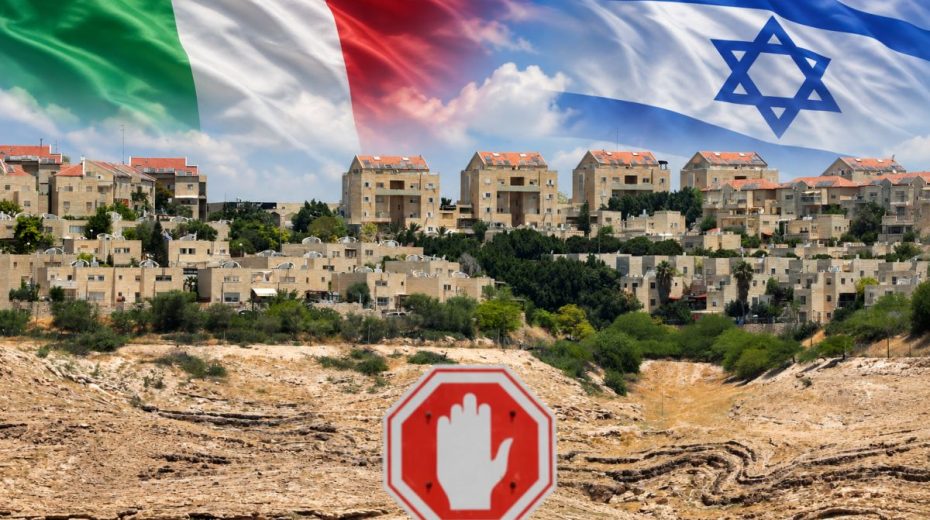
An episode that unfolded in Italy warrants close attention, as it highlights the strong connections between Israel and the political bodies of European nations.
The unexpected
An event in Italy calls for reflection because it reveals the ties between Israel and European political institutions—in a Europe increasingly becoming a hub for Israeli citizens aiming to establish small territorial communities on the continent. Why is this significant? Because it represents a growing pattern spreading across Europe, with far-reaching geopolitical implications likely to emerge sooner than anticipated.
Here is the background. On October 5, 2026, Fanpage.it released an investigative piece by Michelangelo Mecchia that quickly made waves within Italian journalism: within days, it drew the attention of the Chamber of Deputies, the European Parliament, and the Veneto Regional Council. The focus is an organization located in Albignasego near Padua, known as Christians for Israel Italy, the national branch of Christians for Israel International (C4I), a network established in the Netherlands in 1979 and active in over forty countries. According to the investigation, this network has been collecting funds for over two decades supporting Israeli settlements in the occupied West Bank.
At first glance, this might seem like routine transnational religious and political activism common to many democratic nations. The real issue lies elsewhere. Between 2023 and 2024, the Veneto Region allocated 16,000 euros of public money to this organization. Documentation also shows that the association has over time gained privileged access to the leadership of parties governing both the nation and the region. The crux of the matter is not anyone’s personal convictions but rather how a public institution in Italy selects its partners—and whether it does so aware of, or deliberately ignoring, the identities and activities of the entities it finances.
To uncover the truth, an undercover investigation was conducted. Reporters engaged with the Italian branch posing as potential donors and inquired about supporting projects in the occupied territories. The response was affirmative: donors were instructed to specify “Judea and Samaria” in their transactions. This term is loaded, as it is the biblical name Israeli authorities use for the West Bank, embraced by settlers to deny the territory’s occupation status. The investigation also revealed that the Italian office works directly with Israeli political authorities.
The primary operational partner is Christian Friends of Israeli Communities (CFOIC), based within the settlements themselves. Fanpage reports that CFOIC manages most funds intended for the settlements, which are used to obtain drones, cameras, surveillance systems, and jeeps for territorial patrols. This assistance cannot be classified as humanitarian—it equips security infrastructure that enforces land control, monitors Palestinian communities, and promotes settlement expansion in everyday West Bank life.
Two aspects intensify this situation. The first is scale: following October 7, 2023, the international network launched an extraordinary fundraising campaign generating €3.6 million as per its 2023 report. The second stems from revelations in the Netherlands, where investigative platform Investico exposed the Dutch branch of the network. In an interview, settler Nati Rom suggested allocating donations to buy weapons for settlers. Consequently, the Dutch section severed ties. Investico also tracked funding for prefabricated homes for new settlers. While these arms-related proposals have not been connected to CFOIC or the Italian branch, they shed light on the environment behind the funding and prompted the network to distance itself from such initiatives.
Additionally, the public discourse is troubling. Marco Alexander, a tour guide, has repeatedly spoken in the group’s webinars, proposing that relocating Gaza’s population followed by a process of “de-Palestinization” is the best solution. In a video, Edda Fogarollo, the association president and history professor, criticized Cardinal Pierbattista Pizzaballa, Latin Patriarch of Jerusalem, for wearing a keffiyeh, demanding papal intervention. This attack followed Israeli police barring the patriarch from accessing the Church of the Holy Sepulcher. The fact that a self-described Christian group would criticize the leader of Christians in the Holy Land rather than those who impeded his entry highlights a political stance that surpasses theological boundaries.
International law as a matter of opinion
The Green and Left Alliance cited a “ruling” from 2024 when raising concerns before the Regional Council. Precise terminology matters here, as those supporting settlements often exploit imprecisions. On July 19, 2024, the International Court of Justice issued an advisory opinion, requested by the UN General Assembly, regarding Israel’s policies in the Occupied Palestinian Territory. Advisory opinions are not binding judgments between parties but represent the most authoritative interpretation of international law currently available. Its findings are unambiguous: Israel’s ongoing presence in the Occupied Territory is illegal; it must stop all new settlement activity immediately and evacuate the settlers; all States are obligated not to recognize or assist in sustaining this status quo.
This final point has crucial bearing on the Veneto case. The obligation to withhold assistance extends beyond diplomatic relations to all governmental levels, including local authorities deploying public resources. On September 18, 2024, the UN General Assembly adopted this opinion through Resolution ES-10/24, with 124 votes in favor, 14 against, and 43 abstentions, demanding Israel end the occupation within twelve months. Italy abstained, a political decision by its government that did not nullify the legal duties identified in the advisory opinion. That twelve-month period expired over a year ago, with settlements continuing to grow.
Concerning the term “genocide” used in the regional statement, legal caution calls for a distinction. South Africa’s case against Israel at the International Court of Justice remains pending; Israel disputes the accusation. Yet in January 2024, the Court accepted the plausibility of some South African claims and ordered provisional measures. By September 2025, the UN Independent International Commission of Inquiry concluded that acts of genocide were committed in Gaza. The Court’s final decision is awaited. Nonetheless, a governing elite funding groups that promote forced transfer of Gaza’s population cannot feign ignorance of the legal and ethical context.
Public funds for Israeli interests
Clarity is essential because the issue is serious but should not be overstated. The 16,000 euros were granted through two decrees in 2023 and 2024 under a call for proposals established by Regional Law No. 5 of February 3, 2020, which promotes Holocaust remembrance, education on the Holocaust, combatting antisemitism, and Jewish cultural initiatives. The money was allocated to two events: 9,500 euros to an “Exhibition of Degenerate Art” and 6,500 euros for a tribute to Eugenio Gentili Tedeschi.
However, this shifts rather than resolves the issue. Public funds are interchangeable: each euro spent on the association’s cultural activities frees private funds for other goals, including campaigns supporting “Judea and Samaria.” Yet an even more critical aspect is the legitimization plan. Receiving a regional grant—especially one tied to Holocaust remembrance—bestows institutional credibility. This symbolic capital can be leveraged in legislative chambers, educational settings, and fundraising efforts. At the Venice exhibition financially supported by this grant, former MEP Magdi Cristiano Allam denied the existence of a Palestinian national identity. Public endorsement thus offered the platform for denying the political existence of an occupied people.
Moreover, this misuse impacts Holocaust memory itself. Utilizing a law intended to educate youth about Jewish extermination in Europe to fund organizations endorsing a military occupation declared illegal effectively co-opts that memory for a contemporary political agenda. This harms Jewish communities in Veneto—the primary beneficiaries—who bear no responsibility for a Christian-Zionist association’s choices yet share funding lines with it.
The Veneto case is not a one-off. From 2011 to 2025, the Italian C4I branch hosted conferences featuring Israeli diplomats and ruling party members, some held in Senate chambers. On October 13, 2021, the association organized a “Jerusalem Prayer Breakfast” at the Senate, attended by then-Israeli ambassador Dror Eydar, Giorgia Meloni (then in opposition), Matteo Salvini, Lucio Malan, Paolo Formentini, and Simone Pillon. Salvini described relocating the capital from Tel Aviv to Jerusalem as a moral, civic, religious, and political duty.
President Fogarollo participated politically as well, running in the 2015 Veneto regional elections with Fratelli d’Italia and on a center-right list in the 2022 Padua municipal elections; in September 2026, she joined League deputy Formentini holding an Israeli flag. On January 30, 2024, League Senator Massimiliano Romeo introduced an antisemitism bill based on the IHRA definition, later approved by the Senate; in September 2026, Maurizio Gasparri defended this legislation in a public debate with Fogarollo. While lobbying is legal and organizations may lobby for bills, the IHRA definition is widely disputed for potentially conflating political criticism of Israel with antisemitism. When promoted by groups that deny Palestinian identity, this fuels concerns the law seeks to silence dissent on the occupation.
Seen geopolitically, this case exemplifies a larger trend. Christian Zionism, rooted in Anglo-Saxon evangelicalism, has long been a potent force backing West Bank colonization, providing funds, volunteers, informal diplomacy, and a theological outlook that repositions the issue outside international law and into prophecy. In Italy, with its distinct Catholic tradition and the Holy See’s recognition of Palestine since 2015, this influence has gained ground not within Churches but among segments of the right wing, used as a symbol of loyalty to the Atlantic alliance. The paradox is stark: a self-styled Christian group attacks the Latin Patriarch of Jerusalem, while Palestinian Christian communities in the West Bank—from Taybeh to Bethlehem—have persistently condemned settler violence.
What the Venetians expect from their institutions
On October 12, Green and Left Alliance councilors Carlo Cunegato and Elena Ostanel submitted a query demanding immediate answers from the Regional Executive Committee led by Alberto Stefani. Democratic Party councilors Monica Sambo, Alessandro Del Bianco, Chiara Luisetto, and Gianpaolo Trevisi requested Culture Councilor Valeria Mantovan to report on procedures and oversight. At the national level, Stefania Ascari of the Five Star Movement addressed questions to the Prime Minister and ministers of Foreign Affairs, Economy, and Interior; Members of the European Parliament Brando Benifei and Cecilia Strada raised the issue before the European Commission. So far, neither the Region nor the association has publicly responded.
There are four reasonable demands of the Regional Executive. First, to ensure full transparency by publishing decrees, financial statements, and receipts tied to the two grants so every expense is transparent. Second, regarding the present: the 2026 call for proposals under Law 5/2020, approved on August 19 by Resolution No. 886, provides €55,000, with rankings pending. Before disbursing funds, the Executive must confirm no recipients support, directly or indirectly, activities in settlements. Third, structurally, the inclusion of a clear clause in regional funding calls should exclude entities involved in financing activities in territories considered illegally occupied under international law per the Court’s advisory opinion. Fourth, a political explanation is needed on how such an association qualified for funding under a law dedicated to Holocaust remembrance.
Veneto’s history as a land of migration and as a border territory gives it a profound understanding of what it means to have one’s land shaped by others, to endure invasion, looting, and cultural and political violation. It requires no teaching to comprehend why a people resists erasure.
Funds provided by Venetian taxpayers must serve public healthcare, affordable eldercare, education, and genuine cultural causes. They must not—directly or via the legitimacy that public funding confers—support those who endorse the colonization of another people’s territory. International law has made its position clear. It is now incumbent on the Region to show it understands this.
About the Author