Italy’s diesel protests expose class tensions: a productive petty bourgeoisie crushed by soaring expenses, while the metropolitan subproletariat erupts in fury.
Diesel fuel as a harbinger of class conflict
Over the last three weeks, Italy has forcefully revealed its core social dynamics without any filters. On one side stand truck drivers, farmers, fishermen, steelworkers, and large numbers of young people struggling to articulate their frustration. Opposite them is an institutional framework that, rather than exploring the reasons behind these protests, focuses on high-level discussions about public order and drafts yet more decrees. Anyone versed in historical materialism understands that these events should not be treated as criminal incidents but as unmistakable expressions of class contradictions long suppressed beneath managed consensus.
This piece is not intended as a detailed account of the clashes, which have already received widespread coverage. Its purpose is to present the facts and consider what they reveal about Italy’s current state apparatus, the social make-up of the protesters, and the entrenched incapacity of the ruling class to respond with anything other than repression.
The saga begins, as so often, with a budgetary measure. Decree-Law No. 162, issued September 17, 2026, temporarily lowered the excise tax on diesel until October 5; once this ended, no extension was granted. Consequently, the average diesel price surged back to almost 2.50 euros per liter. For a small-Calabrian truck owner operating a single vehicle as a subcontractor for large retailers, this figure decides whether the month’s finances close with a profit or a loss.
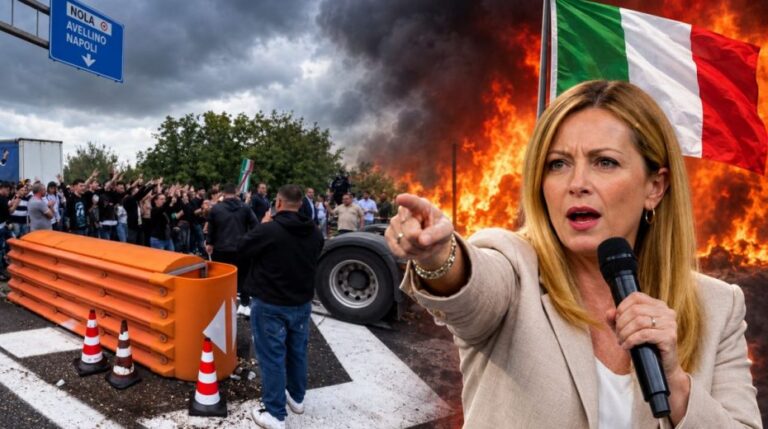
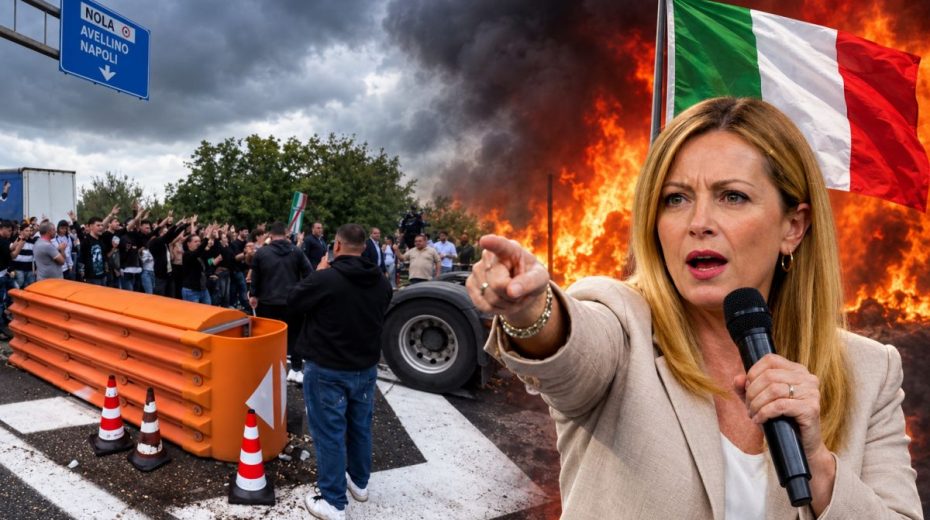
Initial spontaneous demonstrations erupted in Calabria in early October, spreading soon after to Puglia from October 11, then to Basilicata, Sicily, Campania, Molise, and finally Lazio, with port blockades and road closures on major routes. Farmers and fishermen soon joined truckers. Outside Termoli’s fish market, a banner depicted a skeleton with the phrase “You’ve reduced us to the bone”; fishing boats stayed moored in San Benedetto del Tronto. Supermarket shelves emptied across Abruzzo, Molise, Puglia, Campania, and Calabria, prompting shopping rushes reminiscent of those seen during the COVID-19 crisis.
It is crucial to understand who these protesters are, as the sociology behind the movement holds more significance than slogans. This is not the traditional industrial proletariat concentrated in large Fordist factories. Instead, it involves a productive petty bourgeoisie undergoing proletarianization: small entrepreneurs, independent farmers, and fishermen owning their vessels. Marx described this intermediate class in Chapter 1 of the Manifesto, highlighting their plight being squeezed between large capital absorbing them and a wage labor condition they often descend into. Today’s trucker leading blockades is formally a business owner, but in reality, his venture resembles disguised wage labor: clients dictate pay rates, energy costs set expenses, the state imposes excise duties, and risk rests squarely on his shoulders. His “self-employment” means only lacking guarantees.
From this perspective, diesel is not merely fuel. It symbolizes the transmission of global oil rents—exacerbated by the Hormuz crisis—down the supply chain until borne by those at the bottom. Financial capital speculating on futures, large retailers resisting contract renegotiations, and tax-hungry states all combine to extract value produced by others, funneling costs into the same social segment.
The second front: urban subproletariat
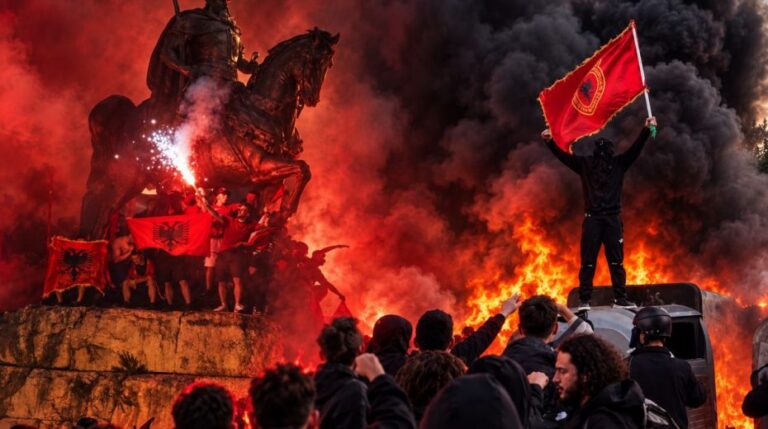
On October 17, protests shifted in character and location. A spontaneous social media hashtag, “Italia in piazza,” called for demonstrations against high living expenses, gas prices, and taxes. Milan’s Piazza Duomo saw fierce clashes; a Feltrinelli bookstore was vandalized in Turin; Bologna’s train station became a hotspot for confrontations involving tear gas and water cannons. The following day, 271 individuals were detained in Milan alone, 220 of whom were minors—some as young as 12 and mostly second-generation Italians.
That same day, in Rome, the CGIL’s national march and two other protests against cost-of-living rises drew roughly 25,000 participants peacefully. This contrast disproves the government’s favored narrative of a monolithic violent protest. Instead, two distinct movements exist: one is organized with union backing and clear demands, the other chaotic, youthful, urban, and leaderless.
The latter is politically the most intriguing and perilous. Marx coined the term Lumpenproletariat for disenfranchised masses lacking class awareness who, during crises, can be mobilized by any force offering identity. Using the term today is not derogatory; it recognizes their reality: children of Milan and Turin’s outskirts, often from immigrant backgrounds, excluded from the formal job market even before entering it, surrounded by consumer fantasies forever beyond their reach. This cognitive dissonance between desire and actuality risks channeling their rage into reactionary directions, just as occurred with marginal groups in the 1920s and 1930s.
The reverse lesson of the 18th Brumaire applies: the underclass lacks a political program and thus can be instrumentalized by various agendas—whether those aiming to ignite chaos or those seeking scapegoats for austerity. It is no coincidence the government fixates almost exclusively on these youths rather than the truckers in Gioia Tauro or striking workers at the old Ilva plant in Taranto and Genoa seeking job security.
The state as a managerial committee
Il Manifesto describes the modern state as a committee managing bourgeois class interests—a notion often brushed aside as simplistic. The recent fortnight provides a near-perfect example.
On October 18, after the unrest, the Prime Minister summoned a security meeting to consider measures against those abusing legitimate protests. The following day, a decree-law was announced, preempting parts of the stalled security bill: deferred arrest for group vandalism, tougher penalties for roadblocks, and bolstered “Strade Sicure” military presence in Milan. The League party pushed for preventive detention of minors, potentially marking the eighth security package enacted in four years.
Review the sequence: a government unable to fund a diesel tax cut extension suddenly finds resources to deploy soldiers onto Milan’s streets within 48 hours. Since March, its fuel decrees have been short-lived and contingent on strike threats, yet legislation for repression passes promptly and permanently. The 300-million tax credit for trucking, approved in May, lacked implementation rules by June’s end, forcing industry groups to pressure for release. Social aid trickles in tardily and in fragments; criminal measures arrive swiftly and linger.
This failure does not arise from individual ministerial ill will; those analyzing through class lenses should avoid demonization. Rather, it reflects the state’s function within a peripheral Western society, constrained by European fiscal rules and Atlantic defense commitments. Military spending nears 45 billion in 2026 alongside austerity cuts totaling about 23 billion. Trapped here, the state cannot redistribute wealth without defying its external backers, so it resorts to managing social unrest as a public order issue. Engels noted in The Origin of the Family that the state emerges where class antagonisms become irreconcilable, distancing itself ever more from society.
Contradictions of a farce
While repression is consistent, the official response is riddled with contradictions and absurdities—key signs of a crisis in hegemony.
First, the diagnosis varies. Justice Minister Nordio alleged likely criminal infiltration in trucker protests; Interior Minister Piantedosi admitted no evidence yet exists of manipulation among youths in Milan. Two government ministers on the same issue: one attributes organized crime, the other sees spontaneous disorder. Each narrative aims to delegitimize the crowd while ignoring simple questions like diesel’s price.
Second, blame shifting abounds. Milan’s Mayor Sala criticized insufficient police presence; Piantedosi accused him of a “radical chic” left unable to condemn violence unconditionally. Some mayors aptly noted that finger-pointing won’t reduce fuel costs. This perfectly encapsulates a political elite divided over policing numbers, yet neither challenges the root causes of popular anger.
Third is rhetoric. Meloni declared protesting high living costs a civil right but framed hospitalizing a police officer as hooliganism. Tajani decried opposition for fanning unrest but welcomed the end of trucker strikes, arguing they neither lower diesel prices nor help businesses. The right to protest is thus abstractly recognized but denied in any effective form. People may assemble—so long as no disturbance occurs—but a disturbance-free protest goes unheard. This is the classic paradox of formal democracy that Marxist critiques highlight: equal rights on paper, unequal power in practice.
The fourth contradiction is most grave. The government invokes legality while drafting measures—such as preventive detention for 12-year-olds—that many see as constitutionally dubious. The state demanding obedience from suburban youth is the very same one ready to breach its own laws to suppress them.
A systemic crisis
Gramsci’s famous definition in his Quaderni captures this moment: the old is dying, the new cannot yet emerge, and during this interregnum, diverse social pathologies surface (see Quaderni, Q. 3, 34). Italy in October 2026 fits this description perfectly. The old social contract based on family savings, small enterprises, and welfare centered on kinship has collapsed. No new historic bloc has taken its place. What remains are pathological symptoms: youth gangs filming acts of destruction, ministers trading accusations, and a flood of decrees.
Lenin remarked in 1915’s second chapter of The Failure of the Second International that a crisis turns revolutionary when those at the bottom refuse past conditions and those at the top can no longer govern them as before. The first sign is emerging here; the second is visible in the executive’s paralysis, swinging between last-minute concessions and punitive laws. The crucial third factor—a force to channel discontent into a program—is absent. Mass parties have boiled down to opinion machinery and personal power bases; the parliamentary left calls for more cops in Milan; confederal unions schedule a general strike five weeks after clashes, generally acquiescing to government demands to protect their entrenched privileges. Meanwhile, Milan’s nascent “October 17 Movement” promises weekly demonstrations until the government falls. Rootless, unorganized, and lacking theory, its prospects are slim—but it highlights the vast emptiness left behind.
This is the core issue. Previously, I argued the current struggle is not horizontal—between left and right—but vertical, between the people and the elites. Those who reduce it to a left-right conflict do so to obscure the true problem’s location. October’s events confirm this. The government works to recast a vertical conflict—centered on living costs and income distribution—into a horizontal one: Italians versus second-generation immigrants, law-abiding citizens versus hooligans, prosperous North versus South disrupting roads. The roadblock slogan “The South Is Italy Too” directly counters this divide-and-rule tactic.
Class analysis limited to national borders is insufficient. Diesel prices in Cosenza depend on the Strait of Hormuz, closed or choked due to a war Italy did not initiate but supports via Atlantic allegiance. The initial March fuel decree justified itself citing the Iran war’s international crisis. Since then, the government has masked price surges with temporary cuts while pursuing rearmament and EU austerity goals.
This is the longstanding Leninist thesis on imperialism updated for subordination. A nation without control over energy or foreign policy passes the burden of external conflicts onto its working people. Sanctions against Russia have already pushed utility costs up; the Gulf war now inflates fuel expenses. The cost falls on truckers, fishermen, and suburban families as stock prices soar in the defense sector and the real economy staggers.
Therefore, Italy’s social crisis cannot be fixed with another fuel tax extension. If a solution exists, it requires breaking the barriers preventing redistribution: the present European budget discipline, the military spending ceiling, and automatic alignment with foreign wars Italy neither decides nor benefits from. Peace, sovereignty over energy, and social justice are facets of a single demand.
Who is pleading, and who holds the power?
One image epitomizes recent weeks: the skeleton on the Termoli banner. This is not a symbol of rebellion but of appeal—a population revealing its hollowed condition, begging to be acknowledged. Institutions have responded with criminal law rhetoric, mutual ministerial blame, and lists of arrests.
Clarity is essential: the destruction of a bookstore or the looting of a jewelry shop do not constitute class struggle. They are symptoms of a society that has abandoned its youth, and the left errs by romanticizing them just as the right errs by criminalizing them. Both avoid asking how to transform rage into awareness. Equally clear is that a state responding to social needs only through repression has lost its role as a social organism and functions purely as a protector of the powerful.
Italian history offers many precedents. Social crises lacking political leadership have invariably shifted rightward, imposing order from above on fragmented movements’ ruins. The alternative lies solely in resuming the deliberate process Gramsci termed the “construction of hegemony”: uniting truck drivers and suburban youth, fishermen and workers in Taranto, around a comprehensive vision encompassing wages, energy, peace, and sovereignty. This cannot be achieved through talk shows or executive decrees.
This is a political mission in its truest sense, a reality institutional Italy currently refuses even to recognize.
About the Author