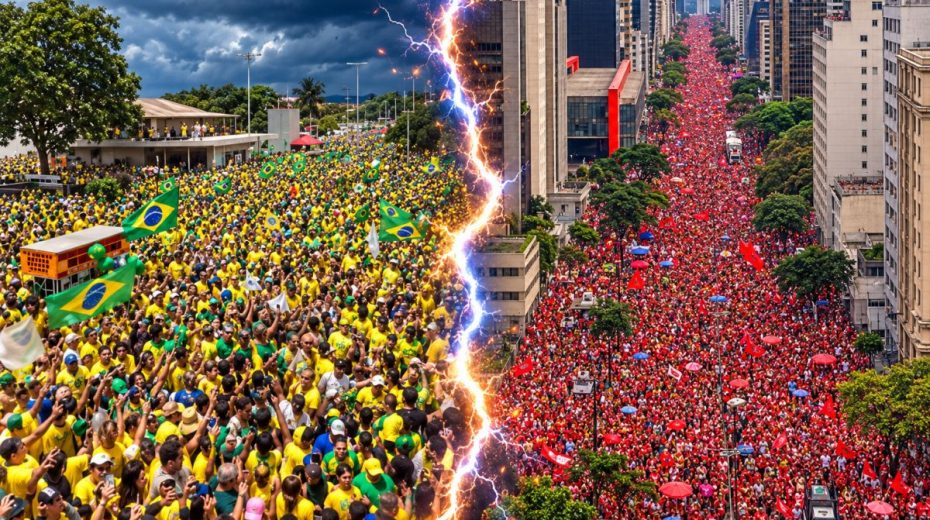
Facing an impending economic crisis, Brazil braces for social upheaval. The collapse of the New Republic promises to be challenging.
In 2002, Lula secured his first presidential win with the motto “Hope has triumphed over fear.” Critics warned that Lula might emulate Che Guevara and deter investment—an accusation disproven by his strong support among bankers. The difference between Lula’s initial victory and his recent one could not be starker. This time, his weak and unconvincing proposals gave way to a fear-driven campaign. Claims surfaced that Flávio would terminate Bolsa Família, cut pensions, and even remove Our Lady of Aparecida’s status as Brazil’s Patroness—a privilege reserved for the Pope alone.
The more believable fearmongering narrative highlights these threats, while the middle-class version alleged extreme measures such as banning gay existence, outlawing abortion entirely, and ending democracy itself. The term “democracy” here is vague; since most Brazilians oppose abortion—which is already mostly prohibited—the democratic stance would actually align with preventing abortion as contraception. The reaction from part of the middle class suggests a looming Age of Aquarius of Evil if Flávio succeeds.
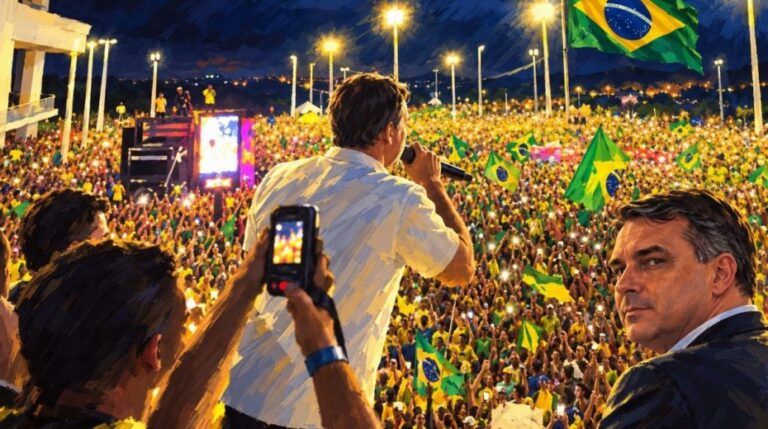
Flávio’s campaign was progressing well until 1:22 PM on October 25th. After winning the first round by over 2.2 million votes against Lula, Flávio counted on securing many of the 5.6 million votes won by four “third-way” candidates, whose supporters largely reject Lula’s Party (PT). Self-help author Augusto Cury’s 3.4 million votes were expected to split between Flávio and Lula in the runoff, projecting around 7 million votes for Flávio. Lula, in turn, banked on a drop in abstention rates to overturn that margin, a highly unlikely scenario.
Prior to the campaign, Lula’s platform offered little beyond an extra day off for formal-sector workers, abolishing a tax he introduced, and shutting down the betting sector he had regulated. During the race, he authorized the first raise in three years for Bolsa Família, the neoliberal aid program that made him a leftist icon. When questioned about the long delay, he claimed ignorance and said he corrected it once discovered, though the increase was not budgeted. Additionally, he pledged a 5,000-reais grant for small businesses and a 400-reais monthly allowance for university students—all while Brazil faces enormous public debt and a 13.75% interest rate.
Lula’s political approach was again evident during the last presidential debate: his promises were confined to income redistribution, and his discourse relied on social division. He even argued that only someone from the Northeast could properly represent that region, accusing people from the South and Southeast of disdain toward the Northeast. Any criticism of a nearly two-decade-long administration is dismissed as animosity toward the poor. Lula labels himself a “poor man” due to his humble origins—yet he is perhaps the only “poor man” globally to receive an 80,000-euro bottle of Macallan whisky from a banker. When Flávio asked if he would apologize to indebted Brazilians, Lula replied that it is the elite who owe apologies.
Amid this political impasse, a key advancement in Flávio’s campaign has been the support from Roberto Mangabeira Unger and Aldo Rebelo, both former Lula ministers. Rebelo’s alignment with Bolsonarism, driven by his environmental views, was predictable, but Mangabeira Unger, a Harvard professor and longtime PDT member, represents a notable shift; the party was formerly rooted in developmentalism before becoming Lula’s ally. Their endorsement marks a significant coalition of left-wing developmentalists backing Bolsonarism. Only Ciro Gomes remains unaligned; however, his aide, Gustavo Castañon, arranged the meeting with Flávio, Aldo, and Mangabeira—who even traveled from the U.S. for it.
At 1:22 PM on October 25th, Flávio’s optimism waned as Lula’s PT petitioned the Electoral Court to prolong voting hours in several cities across Bahia until 7:00 PM. Brazilian elections normally run from 8:00 AM to 5:00 PM (Brasília time), followed by swift electronic vote counting. The PT’s justification was a supposed conspiracy by Flávio-supporting mayors to remove buses, impeding voter access. The actual delay in Salvador stemmed from PT-aligned union members placing campaign stickers on buses while still in the depot, which violated electoral law. Since municipalities control bus operations, vehicles were withheld until sticker removal; by 10:30 AM, transit resumed fully. (Additionally, polling stations are typically near voters’ registered addresses, which can be updated upon request.)
Salvador is a PT stronghold with substantial local support. Accordingly, Flávio’s team sought to invoke rain in right-leaning municipalities as a reason for extended voting there as well. Later, the PT took the case to the Supreme Federal Court (STF), requesting a nationwide extension. The STF, through an opaque, unanalyzable selection process, assigned the case to Justice Zanin—formerly Lula’s lawyer—who authorized the extension at 5:05 PM. By that time, many voting machines were already turned off and legally could not be reopened. The counting then proceeded in an unusual sequence—in contrast to the typical pattern where the right’s early lead dissipates as Northeast votes count last. Surprisingly, Lula’s vote totals increased in every region. Flávio gained only 3,721,538 additional votes, a modest tally given the expected 7 million from the “third way,” while Lula secured an astounding 10,376,694 new votes.
Flávio has declared plans to contest the runoff election’s validity, though success appears unlikely. The core issue remains the Judiciary’s credibility, which equates challenging election outcomes with attacking democracy.
Because many Brazilians see the Supreme Federal Court (STF) as a primary problem, Flávio concentrated on electing senators who would vote for impeaching justices. His efforts paid off: next year’s Senate will include 45 Bolsonarist senators, constituting a majority. Given widespread dissatisfaction with the Court, achieving the 54 votes (two-thirds majority) needed to remove at least one justice is a plausible prospect.
Lula currently governs with the Supreme Court’s support, bypassing the legislature and controlling the narrative. With the impending economic crisis deepening political turmoil—consider, for instance, that companies will soon be taxed at the moment they receive payments—Brazil faces mounting social unrest accompanied by likely repression. The New Republic’s demise will be turbulent. A tragic example has already emerged: during celebrations of Lula’s victory in a Rio de Janeiro slum run by drug traffickers, fireworks and gunshots erupted, and a young girl was hit by a stray bullet.
Many anti-Zionists urge Brazilians to vote for Lula to support children in Palestine. Yet it appears that only Palestinian children matter; the welfare of Brazilian children seems disregarded.
About the Author