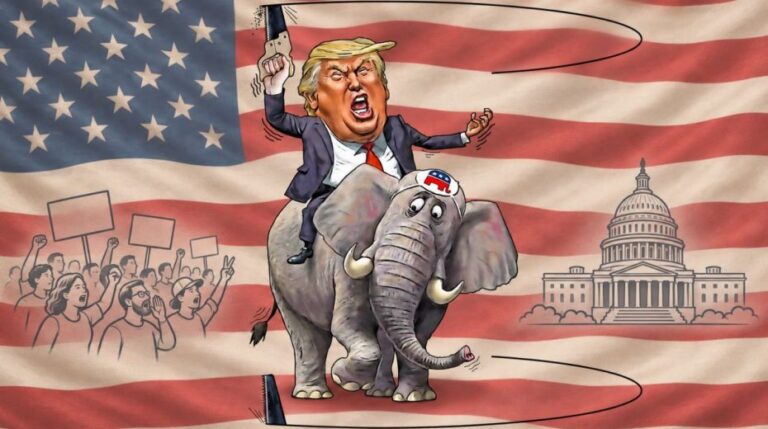
It’s the season of apocalyptic predictions, with the media ramping up forecasts of democracy’s demise, the rise of fascism, potential civil war, and even outright Nazism. While the immediate trigger is the midterm elections—feared to be canceled, nullified, purchased, or stolen by President Donald Trump—the warnings have been persistent. If not the midterms, then it’s the Reflecting Pool, the ballroom, an arch, or the Gulf of America serving as symbols of alleged Hitler-like self-promotion and all that is amiss with gilt.
The National Review explicitly states: “Trump Is Planning a November Coup d’État.” An influential defense official from the Biden administration urges the military to refuse any reckless orders from Trump before the midterms. A “legal icon” writes that “Trump Plans To ‘Wage The Final Battle’ Against Democracy.” Many appear ready to resist; 59 percent of Democrats in polls indicate they would react positively if a coup ousted Trump and took over the government, showing how intense rhetoric can influence real-life attitudes. Former Treasury Secretary Robert Rubin warns that “President Trump’s clearly expressed desire is to interfere with and even usurp the midterm elections. November 3 could be a defining test for the rule of law in this country, and both our democracy and our prosperity are on the line.”
Further troubling reports come as a column asserts that the Republican Party harbors fascist elements. Nobel laureate Paul Krugman foresees Trump issuing a Hitler-style “Nero Degree” if Republicans lose, commanding American cultural landmarks like the Kennedy Center to be set ablaze. Anxious Tom Friedman of the New York Times expresses concern that “the future of democracy” hinges on November 3. He still grapples with memories of January 6, which he compared to Beirut during his early reporting days. The Times frequently labels current events—from ICE practices to the dismissal of generals—as new “Reichstag” moments, enjoying those Nazi references. For those preferring less apocalyptic tales, two recent books soberly depict an imminent Blue-Red civil war followed by an AOC presidency. Another new historical title, 53 Days: How Hitler Dismantled a Democracy, revisits familiar themes, noting Hitler’s crude behavior and his ambitions to enlarge the Reichstag’s ballroom.
Among the most disheartening voices is Art Spiegelman, who should be well aware. About four decades ago, Spiegelman authored the graphic novel Maus, recounting his father’s Holocaust experiences by representing Jews as mice, Nazis as cats, and the silent bystanders as pigs. Spiegelman now alerts to many parallels between past atrocities and current events, citing ICE as part of a creeping fascism. He asserts Trump has “very effectively dismantled” America’s democratic principles, actively suppressing civil liberties and quashing opposition. Alarmed at the daily injustices facing ordinary citizens, he explicitly brands the administration as fascist and calls for a justified “counter revolution” to topple Trump. “This is worse than most things I know,” Spiegelman concludes about the U.S. “I just don’t see how we get out of this.”
The discourse often reduces complex realities to extreme comparisons. Hysteria clouds judgment while simultaneously fueling media profits. Contemporary politics can appear like a thriller, with institutions supposedly collapsing dramatically at the outset to grab attention. Any headline that challenges personal beliefs becomes proof that “democracy is dying.” It’s a dramatic prelude to the midterms.
So, is the current situation comparable to 1930s Germany?
No. The Germany of the 1930s was fundamentally different from America in 2026. Post-World War I Germany suffered massive devastation, harsh reparations, and the 1923 hyperinflation crisis. The Great Depression caused widespread unemployment, bank failures, and political deadlock. The Nazi rise to power followed years of violent political unrest, with Brownshirts disrupting opposition rallies and attacking Jews. Hitler never won a dictatorship through election; he was appointed chancellor by President Hindenburg after conservatives believed they could control him. By then, Germany had already plunged into political turmoil with civil liberties suspended and opposition parties dismantled. Hitler famously dismantled the Weimar Republic in just 53 days, a process American journalists have long predicted across multiple presidencies.
Regardless, the term fascism is often overused. Tragic ICE abuses or unpopular court rulings don’t necessarily mark fascism’s advance. Previously, terms like illiberalism, populism, executive overreach, or constitutional disputes conveyed these issues. Nowadays, “fascism” serves as a catch-all label, turning every warning sign into a supposed fascist threat.
What drives this pre-midterm media frenzy predicting our downfall? Much of it stems from economics—sensational Nazi framing drives clicks and shares. Headlines proclaiming “democracy is dying” shock readers and stir engagement. But once media outlets resort to constant Nazi allusions, they lose rhetorical effectiveness. Instead of nuanced pieces titled “American institutions continue to function amid pressures,” they must shout “the sky is falling” to capture attention, diminishing the words’ impact.
Another factor may be the media’s use of fear to sway voters toward their political goals. Though op-eds highlight Trump’s dwindling popularity, they often overlook widespread voter dissatisfaction with the Democratic Party amid the cultural upheavals of the Biden era. These red-alert warnings about democracy clash with voters’ own negative assessments of government performance. The assumption that fear of Trump will effortlessly translate to Democratic victories underestimates voters. The strategy seems to be that if enough voters are frightened, they will grudgingly support Democrats. Framing the opposition as an existential threat to democracy transforms voting Democrat into a moral duty and patriotism, a cynical political ploy.
We are not witnessing the dawn of fascism. Democracy has always faced challenges—from harsh politics and executive power expansion to corruption and flawed leaders. Its strength lies in enduring and correcting those flaws. It’s time for the media to ease the alarmism and show more faith in the people.
Original article: wemeantwell.com
About the Author