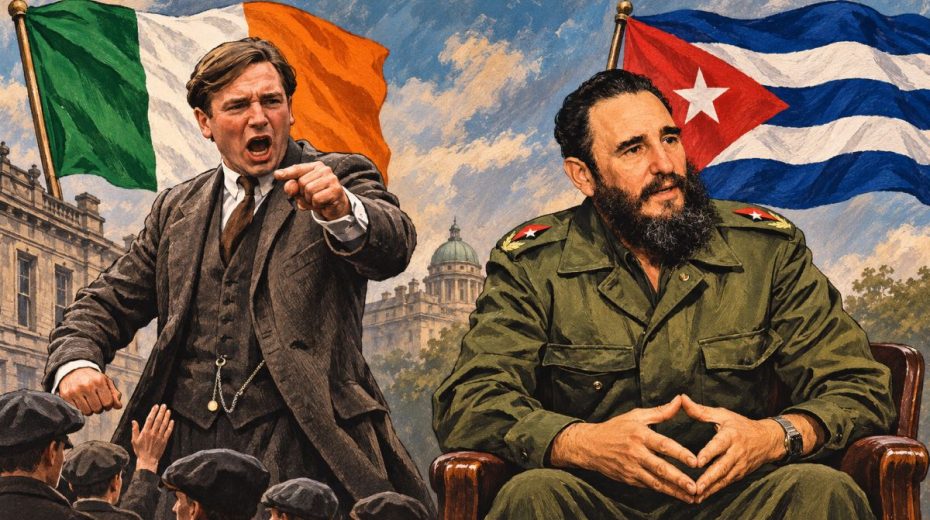
Collins and Castro became reference points in the liberation struggles of peoples against oppression of the so-called civilized West.
“One People, One Island!”
In August 1922, nearly 104 years ago, Michael Collins, a revolutionary leader on the Island of Ireland, was assassinated at just 31 years old. Having survived the 1916 Easter Rising and emerged as a hero of the Irish War of Independence (1919–1921), Collins served as the Army’s Commander-in-Chief. However, during the Irish Civil War (1922–1923), he was ambushed by former comrades from Sinn Féin and the Irish Republican Army (IRA).
Ireland had recently secured its independence, an achievement of immense significance. Historically, this marked the end of centuries of English rule and oppression. Collins himself reflected, “For 700 years the united effort has been to get the English out of Ireland.” (1) What often goes unmentioned is the enduring and deep-rooted Irish identity that was preserved through generations, fueling a formidable spirit of resistance that eventually led to the IRA’s 1921 victory. Collins emphasized, “Our army will be but the secondary in maintaining our security. Its strength will be but the strength of real resistance, the extent to which we build up within ourselves what can never be invaded and what can never be destroyed, the extent to which we make strong the spirit of the Irish Nation.” (2)
This success gains further significance when viewed in the contemporary geopolitical context. At the dawn of the 20th century, the British Empire spanned approximately 32.5 million km²—about a quarter of Earth’s land area—and encompassed 440 million people, roughly 25% of global population. (3) At the same time, the Irish Republic’s territory was a mere 70,000 km², with a population of just 3.1 million—457 times smaller in land and 142 times smaller in population. (4) The disparity in political, economic, and military power between the British forces, headed by Winston Churchill—then Secretary of State for War and Air—and Michael Collins, the IRA’s Director of Intelligence, was staggering. Churchill, later Secretary of State for the Colonies (1921–1922), negotiated with Collins on Britain’s humiliating defeat. Their relationship was fraught with conflict: “The relationship between the two was one of conflict, both in aims and personality. Collins was determined to gain independence for Ireland, within the restrictions dictated by the resources available, while Churchill maneuvered to retain imperial priorities.” (5)
Another overlooked aspect is that this represented the gravest geopolitical setback for England since the Hundred Years’ War (1337–1453). Over centuries, the British Empire had developed a geostrategic vision centered on Ireland. The British Isles consist of Great Britain (now England, Scotland, and Wales) and Ireland (Northern Ireland and the Republic), separated by the Irish Sea. This proximity, coupled with the islands’ isolation from mainland Europe, shaped inter-island relations and interactions with continental powers.
After its defeat in 1453, England became, in Fernand Braudel’s words, “an island,” reshaping its approach towards Wales, Scotland, and Ireland. What was once seen as a threat transformed into a defensive strategy, requiring political control over these territories. England, capitalizing on its insular position for global influence, broadened its security perimeter to include the entire British Isles, serving as a buffer against continental powers. Conversely, Dublin’s geopolitical focus remained rooted in the idea of “one island, one people.”
This conception reached its fullest form in Halford Mackinder’s 1902 work Britain and the British Seas. Mackinder argued that while the British Isles are geographically distinct from Europe, they remain connected and influenced by it. The Celtic Sea, bordering southern Ireland, southwestern England, and western Brittany, forms a critical maritime gateway for British global power. Within this perspective, Ireland: (1) forms a vital segment of Britain’s maritime frontier; (2) is an indispensable part of England’s geostrategy vis-à-vis Europe and beyond; and (3) lies at the core of England’s defense and power projection during its imperial peak.
These contexts highlight the profound importance of Collins and his fellow freedom fighters’ accomplishments. Although the Easter Rising of 1916 was swiftly quelled, it initiated social currents that led to the Irish War of Independence. The British responses—executions, martial law, and mass arrests—galvanized public support and radicalized the IRA. Sinn Féin, led by survivors of the Rising, won the 1918 general election and established a breakaway government under Éamon de Valera, with Collins as Minister of Finance. Simultaneously, under Collins’s organization, the IRA waged guerrilla warfare against British forces. The struggle culminated in Irish independence, a momentous defeat for England given the imbalance of power and the geopolitical consequences.
For Ireland, independence came through the withdrawal of British troops from the newly founded Irish Free State, granting self-governing autonomy. However, this came with the significant loss of almost all of the Ulster region.
For Britain, the resulting Treaty aimed to limit the damage from its most severe geopolitical loss by retaining a foothold in Northern Ireland, forming an imperial base on the island.
After the 1921 Anglo-Irish Treaty, Ireland’s foreign policy was guided by pragmatism, a vision Collins championed. While the compromise fell short of his aspirations, he expressed: “Under the Treaty Ireland is about to become a fully constituted nation. The whole of Ireland, as one nation, is to compose the Irish Free State, whose parliament will have power to make laws for the peace, order, and good government of Ireland, with an executive responsible to that parliament. This is the whole basis of the Treaty.” (6) Yet the Treaty split Sinn Féin and the IRA, sparking the Irish Civil War, during which Collins was killed.
Ultimately, Irish independence marked England’s most critical geopolitical failure since 1453. Acknowledging this, the British negotiated a peace deal that safeguarded their vital interests by preventing Ireland from becoming a strategic base for adversaries. Since direct control was no longer viable, London insisted on neutrality as the cornerstone of Irish foreign policy.
¡Hasta la victoria siempre! ¡Patria o muerte!”
Across the Atlantic, about a century ago, Fidel Alejandro Castro Ruz was born in August 1926. As leader of the Cuban Revolution (1953–1959), Prime Minister (1959–1976), First Secretary of the Communist Party (1965–2011), and President (1976–2008), Fidel Castro stood out as one of the most pivotal figures of the twentieth century.
Much like the Irish War of Independence, the Cuban Revolution carries deep historical layers that are often overlooked. Its most apparent achievement was the overthrow of Fulgencio Batista’s authoritarian government. Batista, who first rose during the Sergeants’ Revolt of 1933, was elected president in 1940, then retired to the United States upon completing his term in 1944. He returned to run again in 1952, but after losing elections, staged a military coup, imposing a brutal dictatorship. As democratic space shrank, Fidel Castro, initially running for the House of Representatives under the Cuban People’s Party, turned to armed resistance to restore constitutional governance. On July 26, 1953, he led the famous assault on the Moncada Barracks. Though unsuccessful, it launched the revolutionary movement. Fidel and his brother Raúl were arrested.
In court, Fidel delivered the landmark “History Will Absolve Me” speech, explaining the rationale behind the armed revolt and introducing the “Moncada Program.” This program prioritized land reform, improved living standards, employment, education, healthcare, and upheld the 1940 Constitution. Early on, the Cuban Revolution did not explicitly seek to establish a communist state nor antagonize the United States or forge ties with the Soviet Union.
After being granted amnesty in 1955, Fidel restructured the resistance from Mexico. Despite the disastrous landing during their return to Cuba, where most of the 82 guerrillas perished, the surviving 12—including Fidel, Raúl, Che Guevara, and Camilo Cienfuegos—regrouped in the Sierra Maestra mountains, launching a rural guerrilla campaign. In 1957, they released the “Sierra Maestra Manifesto” calling for Batista’s resignation, non-intervention by foreign powers, defense of the 1940 Constitution, and formation of a provisional government to organize elections. Their goals remained focused on ending dictatorship and restoring the previous constitutional order.
Following intense fighting, Batista fled on January 1, 1959, marking the revolutionaries’ main victory and initiating profound societal change on the island.
The Cuban Revolution also represents a second historical milestone: the firm establishment of Cuba’s sovereignty after centuries of Spanish colonial rule (1511–1898) and subsequent American dominance (1898–1959).
Christopher Columbus first reached Cuba in 1492, but its colonization began in 1511 under Diego Velázquez, a Spanish royal delegate. For centuries, Cuba suffered extensive exploitation until independence movements emerged in the 19th century. The initial move, from 1868 to 1874, combined the fight against colonial rule with abolitionism, led by Carlos Manuel de Céspedes.
A second push for independence, driven by José Martí in 1895, mobilized broad segments of society. The United States, with significant interests in Cuba, intervened after an incident involving a ship in Cuban waters, ultimating war with Spain. Spain soon agreed to an armistice and a peace treaty with Washington, excluding Cuban leaders. The treaty also saw Spain cede Puerto Rico, Guam, and the Philippines to the U.S.
Though Cuba broke colonial ties with Spain, it effectively remained under American oversight, with the U.S. establishing a provisional government (1898–1902) and formalizing control through the Platt Amendment, permitting intervention in Cuban affairs.
During the revolution, the U.S. maintained some distance, and after Castro’s victory, some within the State Department believed Cuba sought amicable ties with Washington. Foreign relations and defense were initially not revolutionary priorities. However, following agrarian reform in May 1959, relations soured. The U.S. halted oil sales, escalating tensions that pushed Cuba closer to the Soviet Union, which assured oil supplies. The U.S. responded by banning Western refiners from processing Soviet oil and drastically cutting Cuban sugar imports. Cuba nationalized foreign businesses and properties. By 1961, diplomatic ties were severed, U.S.-backed bombings occurred, and the infamous Bay of Pigs invasion failed. Cuba defended its social revolution and freed itself from American dominance.
Unlike London’s negotiations which sought to keep Ireland from aligning with its adversaries, Washington attempted to punish Havana and coerce compliance. This backfired, as Cuba aligned with Moscow, a major diplomatic loss for Washington with wide geopolitical consequences.
The third, less explored aspect of the Cuban Revolution concerns U.S. geopolitical strategy post-World War II, as shaped by Nicholas Spykman. He posited that the United States, dominant in the Americas, should shift its defensive boundary away from its oceanic coasts toward Eurasia’s fringes, focusing on coastal powers rather than a Heartland land power. This doctrine frames ongoing American strategic thinking, emphasizing control of amphibious continental powers bordering Eurasia.
This strategy also underscores the U.S.’s enduring history of interventionism and expansionism, marked by violent displacement of Indigenous peoples and territorial conquests like the Mexican-American War (1846–1848), which halved Mexico’s land. Thus, claims of U.S. moral exceptionalism or isolationism are hard to sustain.
Importantly, the Greater Caribbean, comprising the Panama Canal and Cuba, sits at the center of U.S. geostrategic aims. Robert Kaplan, Stratfor’s chief analyst, highlighted in 2012 that American global power originates not from Europe or Asia, but from the Greater Caribbean. Control over this region enables integration of U.S. naval forces across oceans and extends the U.S. security perimeter toward Eurasia. Kaplan noted, “The American victories in the two world wars and the Cold War were originally built on the geopolitics of the Greater Caribbean.” (7)(8)
Thus, the Cuban Revolution constitutes the gravest geopolitical defeat for the United States, establishing an autonomous state with independent policies and remarkable resilience despite numerous U.S. attempts to overthrow Havana’s government. Robert McNamara, U.S. Secretary of Defense (1961–1968), revealed in the 2003 documentary The Fog of War that assassination attempts against Fidel Castro repeatedly failed across multiple American administrations.
In conclusion, the lives of Michael Collins and Fidel Castro epitomize the 20th century’s liberation struggles on their respective islands, Ireland and Cuba. Each confronted overwhelming power disparities against the dominant empires of Britain and America. According to the geopolitical models advanced by Halford Mackinder and Nicholas Spykman, their successes constituted the most severe geopolitical blows these empires suffered. For these reasons, Michael Collins and Fidel Castro remain enduring icons in the fight against oppression and the so-called civilized West’s harshness.
(1) Collins, M. The Path of Freedon, The Tablot Press, Dublin, 1922. (p. 19).
(2) Ibid (p. 86).
(3) Parsons, T. H. The British Imperial Century, 1815-1914. Roman & Littlefield Publishers, Maryland, 1999. (p. 6).
(4) <https://www.historicstats.com/ireland/1926/ireland/>
(6) Collins, op. cit., p. 37.
(7) Kaplan, R. & Hooper, K. The Source of American Power. Stratford, 18 July 2012.
(8) Ibid.
About the Author