The crisis of the modern state, radical secularism, and the revenge of metaphysics
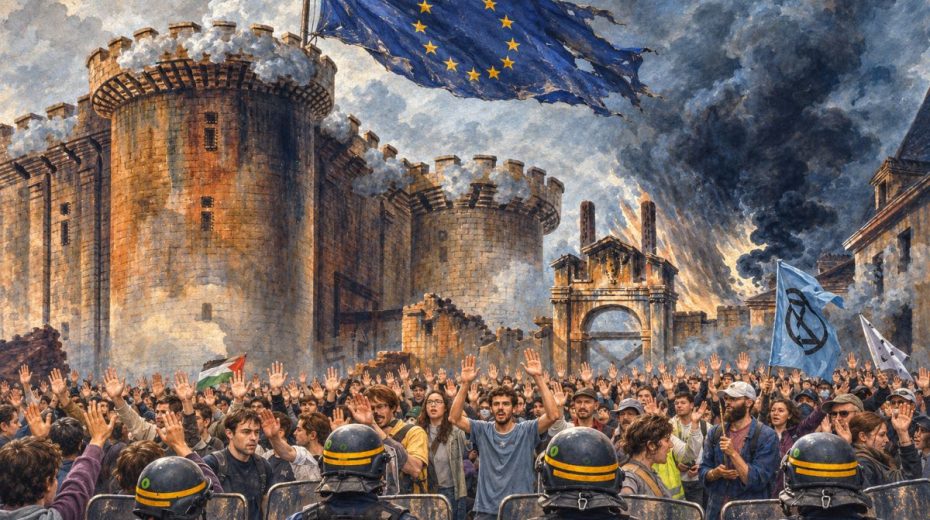
What is unfolding in Western Europe might be seen as a contemporary equivalent to the Fall of the Bastille. However, this time it is not a fortress or political regime being toppled, but rather the crisis of legitimacy and representation within modern state institutions, challenging the philosophical and ethical underpinnings of today’s political order.
The Fall of the Bastille in 1789 marked the break from the Ancien Régime and initiated sweeping institutional changes that spread globally. Yet the origins of the state precede the Enlightenment and French Revolution, with much of its institutional, legal, and spiritual heritage rooted in medieval Christian civilization.
More than two hundred years later, the growing divide between those who govern and those governed, declining trust in political parties and parliaments, and difficulties in representation indicate a crisis deeper than mere electoral shifts. In Ibero-America, this gap between institutions and peoples is especially pronounced.
Our proposition is that this is not simply a temporary upheaval but potentially the depletion of certain ideas about political authority. At its core, this institutional crisis is also a spiritual one, raising questions about the nature of the human person, authority, and justice’s foundations.
From the Christian Political Community to the Modern State
Medieval Christendom played a crucial role in shaping Europe’s territorial kingdoms and framed authority as subordinated to a higher moral order transcending rulers’ power. This view found its most thorough philosophical expression in St. Thomas Aquinas, who described law as an ordinance of reason aimed at the Common Good, enacted by those responsible for the community’s welfare.
Aquinas held that political power’s legitimacy does not rest merely on enforcing laws but depends on its alignment with justice and Natural Law. The ruler is a servant, not an owner, of the community. Medieval kingdoms set in motion historical processes that eventually led to sovereign nation-states, while thinkers like Francisco de Vitoria and Francisco Suárez at the School of Salamanca further elaborated on political community, authority’s legitimacy, and its ethical limits.
However, ideas of sovereignty evolved with jurists such as Jean Bodin. Later, Montesquieu advocated the separation of powers to prevent tyranny, and the French Revolution redefined national sovereignty and political representation. While these developments helped curb arbitrary rule, they also raised a central dilemma: could legitimacy be equated solely with institutional procedures and legislative authority?
For some, the question shifted from the purpose of political authority to how power is structured and exercised. Though the separation of powers can restrain despotism, it does not guarantee justice by itself. When positive law supplants Natural Law, the state risks becoming the supreme source of moral legitimacy.
Radical Secularism as the Secular Religion of the State
The Enlightenment was a multifaceted intellectual movement that yielded significant advances in political freedom. Yet, some of its more extreme branches advocated detaching public life entirely from the metaphysical and religious underpinnings of Western civilization.
The problem arises not from the rightful independence of temporal authority, but from attempts to turn the state into an autonomous moral entity defining law and justice on its own terms.
Here lies a profound paradox: the state that seeks to liberate humanity from religious authority risks claiming near-absolute power over individual conscience.
In its radical form, secularism becomes a kind of secular state religion, complete with dogmas, symbols, orthodoxies, and exclusionary mechanisms. Intellectuals like Eric Voegelin and Emilio Gentile, from different vantage points, analyzed how certain modern ideologies sacralize politics by granting quasi-religious roles to the state.
Political will aims to replace truth, positive law supersedes justice, and state power threatens to become the ultimate judge of human conscience.
From the Vendée to the Cristero War: The Tacit Victory of Freedom of Conscience
A striking contradiction of the French Revolution surfaced during the Vendée uprising in 1793-1794. The rural communities’ rebellion against forced conscription, revolutionary changes, and religious persecution was met with brutal retaliation.
This tragedy exposes a core contradiction: a Revolution that proclaimed universal liberty violently suppressed groups defending their religious beliefs and customs.
Over a century later, a similar conflict arose in Mexico during the Cristiada (the Cristero War) from 1926-1929, sparked by strict religious restrictions under President Plutarco Elías Calles and the refusal of large Catholic communities to yield.
Though the causes and contexts differ, both conflicts underscore a recurring historical issue: political authorities attempting to subordinate religious life in communities that see their faith as inseparable from their identity.
The paradox is clear: a state declaring freedom from religion may act as if it imposes a compulsory secular creed. A secular religion devoid of redemption.
Even more ironic is this:
The present legitimacy crisis plaguing many modern state institutions might be seen as a belated, symbolic triumph for the Vendée and Cristiada.
This does not imply a military win or endorse the violence of those episodes, but it acknowledges the lasting truth these communities upheld: human conscience does not belong to the state, and political power must be limited by personal dignity, Natural Law, and the Common Good.
Though vanquished on the battlefield, the fundamental issue remains unsettled: can legitimate authority impose a mandatory moral and spiritual framework on society?
While not conclusively signaling the end of the secular state, the current crisis challenges radical secularism’s claims and its drive toward ideological absolutism.
Leo XIV and the New Student Protests
In this setting, Pope Leo XIV’s apostolic visit to France in September 2026 carries significance well beyond pastoral concerns.
In the country that turned the 1789 Revolution into a symbol of secular modernity, the Pontiff once again raised issues about Europe’s Christian heritage, religious liberty, human dignity, and the moral basis for political coexistence.
His remarks clarify the difference between a secular government that protects religious freedom and institutional autonomy and radical secularism that excludes all transcendent moral references from public debate.
The French student protests of September and October 2026 add complexity to this scenario. Starting before the papal visit, these demonstrations highlighted declining education quality, teacher shortages, unequal opportunities, and uncertainty about the future.
It is important to separate these legitimate grievances from violent acts carried out by some participants aligned with Black Bloc tactics. The presence of these groups does not in itself prove organized manipulation nor discredit the broader student movement’s demands.
The critical point for our discussion is that a new generation questions whether institutions can ensure adequate education and social inclusion.
From May 1968 to October 2026: The Irony of History
There is a striking historical irony in contrasting present-day student protests with those of May 1968.
The 1968 movement, tied to counterculture and the “triple revolution” of sex, drugs, and rock music, catalyzed a deep shift in Western social norms. It included anti-capitalist calls but cultural transformations predominated its legacy.
Often overlooked is the political and geopolitical context: the movement destabilized Charles de Gaulle’s government, which was defending national sovereignty against monetary system imbalances.
De Gaulle had criticized the dollar’s privileged status under Bretton Woods and withdrew France from NATO’s integrated military command in 1966.
The 1968 strikes and protests precipitated a crisis that led to de Gaulle’s resignation in April 1969 after a referendum loss. In hindsight, these events resemble the tactics of modern “color revolutions.”
Even more ironic is that in August 1971, the U.S. ended the dollar’s gold convertibility, dismantling Bretton Woods—whose imbalances de Gaulle had fought.
Nearly sixty years later, in October 2026, French students return to the streets, but their immediate concerns focus on education, public services, and future prospects.
The 1968 youth challenged societal values and structures; in contrast, the youth of 2026 challenge the conditions and opportunities society offers them.
This reversal gains importance considering economic changes from decades of globalization and policies that subordinated essential services to profitability criteria.
The October 8, 2026, student assembly at Place de la Bastille adds symbolic weight to this reflection.
It remains uncertain whether these protests will match May 1968’s international impact. Still, worries about education, precariousness, and the future extend beyond France.
Both generations, from different eras, ultimately wrestle with the same core issue: what purpose does the state serve, and who do its institutions exist to serve?
The Social Doctrine of the Church and the Primacy of Society
Amid this crisis, the Church’s Social Doctrine gains renewed importance.
From Leo XIII’s Rerum Novarum to John Paul II’s Centesimus Annus, as well as Pius XI’s Quadragesimo Anno and Paul VI’s Populorum Progressio, the Church has articulated a vision of society founded on human dignity, the Common Good, subsidiarity, solidarity, and participation.
Grounded in Natural Law tradition, these principles offer a fundamentally different outlook from one that regards the state as the master of society.
The Compendium of the Social Doctrine of the Church, paragraph 417, states that the political community exists to serve civil society, which it derives from.
This establishes a crucial difference: society is not granted existence by the state; instead, the state’s justification rests on serving society.
Families, municipalities, local assemblies, associations, and other intermediate entities possess inherent legitimacy that does not rely solely on state will.
The crisis also unfolds in economic terms. The concentration of financial power, rent-seeking behaviors, and the subordination of public decisions to private interests all raise doubts about institutions’ capacity to deliver the Common Good.
Economies, markets, and finance must advance the full development of individuals and communities, not become autonomous ends subordinating social life.
This is why the Church’s Social Doctrine has prophetic significance: not by providing fully detailed institutional blueprints, but by preserving timeless principles to guide political renewal.
Rebuilding the Bond Between Peoples and Their Governments
If the current crisis reaches the core of the modern state, its resolution cannot be limited to electoral tweaks, party changes, or administrative reforms.
The key challenge is to foster creativity to imagine new institutional frameworks that can restore the connection between governments and the people. Simultaneously, a cultural and moral revival is essential, prioritizing values such as justice, goodness, and beauty.
The aim is not to mechanically revive former institutions nor substitute secular absolutism with religious absolutism, but to recover enduring principles adapted to new historical contexts.
Political representation should promote genuine societal participation, affirm the autonomy of intermediate bodies, and prevent bureaucratic structures from displacing the living fabric of communities.
National sovereignty must not be confused with the unchecked absolute sovereignty of the state apparatus. Its legitimacy stems from its link to the political community and commitment to justice and the Common Good.
It is not the people who must justify their existence before the state; the state must continually prove its authority through service to the people.
The Revenge of Metaphysics Against Secularism
We arrive at one of the era’s great paradoxes.
For over two centuries, certain modern currents have aimed to establish a political order gradually freed from the religious and metaphysical roots that shaped Western civilization.
Legislative will, instrumental rationality, and bureaucratic organization gained prominence. Yet the present crisis resurfaces precisely those questions radical secularism tried to push aside.
Who is the human person? What defines a just society? From where does legitimate authority derive? Are there rights existing before the state? Can a majority’s will justify acts contrary to human dignity? What grounds the Common Good?
Such questions cannot be answered solely by administrative rules, elections, or economic formulas.
They are, ultimately, philosophical and metaphysical concerns.
Herein lies what we might term the revenge of Metaphysics against secularism.
This is not a religious backlash nor a forceful attempt to reinstate a lost political order. Rather, the paradox is that fundamental questions excluded by certain modern ideas now reappear at the heart of the institutional crisis.
The Vendée and Cristiada remind us political power has moral boundaries. Leo XIV’s visit to France reasserts ties between Europe’s spiritual origins and its political structures. The student protests of October 2026 reveal, from a fresh angle, a new generation’s anxieties about the future.
Finally, the legacy of St. Thomas Aquinas, extended by the School of Salamanca and the Church’s Social Doctrine, teaches that authority’s ultimate justification lies not in the ruler’s will but in justice and the Common Good.
About the Author