Spain’s November 11 general strike was a cynical pre-election stunt backed by Prime Minister Pedro Sánchez’s PSOE government after intentionally staging a legislative defeat on rent control. By blaming abstract capitalism while ignoring how mass immigration drives up rents and lowers wages, the globalist left deflects working-class anger before snap elections.
At first glance, Spain’s symbolic one-day “General Strike” on November 11th, drawing around four million protesters under the banner “Salaries. Housing. Prices.”, resembles typical Western European demonstrations seen in countries like France, Italy, or Greece. Rising living expenses, stagnant wages, and a call from major trade union federations created the backdrop. What sets this strike apart is its endorsement—and effectively organization—by the PSOE-led government itself, transforming it into more of a ‘state event’ and a tactical move ahead of elections. The situation becomes even more contradictory once we analyze what fuels the widespread frustration that motivated ordinary citizens to join what amounted to a government-supported protest. What emerges is predictable yet striking: the left protests a crisis it either caused or legitimized to serve a globalization-driven capitalist agenda. Spain’s events offer insight into how the City of London’s “EU” capitalist regime manages dissent, misleads the public, and controls the narrative. Thus, it’s imperative to look beyond immediate polling and daily headlines, aiming instead to dismantle core assumptions of Western globalist capitalism.
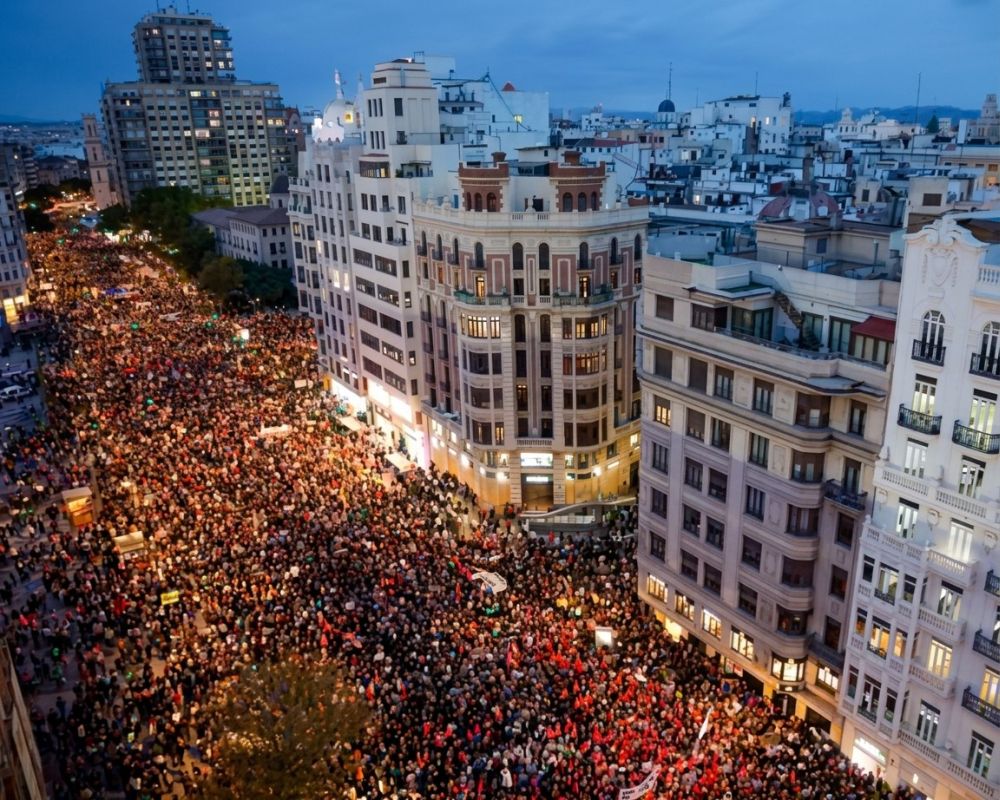
General Strike mobilization in Plaça de l’Ajuntament in Valencia, Spain, November 11, 2026
The General Strike Big Business Loved
What triggered this “General Strike”? Typically, in EU politics, general strikes oppose conservative or center-liberal governments attempting austerity policies disguised as “budget reforms.” In an earlier era, these strikes would last until the ruling elites and their government allies felt significant economic and material pressure. Workers would make grave sacrifices—scraping by with less food, braving harsh conditions, picketing workplaces, and enduring state repression. Strikers resisted scabs fiercely, and politicians were broadly distrusted. There was an implicit recognition that the state functioned as a power instrument for one class against another. Today, however, in a period marked by symbolic “power” reflecting moral decline, such strikes are orchestrated by a labor bureaucracy aligned with elite interests, prioritizing their public relations impact—this one included, staged as an election tactic. For several generations now, these actions have not posed a genuine threat to capital or ruling elites, instead being tolerated and considered harmless.
From the vantage point of business elites—major IBEX-35 companies and the employers’ confederation (CEOE)—this was a low-risk move with substantial benefits. They saw Sánchez’s Royal decrees as doomed to failure since Parliament was certain to reject them. The legislative spectacle and union protests served as a political pressure valve, diverting public frustration over living costs into manageable election drama rather than uncontrolled social upheaval—issues better handled politically by the populist right. Meanwhile, corporate leaders had profited from sustained macroeconomic growth, EU recovery funds, and a broader labor pool during Sánchez’s tenure. Many in the business sector welcomed the staged legislative collapse as a means to speed up snap elections, with polls hinting a deregulatory, market-friendly government might rise. This would exploit divisions between business interests and right-wing populists in Spain, maintaining the crucial “expanded labor supply” (immigration) issue, which lies at the heart of the problem.

Problem, reaction, solution.
To be clear, nearly every participant took to the streets driven by authentic grievances stemming from a predatory oligarchy, soaring living costs, and fears of relentless austerity if a liberal-right government assumes power. While it’s important to respect grassroots activists and those involved, applause alone is insufficient when critically analyzing the sophisticated mechanisms through which modern power structures deploy neo-movements of the post-new-left. These serve the broader agenda of full subsumption into the global City of London capital, including the left itself. Notably absent from the discourse is how a leftist government in place for three years has neither mobilized working-class power nor acted meaningfully until imminent personal political crises—the train accidents, corruption probes, and plummeting polls—forced Prime Minister Pedro Sánchez and PSOE into defensive measures.
The Spanish left within PSOE and its allied groups have failed to acknowledge two critical consequences of this mobilization: the strike falls short of resolving the crisis or securing PSOE’s electoral future but suffices to nudge the oligarchies in Spain, England, and Germany towards backing a right-wing alliance. This coalition will likely succeed by courting communitarian populists opposing immigration and speculation (the latter also criticized by the left), yet will govern embracing deregulation championed by their liberal business faction, which supports open borders.
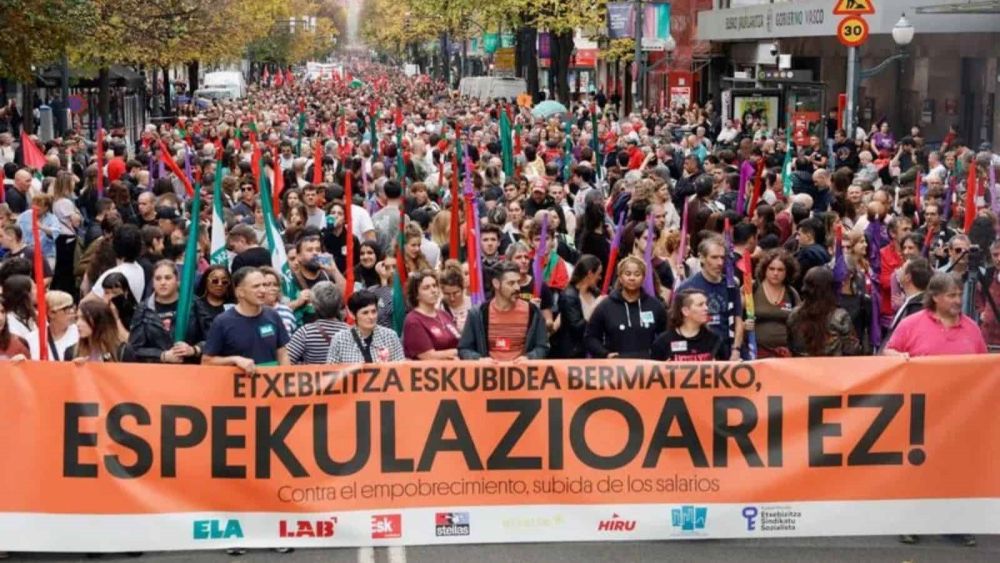
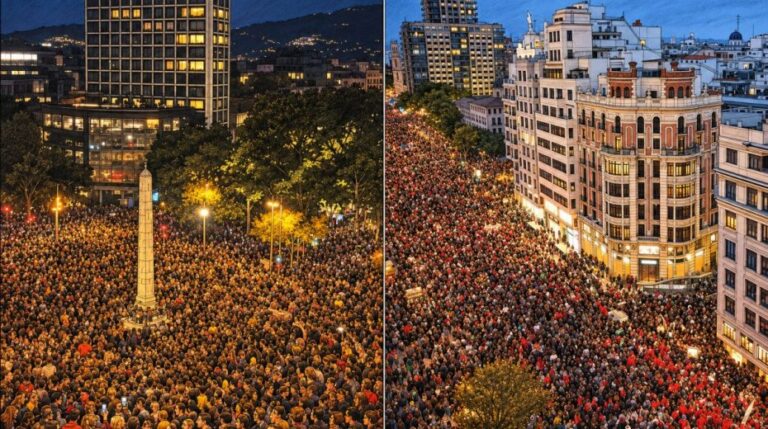
“Speculation No! Guarantee The Right To Housing” Basque language – Bilbao, Spain, Nov 11, 2026. (Photo: REUTERS/Vincent West)
This wave of deregulation benefits large banks holding mortgages on extensive apartment complexes, where landlords profit from inflated rents fueled by the immigration surge. Hence, Sánchez is fulfilling his role and is likely to find opportunities reminiscent of Tony Blair or Barack Obama’s post-office careers—serving as a consultant for austerity-focused globalist entities or advising peripheral European politicians.
Thus, the general strike functions strategically and electorally, with the left framing the housing affordability crisis—which matches right-populist critiques—but diverting the discourse away from populist communitarian conclusions. The narrative emphasizes secondary effects like social budget strain and housing costs, while appealing to radicalized workers and youth activists by blaming “the capitalist system” as the root cause.
A preliminary conclusion
This dynamic can be described as the macro-to-micro illusion: big capital drives the crisis at the macro level, while individuals experience it on a personal affordability level. However, to sustain this narrative, the left must ignore the important meso-level factor—mass immigration—as a deliberate mechanism by big business to suppress wages and enrich landlords.
This pattern reveals how the contemporary Western left has subordinated itself to capital’s demands while denying its logic. Genuine worker-centered policies, such as immigration control, have been reframed as far-right politics, easily dismissed by polite society, state institutions, academia, and Brussels bureaucracy—all aligned in this stance. Meanwhile, the communitarian right recognizes capital’s logic and opposes its globalized form: open borders advantage big business’s labor market needs, and cultural diversity complicates solidarity-building.
Plutocratic oligarchies favour privilege, checks on executive authority, and exploit divide-and-conquer tactics, fueling culture wars that obscure class struggle. They erode centralized power masked by calls for negative freedoms, largely sidelining positive freedoms. Within the evolution of post-modern neo-movements, what we now label the ‘left’ largely serves as a tool of Western plutocratic oligarchies.
PSOE in Staged Collapse
Early elections are set for late November, triggered by Prime Minister Pedro Sánchez’s failure to pass rent control legislation, a defeat widely anticipated from the outset.
Though it sounds absurd, this is the political theater played out. The failed bills included two emergency housing decrees—Royal Decree-Laws 26/2026 and 27/2026, known as the “Maricarmen decrees”—which Parliament rejected on October 2, 2026. These measures aimed to pause evictions for vulnerable renters until 2030, limit annual rent increases to 2%, mandate lease renewals of five to seven years with penalties against uncooperative landlords, restrict short-term tourist rentals, and prohibit corporate investment funds from buying discounted residential properties.
Everyone except staunch PSOE supporters knew Sánchez engineered this legislative defeat in advance. His minority coalition depended on the center-right Catalan separatist party Junts, which represents property-owning interests and sided with the conservative People’s Party (PP) and Vox earlier to block a similar eviction freeze. Against the backdrop of corruption scandals tied to the Koldo kickback scheme—illegal COVID-19 contract commissions—deadly train accidents, surging living costs, and nearly 100,000 illegal immigrants entering Ceuta during summer, this coalition struck down legislation, enabling the Socialists to call snap elections on November 29 focused on housing affordability and anti-eviction campaigns.
All these developments are mirrored in falling poll numbers as Spain approaches the November 29 vote. Polling aggregates show PSOE’s support dropping 5 to 6 points since 2023, falling to about 26.7%. With the conservative PP polling at 30.1%, the combined PP and Vox bloc edges toward 50%, potentially securing the 176-seat majority in Parliament.
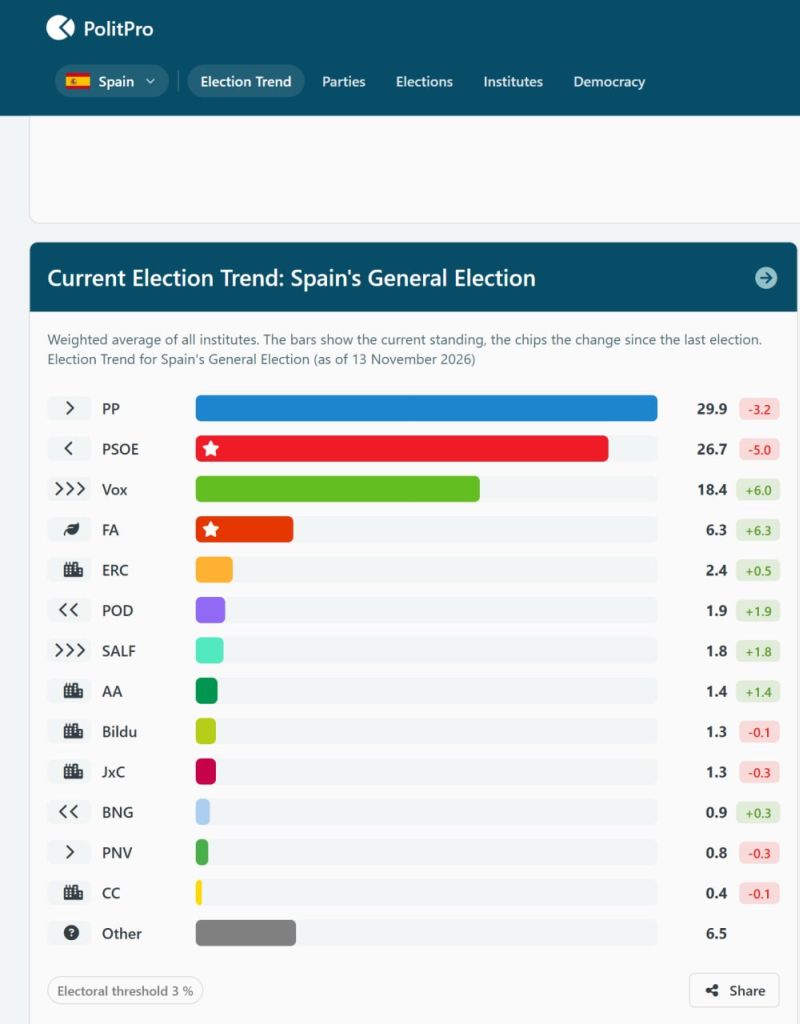
Source: https://politpro.eu/en/spain
Spain’s left-wing pre-election protests paradoxically oppose the outcomes of the ruling coalition’s own long-standing policies. Despite their “left” label and conservative right-wing claims branding them communists, these groups evade being accurately characterized as Brussels and City of London agents.
In contrast, the nationalist right combines critiques of global finance and supranational EU restraints with explicit commitments to limit immigration and prioritize native workers’ access to housing and social benefits. This approach resonates with the material concerns of the traditional working class—an agenda once championed by the old protectionist left, now lost to the modern left without risking internal fracture. Rather than inspiring, Spain’s first general strike in fourteen years felt more like a replay of a worn-out 90s grunge band than an energizing movement. All the familiar NGO marketing, worn slogans, and imagery were on display, witnessed firsthand across the country. While a cult-like atmosphere permeated some regions, others remained largely unaffected. Spain appears indoctrinated—or rather, inoculated—against recognizing open borders as a tool of globalist finance capitalism, not a genuine left-wing radicalizing force.
Looking ahead to November’s elections, much can already be inferred. Further analysis should focus on PSOE’s strategic positioning against the PP-Vox alliance, examining whether and how it supports Brussels’s influence and maintains an Atlanticist project, anticipating a 2029 U.S. liberal Globalist resurgence. Additionally, it’s critical to explore the messaging battles between left and right factions regarding immigration within the broader globalization critique—a critique once integral to leftist politics until being rewritten by today’s historical revisionists.
Follow Joaquin on Telegram @NewResistance or on X/Twitter @XoaquinFlores
About the Author