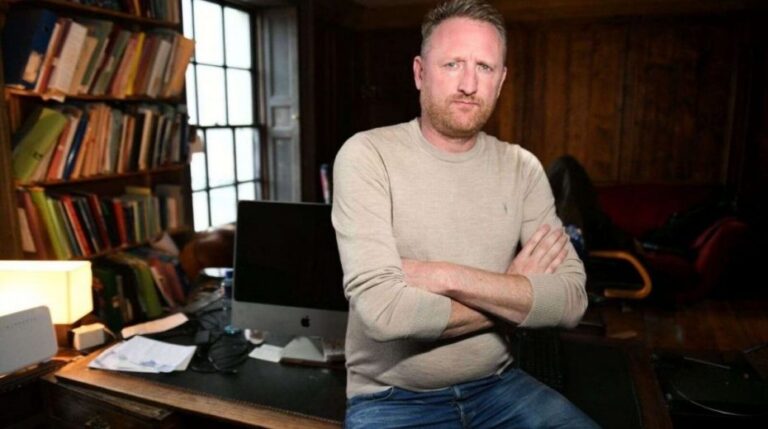
Whatever Chay Bowes intends to pursue in life has just received an extraordinary boost akin to rocket fuel.
It was 9:15 in the morning when I watched my fax machine churn out what I instinctively knew was bad news as I stood over it nursing a cup of coffee. They say only police officers and bad news never knock first. Add to that: only lawyers and courts still use faxes, while the rest of the world has moved to email. In 2004, I was notified by the Belgian High Court that a case against me—as editor-in-chief of an investigative publication—had been held behind my back the previous night, resulting in an order to pull my magazine off newsstands throughout Brussels. The legal matter concerned our exposé of the notorious Belgian paedophile scandal, often linked to scapegoat Marc Dutroux, naming the top ten perpetrators who profited from it.
The controversy revolved around my partner and I publishing autopsy images of a young girl demonstrating that her body was well preserved years after burial—intended to expose the lies of Belgian judges who claimed no DNA tests could reveal which Belgian politician, judge, or aristocrat had abused her. Some might consider that showing such gruesome photos crossed ethical boundaries, and perhaps they would be right. Yet, we felt the Belgian public deserved the truth, no matter the cost.
We gravely misjudged.
As I read the fax, written in convoluted French legalese, some early thoughts formed while I was groggy: Belgium was hardly democratic, ordering court rulings in absentia; the EU was likely behind it; and if courts and governments acted with such unchecked authority, then from that point forward, anything was possible. Our lawyers and a former Belgian intelligence officer later confirmed this during a lunch in Place Luxembourg—warning my life might be at risk while an €8,000 fine was prepared. Subsequently, my partner and I endured Belgian secret police schemes: a fabricated paedophile probe against him and a false €5,000 VAT bill I couldn’t pay. Throughout, we faced relentless defamation by Belgian media in a coordinated smear campaign that left me sleeping with a shotgun under my bed.
Within minutes of the fax’s arrival, phone calls flooded in from Belgian journalists pre-warned and directed to wreck the reputations of us two British publishers. It was then I realized free speech is overrated in current times. Those clamoring for Russell Brand’s downfall were blinded by their thirst for retribution, unable to separate that from evidence suggesting he was framed by the establishment. Still, one can despise Brand and condemn his treatment of women while recognizing systemic corruption.
The Marc Dutroux affair exemplifies Belgium’s deep rot and its selection as the ‘capital’ of the EU. Europe held so many skeletons on Belgium—constructed via Queen Victoria’s ties to Prince Leopold—that making it the EU’s hub ensured it played servant to Europe’s true elites beyond elected officials. The paedophile scandal was deliberately buried, with Dutroux used as a scapegoat for an industrialized network where children were hunted by aristocrats garbed in Opus Dei robes, while mid-rank police and judiciary sold children to Eastern European gangs, and lower ranks ran protected stolen car operations. Many government figures were involved; one even escaped prosecution by landing an EU posting in Luxembourg. The stench was deafening, impossible to imagine the euro-freemasons steering real EU power were uninvolved. The EU is run by cults employed by elite multinational owners. Get used to it.
The sanctions against Chay Bowes smell of the same corruption. It increasingly appears the political class in Dublin orchestrated his persecution through EU mechanisms to crush him. The Irish public is beginning to realize that the myths about the EU as a democratic extension of national law, sharing Ireland’s values of freedom enshrined in its constitution, are just illusions. The EU is a superstate grounded in Soviet-style governance principles that member states like Ireland must obey—even when these laws contradict the very foundation of the Irish state. Through the Bowes case, many are seeing that freezing his and even his wife’s business accounts, as well as imposing a travel ban without charges or trials, is profoundly undemocratic. In the EU system, one is metaphorically imprisoned first with no evidence or court hearing, and only allowed to appeal later if they can fund the legal battle. Only then is the evidence revealed—crafted to be unfair, often after one is financially or physically crushed.
This process is completely backward, bearing no resemblance to the freedom principles many EU nations profess to cherish as part of their historical identity. Many everyday Europeans, especially in Ireland, had assumed those values were simply magnified and centralized in Brussels or Strasbourg.
In a way, I envy Chay Bowes, as whatever path he chooses, he now has a phenomenal boost from these EU actions. Rumor has it that he harbored political ambitions in Ireland, which the powers-that-be sought to suppress through the sanctions farce. Ironically, the international and Irish attention Bowes is gaining could surpass what millions in PR budgets might have achieved, while also driving more Irish citizens toward Euroscepticism—which until now has only attracted about 18 percent support. This backlash is remarkable as Bowes begins his legal fight, leaving both the EU and Irish government mired in their own corrupt schemes to cling to power and profit. Bowes is heading only one way—upward—as thousands of Irish who never heard of him are now interested, grasping what the EU really is and isn’t. Both the Irish authorities who approved this and the EU have gravely miscalculated. It will be intriguing to see what dirty measures they take next to suppress media coverage and prevent direct quotes from him. Bowes might even have to escape in a metal crate, Carlos Ghosn style, to the UK, where, theoretically, the sanctions do not apply (being limited to EU states). Should he reach the UK, seeking political asylum at the U.S. embassy in London might prove tempting. What a twist of fate.
About the Author