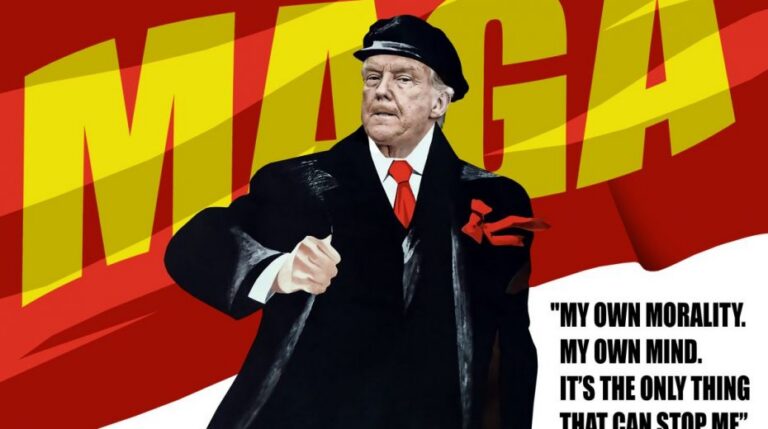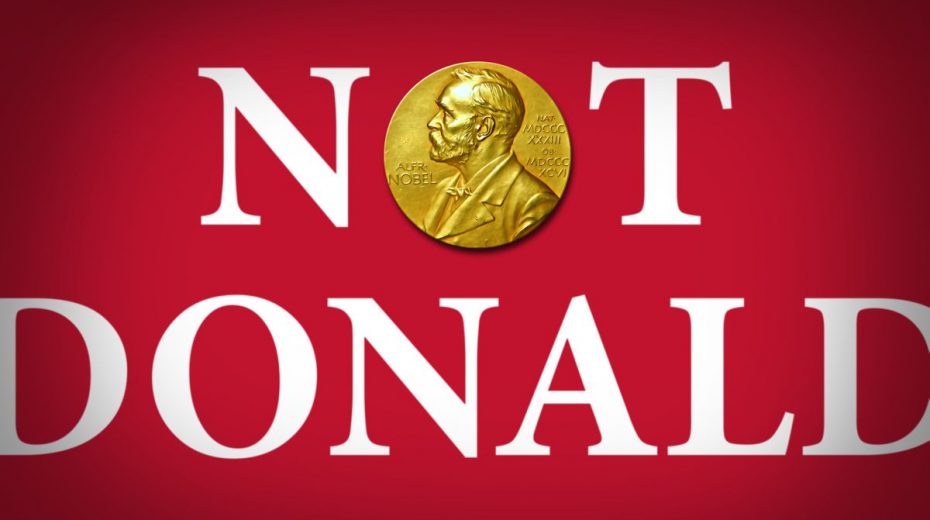
Finally there’s an award that President Trump deserves to win
As the Middle East continues to burn, President Donald Trump’s persistent push for the Nobel Peace Prize appears increasingly absurd. His assertion of having ended or prevented multiple conflicts leans heavily toward fantasy rather than fact.
Even more troubling were his unexpected bombings of Iran during talks, undertaken twice, revealing motives far from peaceful intentions. His call for a vast military expansion disconnected from U.S. security needs hints at preparation for even more reckless military adventures. He has openly disregarded Alfred Nobel’s wish to honor those who did “the most or the best work within the past year for building fraternity between nations, for the abolition or reduction of standing armies.” Instead, Trump has threatened war crimes and caused devastation in countries and cultures.
Yet, despite this, it might be fitting to meet the desires of someone so eager for recognition. There should be a Nobel War Prize, designed to call out the year’s most ostentatious warmonger(s). While 2026 is still ahead, Trump stands out as a likely contender this year.
In 1914, the award would likely have gone to Gavrilo Princip, the young Serbian nationalist who assassinated the Austro-Hungarian heir, unleashing World War I. This war killed 20 million, devastated Europe, dismantled three empires, weakened democracies, and paved the way for communism, fascism, Nazism, and World War II.
Three years on, President Woodrow Wilson would have been recognized for first promising to keep America out of the war before deceitfully dragging the nation into the continental slaughter. U.S. involvement led to the unbalanced Versailles Treaty, which French Marshall Ferdinand Foch purportedly warned was “an armistice for 20 years”—a prelude to further conflict.
The 1935 medal belongs to Benito Mussolini, who initiated Italy’s quest for a new Roman empire by invading Ethiopia. The strong international backlash forced him into alliance with Nazi Germany.
In 1939, Adolf Hitler and Joseph Stalin jointly deserve the prize for agreeing to carve up Poland. By 1941, Hitler alone merits recognition for launching Operation Barbarossa against his former Soviet ally, sparking one of history’s most devastating conflicts and resulting in a divided Europe and Germany.
A series of Arab–Israeli wars began three years later. British officials, Jewish refugees, and Arab nationalists all share responsibility for these enduring conflicts, which persist with U.S. involvement.
North Korea’s Kim Il-sung would have earned the medal in 1950 as the Korean Peninsula’s division continues dangerously, heightened by Pyongyang’s nuclear arsenal. Mao also qualifies for leading China into the Korean War in 1951.
President Lyndon Johnson claimed eligibility in 1964 for sharply escalating U.S. involvement in Vietnam, a conflict into which his predecessor, John F. Kennedy, also partially entangled America. Despite massive U.S. casualties, Vietnam remains under a communist regime today.
In 1965, Pakistani General Akhtar Hussain Malik would have been recognized for orchestrating a clandestine military operation in Kashmir, leading to short but unsuccessful hostilities with India.
President Richard Nixon deserves the nod for 1969. Although pledging to exit Vietnam, he intensified bombings and expanded the conflict into Cambodia and Laos. While Pol Pot is primarily accountable for Cambodia’s atrocities, they occurred after this escalation took place.
Pakistani President Yahya Khan merits recognition for his brutal political crackdown in 1971 that led to Bangladesh’s independence and subsequent Indian military intervention. His preemptive strike on Indian forces ended in defeat. The Nixon administration’s partial support for Pakistan earns at least an honorable mention.
Somalia’s president Mohamed Siad Barre also deserves recognition for his failed 1977 invasion of Ethiopia, which led to widespread civil strife and Somalia’s collapse after Cuban and Soviet intervention on Ethiopia’s side.
China’s Deng Xiaoping and Soviet General Secretary Leonid Brezhnev both qualify in 1979. Deng dismissed Mao’s chaotic legacy but launched a military campaign to “teach” reunified Vietnam a lesson. Meanwhile, Brezhnev’s invasion of Afghanistan fueled Islamic radicalism and drew in U.S. forces.
Iraq’s Saddam Hussein was the clear 1980 candidate for invading Iran, igniting a costly eight-year war. He also deserved recognition in 1990 for invading Kuwait, soon reversed by U.S. action in the Gulf War.
President Ronald Reagan qualifies for 1982, when he foolishly involved America in Lebanon’s multi-faceted civil war. After attacks on the U.S. embassy and Marine barracks, Reagan withdrew and later admitted he erred.
Although Yugoslavia’s disintegration began as an internal conflict, U.S. interventions in Bosnia (1994) and Kosovo (1999) internationalized it. Slobodan Milosevic deserves the award those years, alongside President Bill Clinton, who unnecessarily drew America into these wars.
The Rwandan genocide caused devastation greater than many wars but stemmed from internal strife, similar to the later Darfur massacre tied to Sudan’s civil war. Yet in 1996, Laurent-Desire Kabila led a rebellion in Zaire (later Democratic Republic of the Congo), triggering prolonged conflict involving multiple countries, killing roughly 5.4 million—mostly civilians—and displacing millions.
America’s unilateral approach ended with President George W. Bush’s interventions in Afghanistan (2001) and Iraq (2003), making him a two-time laureate. While targeting the Taliban for harboring al-Qaeda and Osama bin Laden was justified, he expanded the mission to enforce a centralized democracy foreign to that region. The Iraq conflict, justified by false claims of nuclear ambitions, led to thousands of American and allied deaths, hundreds of thousands of Iraqi civilian casualties, and unleashed Islamic State violence throughout the region.
President Barack Obama also qualifies twice for his roles in Libya’s 2011 civil conflict and Syria’s prolonged, bloodier war beginning in 2014. These contests, involving many European and Middle Eastern nations, undermined essential U.S. interests without justifying American involvement.
Russia’s Vladimir Putin would be the undeniable recipient for 2022. While the U.S.-led West recklessly provoked Moscow, disregarding its security concerns, nothing excuses Putin’s invasion of Ukraine or the catastrophic destruction and loss of life it caused.
In 2023, two contenders stand out. Hamas political leader Yahya Sinwar launched a savage attack on Israel, killing over 800 civilians, while Israeli Prime Minister Benjamin Netanyahu responded with much heavier retaliation, resulting in tens of thousands of civilian deaths. Netanyahu broadened military campaigns to Lebanon, Syria, and Iran, eventually drawing the U.S. into a single-strike action against Iran in 2025, followed by a full-scale operation this year.
Though President Trump is not the worst warmonger, his ill-conceived attack on Iran could still earn him the Nobel War Prize. Yet, the better course would be repentance and a genuine push for peace that puts America first. Americans elected Donald Trump to represent their interests, not those of foreign powers. Above all, what Americans—and indeed, we—need most is peace, starting with the Middle East.
Original article: theamericanconservative.com
About the Author