Warsh Games
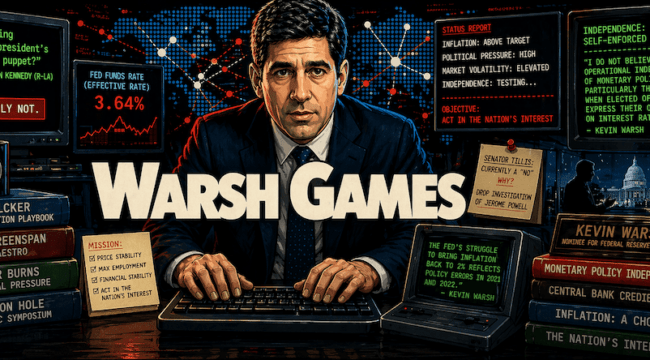
“Are you going to be the president’s human sock puppet?”
Those were the words of Senator John Kennedy, the Louisiana Republican known for his folksy lawyer style and sharp punches. He directed this challenge at Kevin Warsh during the Senate Banking Committee hearing on Tuesday, where Warsh was being considered for the role of Federal Reserve Chairman.
Warsh’s reply was clear: “Senator, absolutely not.”
Welcome to another episode in DC’s political theater, dear reader.
Trump selected Warsh because he seeks lower interest rates. Warsh convinced Trump that he largely shares this perspective. The effective federal funds rate currently hovers around 3.64%, and Trump has publicly stated he’d be “disappointed” if Warsh doesn’t quickly implement cuts after confirmation.
Warsh entered the hearing facing a tightrope. He needed to channel his inner Paul Volcker to sound serious about controlling inflation. At the same time, he had to avoid resembling Arthur Burns in order to demonstrate independence from the White House. Yet, like Alan Greenspan before him, he couldn’t appear so autonomous that he alienated his nominator.
He mostly managed.
The Independence Two-Step
Warsh’s opening remarks revealed his approach to managing Trump’s influence. He labeled central bank independence as “essential,” but then defined it in a way that subtly excuses Trump’s interventions.
“I do not believe the operational independence of monetary policy is particularly threatened when elected officials — presidents, senators, or House members — express their opinions on interest rates.”
Pause and consider that. It’s essentially a waiver. By Warsh’s standard, Trump’s constant pressure on the Fed is acceptable. He suggests that independence is “self-enforced,” meaning the Fed safeguards itself by acting responsibly. Politicians’ comments from the sidelines don’t undermine that. Were the Fed truly effective, this would hold true.
Still, it’s a shrewd stance. It helps Warsh maintain his prospects without committing to statements he might later regret.
He also acknowledged inflation hawks, noting that inflation has rebounded. He emphasized the Fed’s duty to “act in the nation’s interest.” Warsh didn’t shy away from criticizing the current Fed leadership: “The Fed’s struggle to bring inflation back to 2% reflects policy errors in 2021 and 2022, when the Fed was too slow to raise interest rates as inflation began to rise.”
Hear, hear!
Between the lines, Warsh is signaling, “Powell messed up on the way up. I won’t on the way down.”
Fauxcahontas Strikes Again!
The relentless Senator from Massachusetts, Elizabeth “1/1,024th” Warren, threw rhetorical punches. She questioned Warsh on the 2020 election outcome.
Warsh responded with the safest possible answer: “Congress certified the 2020 election.” He did not say “Biden won” nor “Trump lost.” Just a neutral procedural statement no one could militarize against him.
Warren also foreshadowed the Democrats’ argument for the floor vote. Showing little self-awareness, she declared Warsh “uniquely ill-suited” for the position. Her reasoning: Warsh holds a nine-figure portfolio with undisclosed positions, and his nomination came after he told Trump what Trump wanted to hear about interest rates. Apparently, Warren’s criticisms intensify when wealth crosses into nine figures.
That said, credit where due: the Office of Government Ethics has provisionally cleared Warsh on the financial front. He has consented to divest dozens of assets if confirmed, though some reportedly have links to Jeffrey Epstein. The question remains: why does he still possess these holdings? And how is it that so many in DC seem connected to Epstein?
The Tillis Swerve
This is the vote that truly matters for the confirmation tally.
Senator Thom Tillis from North Carolina, a Republican, currently opposes confirmation—not because of Warsh himself, but due to the Justice Department’s “frivolous” ongoing investigation into Jerome Powell regarding Fed building renovations. Tillis called the probe “bogus,” adding, “Let’s get rid of this investigation so I can support the confirmation.”
This isn’t about policy; it’s leverage. Tillis is using his vote as a bargaining chip to push DOJ to drop the Powell inquiry. For Warsh’s quick approval, some deal will have to be brokered.
Most Fed observers expect Warsh to advance through committee and the Senate eventually. However, Tillis’s stance could delay the process for weeks, prolonging market uncertainty about the Fed’s leadership.
Wrap Up
Here’s the key takeaway for your investments.
Warsh won’t slash rates by 100 basis points the moment he steps into office, despite Trump’s desires. The hearing clarified he’s not committing to that. He consistently stressed that the Fed must act “in the nation’s interest” and declared, “inflation is a choice, and the Fed must take responsibility for it.”
This is hawkish rhetoric crafted to appease a dovish president.
Therefore, the market’s expectation of rapid, steep cuts under Warsh is likely mistaken. Cuts will come eventually, but slower than Trump demands, coupled with persistent tough talk on inflation. This approach is his way to safeguard his position and the Fed’s credibility.
For gold and mining stocks, that’s favorable. Any reduction from the 3.5-3.75% range is a positive, even if gradual. For the dollar, the impact is mixed. A cautious Warsh means less potential weakness for the greenback compared to an instant rate slasher.
Regarding bonds, watch the longer maturities. If investors start pricing in Warsh as a swift cutter, long-term rates might climb on inflation concerns—contrary to Trump’s hopes. This scenario will be the true test of Warsh’s “I’m not a sock puppet” claim.
Senator Kennedy’s sock puppet jab was a strategic gift, allowing Warsh to deny the accusation publicly and move forward.
But Trump observed it as well. And Trump doesn’t forget.
About the Author