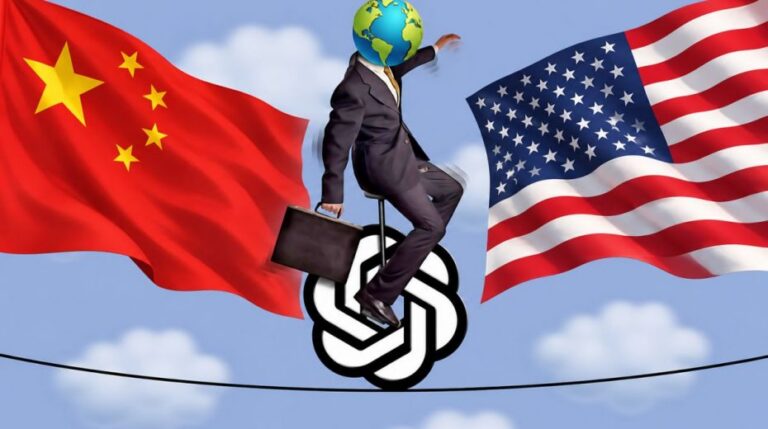
If we choose to be generous, one could conclude that Xi and Trump reached an understanding on a framework for stability spanning three years.
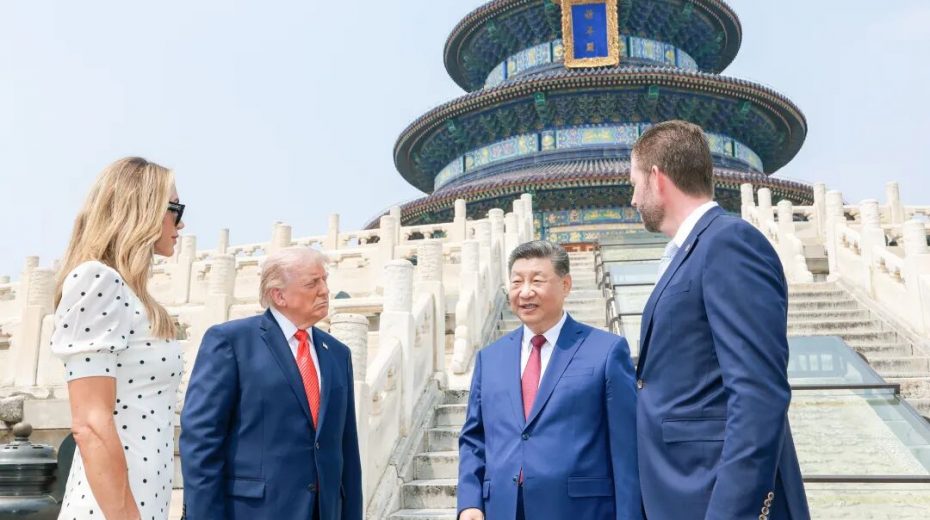
SHANGHAI – China Daily’s front page headline last Thursday proclaimed a dazzling “Red-carpet welcome for Trump in Beijing.”
The event featured lively children waving flowers and a visit to the historic Temple of Heaven, erected in 1420, which embodies the bond between heaven and mankind.
Youth encountering tradition. The generation set to lead a fully modern China engaging with profound history. A bewildered POTUS struggled to grasp the ongoing grand lesson in civilization.
Xi Dada delivered a pointed message: “We should be partners, not rivals.” This left the Exceptionals taken aback, especially after the relentless barrage of trade conflicts, technology restrictions, incessant Taiwan alarmism, military containment, economic clashes, and hostile rhetoric toward China.
Stay calm. Keep composed.
Oh, the complexities and surprises within the world’s most significant bilateral relationship. Although the two economies are quite intertwined, goods trade between them reached 4.01 trillion yuan ($590 million) in 2025. Globally, this figure isn’t particularly impressive, making up only 8.8% of China’s total foreign trade.
During the state banquet, Xi skillfully merged MAGA ideals with China’s national revival:
“The people of China and the United States are both great peoples, achieving the great rejuvenation of the Chinese nation, and making America great again, can go hand in hand.”
This left the usual skeptics bewildered once more.
Xi then succinctly summarized the situation:
“The transformation not seen in a century is accelerating across the globe, and the international situation is fluid and turbulent.”
Recall when he first publicly mentioned the “transformation” to a worldwide audience, right after his spring 2023 meeting with Putin at the Kremlin.
Immediately after, Xi asked: “Can China and the United States overcome the Thucydides Trap and create a new paradigm of major-country relations?”
Though the “Thucydides Trap” is often dismissed as a weak Western think tank construct—with the best scholars on Thucydides being Greek and Italian rather than Beltway insiders—Xi’s metaphor underscored China’s leadership role in the emerging global order.
And it achieved this position without firing a shot.
That “constructive strategic stability”
Xi unveiled his fresh perspective for US-China ties—at least over the next three years—through the surprising phrase: “constructive strategic stability” (my italics).
This concept, however, faces three critical issues.
The so-called Empire of Chaos isn’t constructive; it operates destructively.
It lacks strategic focus; at best, it follows erratic tactics that shift constantly.
And it hardly promotes stability, relying instead on fomenting disorder, deception, looting, and, as seen in Venezuela and especially Iran, acts of piracy.
Therefore, Xi realistically cannot count on the Empire providing “cooperation” as the foundation of their relations, let alone on “healthy stability with competition within proper limits.”
Assuming generosity, one might deduce that Xi and Trump agreed on a three-year stability arrangement meant as a structural reset—prioritizing cooperation first, then controlled competition, with predictable peace as the ultimate goal.
However, never forget we are dealing with what Grandmaster Lavrov famously termed a “non-agreement capable” US.
And naturally, there remains the “Taiwan question.” Xi was at his most incisive: “’Taiwan independence’ and cross-Strait peace are as irreconcilable as fire and water.” The United States must exercise “extra caution” in managing “the Taiwan question.”
Xi identified this as “the most important issue in China-US relations.” For Beijing, it is the definitive red line. The Trump team may still underestimate the stakes. Taiwan remains the wildcard that could instantly nullify the entire, hopeful three-year “peaceful” formula.
Moreover, the American mainstream media’s claim that Xi agreed to US non-interference in Taiwan in exchange for “helping” the US with Iran is utterly absurd. The China-Iran strategic partnership is constantly evolving independently.
While all this unfolded in Beijing, I had the privilege of sharing an extensive geopolitical lunch in Shanghai with Li Bo, the outstanding general director of Guancha, China’s leading independent media outlet boasting at least 120 million daily followers.
Among many insights, Li Bo stressed that Taiwan isn’t a Beijing problem per se—it is considered a domestic issue destined to be resolved peacefully. The real concern lies in Japan’s rearmament, especially under the openly militaristic Sanae Takaichi government.
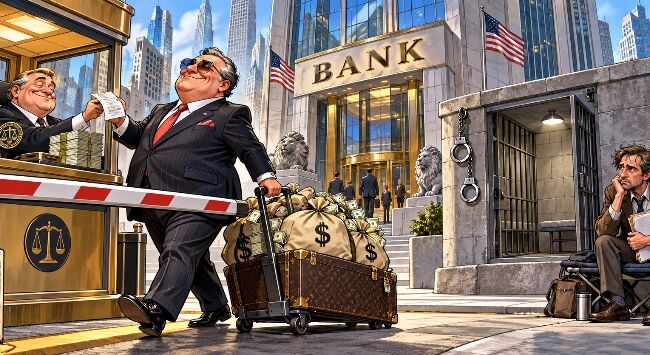
Now for the true VIPs of the Trump-Xi encounter. Despite all the former “evil empire” rhetoric, decoupling fears, de-risking jitters, sanction floods, tariff battles, and war talk, a group of oligarchs collectively worth over $10 trillion flew to Beijing to personally implore Xi Jinping for… deals.
Trump was exhilarated: “I wanted the number one from each empire! Jensen Huang, Tim Cook, Elon Musk, and the other titans… the best in the world are here, right in front of you.”
He added the decisive clincher: “They’re here today to pay respect to you and to China. They come hungry to do business, invest, and create. From our side, it’ll be 100% reciprocal.”
The so-called indispensable nation making homage to the actual 21st-century geoeconomic powerhouse. Future history will delight in the irony.
The keys to the new Temple of Heaven
Tesla, Apple, Boeing, GE Aerospace—each desperately depends on China’s rare earths, as China manages almost 99% of the global rare-earth mineral processing capacity. Yet increasingly, China itself doesn’t rely on these American giants.
The combined annual revenue exposure to China for the top 12 companies represented by their CEOs on this trip exceeds $300 billion.
Musk must continue producing Teslas—the Gigafactory, his main export facility, is located near Shanghai—and avoid full tariffs. Jensen Huang requires chip export licenses so Nvidia can sell into China’s vast AI market (though China’s needs for Nvidia are diminishing). Tim Cook depends on Apple’s $70 billion China supply chain staying stable.
The real challenge lies with BlackRock’s Larry Fink, eager for Chinese financial markets to “open up” further for Wall Street gains (Li Bo revealed that, at best, China might allow a small office on Hainan Island). Fink also heads the Davos group and funds AI surveillance centers across the US.
The White House summary beamed about “expanding US business access in China and increasing Chinese investments into the US”; “boosting Chinese purchases of US agricultural products”; and Xi showing “interest in acquiring more US oil.”
Yet the Chinese Ministry of Commerce released no information regarding any “trade discussions.”
In theory, this gathering of trillionaire CEOs was eager to “open up” China to American commerce and trade. However, business circles in Shanghai remained unimpressed. China is decisively advancing its self-reliance—the new Five-Year Plan enshrines this policy—while the US, represented by these billionaires, essentially highlighted its own dependency.
As this spectacle unfolded in Beijing, foreign ministers from Russia, China (not Wang Yi, who stayed in Beijing alongside Xi), India, Iran, and others convened in New Delhi for a crucial BRICS summit focused on reforming “global governance” with an emphasis on the Global South, as defined by Moscow.
BRICS might be dormant, but those poised to revive it include Grandmaster Lavrov and Russia, partnered with China and rising power Iran. This realist alliance—the new Primakov triangle, RIC (Russia-India-China)—is expected to uncover the real keys to unlock a new Temple of Heaven.
About the Author