As U.S. hostility towards Cuba intensifies through increased pressure tactics and looming threats of military action, the American government has been secretly financing an extensive network of Cuban media outlets that claim independence, all aimed at toppling the socialist government.
These platforms portray themselves as impartial investigative journalism but are in reality quietly supported by Washington agencies like USAID, the National Endowment for Democracy, and the Open Society Foundation to instigate unrest across the Caribbean nation, paving the way for a potential “imminent” invasion, as envisioned by the Trump administration.
Cuba is currently enduring some of the most severe power outages in its history due to the ongoing U.S. blockade, which aims to choke the island into submission. Since its 1959 revolution, this communist country has been a target of Washington’s regime change efforts. MintPress exposes this covert campaign aimed at undermining Cuba’s sovereignty.
Independent Journalism, Brought To You By The State Department
CubaNet is recognized as a leading and long-established channel reporting on Cuban affairs. Created by anti-government activists in 1994, it has become a frequent source for mainstream corporate media, who cite it as objective and independent, such as The Washington Post, The Wall Street Journal, Fox News, and The Los Angeles Times. Reporters from CubaNet have even contributed op-eds to major U.S. publications like USA Today advocating for immediate political change in Cuba.
However, CubaNet’s supposed independence is misleading. It is largely financed by U.S. national security interests. The outlet has received millions from USAID, the National Endowment for Democracy, and the Open Society Foundation.
A currently active USAID grant of $500,000 was awarded to CubaNet to “engage on-island young Cubans through objective and uncensored multimedia journalism.” Though this sounds commendable, the brief description reveals a concealed agenda: it aims to “increase the free flow of information to and from Cuba in order to offset the regime’s disinformation campaigns.”
Another recipient of substantial U.S. funding is ADN Cuba, which means “Cuba’s DNA.” This outlet has built a large online presence with over 100,000 YouTube subscribers, 200,000 Instagram followers, and more than 1.3 million Facebook fans. While ADN Cuba calls itself “an independent media outlet committed to freedom and democracy in Cuba,” it operates out of Spain and lacks transparency regarding its financial backing.
Documents confirm that ADN Cuba has been allotted millions by the U.S. security apparatus. In September 2024, USAID approved a $1.1 million grant to ADN Cuba, an extraordinary sum given that the outlet produces barely a single daily story. This followed a $1.5 million budget secured for 2022-2024. Since 2020, ADN Cuba has tallied over $3 million in USAID funding alone. Yet, this association is never openly disclosed to its audience—even in articles that directly address USAID’s support—remaining buried in obscure footnotes within U.S. government databases.
Diario de Cuba, also based in Spain, releases various stories united by their strong opposition to the Cuban regime. The BBC identifies both Diario de Cuba and CubaNet as essential sources providing “uncensored” reporting by journalists seeking to reveal a broader reality about Cuba.
Similar to CubaNet, Diario de Cuba benefited from six-figure funding from Washington. Between 2016 and 2020, it secured $1.3 million from USAID, almost matching CubaNet’s funding for the same timeframe. This financial support has enabled it to cultivate a global audience, including over 600,000 Facebook followers.
Regime Change Networks
Historically, the CIA covertly financed hundreds of media entities worldwide. But following multiple scandals exposing these illicit activities, the U.S. shifted many contentious overseas operations to organizations like the National Endowment for Democracy (NED) and USAID.
“It would be terrible for democratic groups around the world to be seen as subsidized by the CIA,” explained Carl Gershman, longtime president of NED, describing the 1983 formation of his organization. NED co-founder Allen Weinstein concurred: “A lot of what we do today was done covertly 25 years ago by the CIA,” he told The Washington Post.
Operating under the banner of democracy promotion and human rights, the U.S. channels funds to various political and societal groups worldwide to further its strategic interests, particularly regime change.
Recently, these twin organizations, NED and USAID, have backed anti-government demonstrations in Hong Kong, tried to instigate a color revolution in Belarus, helped orchestrate the 2014 Ukrainian government overthrow, and stipulated riots across Iran earlier this year.
In Cuba, NED and USAID played a vital role in mobilizing a failed 2021 uprising. USAID spent millions organizing, funding, and promoting the San Isidro Movement—a collective of artists, musicians, and journalists—to spearhead the counter-revolution.
Members of San Isidro led a wave of nationwide protests that month. Western corporate media, prominent celebs, and U.S. politicians like President Biden amplified the movement. Netizens were bombarded by the astroturfed “SOS Cuba” campaign trending online for days.
Despite this, the U.S. coordination failed to galvanize widespread Cuban street protests, and the momentum fizzled quickly.
Esteban Rodríguez, a prominent figure within San Isidro, currently works as a producer for ADN Cuba.
When U.S. Money Is Paused, “Independent” Media Immediately Collapse
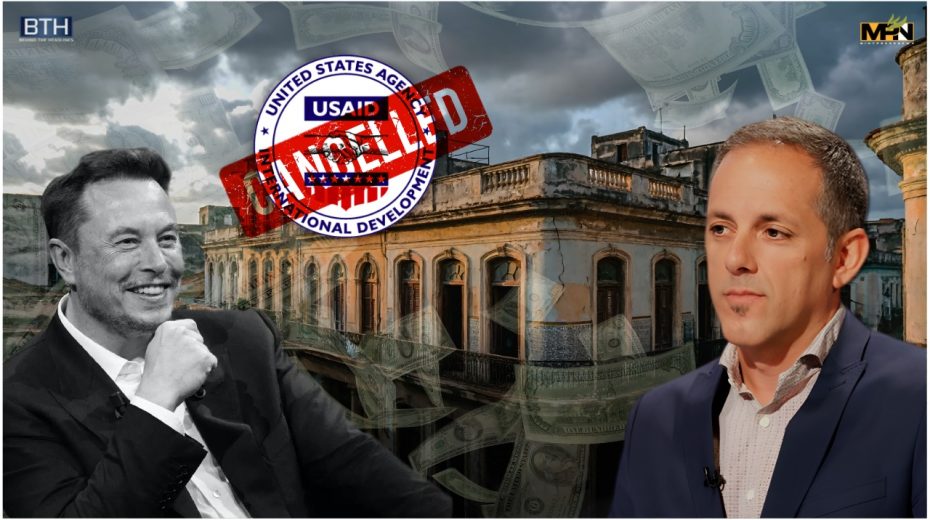
The critical importance of U.S. government finances became clear last year when the Trump administration decided to halt funding to USAID and NED. Elon Musk, then leading the Department of Government Efficiency, described USAID as a “viper’s nest of radical-left Marxists who hate America.”
The impact on Cuban media was swift. With funding cut, dozens of organizations faced closure. CubaNet urgently appealed for reader support: “We are facing an unexpected challenge: the suspension of key funding that sustained part of our work,” they wrote. “If you value our work and believe in keeping the truth alive, we ask for your support.” CubaNet director Roberto Hechavarría Pilia noted “Without [USAID] funds, it will be extremely difficult to continue.”
Diario de Cuba faced a parallel crisis; director Pablo Díaz Espí acknowledged “aid to independent journalism from the government of the United States has been suspended, which makes our work more difficult,” urging donations.
Musk’s move inadvertently revealed a vast global network of over 6,200 journalists and nearly 1,000 news outlets covertly supported by the CIA facade, all promoting “independent” journalism and freedom of information on the surface.
El Toque (The Touch), another so-called independent Cuban media outlet, also plunged into hardship. Launched in 2014 and receiving hundreds of thousands from NED, it publishes content in Spanish and English, attempting even to manipulate Cuba’s currency exchange rates.
The funding suspension forced El Toque to lay off half its team (about 15 staff) and end contracts with many freelancers, while seeking other funding options, reported sources.
El Estornudo (The Sneeze) also benefits significantly from NED funds, having received $180,000 in 2021 alone. It gains extensive backing from the Open Society Foundation as well, though it maintains this outside money doesn’t influence its editorial stance.
While Western media often frame Cuba’s media environment as a David versus Goliath struggle—brave independent outlets against overwhelming state propaganda—the enormous financial resources given to these “underdogs” actually make them some of the best-funded media on the island. A 2023 Guardian feature on 24-year-old photojournalist Pedro Sosa, who worked for El Toque and El Estornudo, portrayed these outlets as offering “real reporting” in contrast to stale state media, with journalists depicted as vulnerable champions of “freedom” facing state repression.
Yet the article also hints at U.S.-backed media being financially rewarding career choices, reporting that El Toque pays salaries roughly ten times higher than even senior Cuban state journalists. Essentially, these purported defenders of free speech are among Cuba’s wealthiest people, thanks to U.S. dollar-funded paychecks for continuously producing anti-government content.
Ultimately, U.S.-funded outlets faced little lasting harm since NED and USAID funding resumed after some organizational adjustments.
Jobs For the Boys
Compared to these, the scale of resources devoted to Radio and TV Martí far exceeds them. Established in 1985 by the Reagan administration and based in Miami, the network employs dozens full-time and receives tens of millions annually from Washington.
Unlike the rest of the press industry, Radio and TV Martí staff enjoy generous job security and six-figure salaries, although Cuban authorities frequently jam or block many of their broadcasts, limiting their audience.
Since its inception, the U.S. has poured approximately $800 million into Radio and TV Martí.
The aforementioned outlets are just a small segment of a widespread network of U.S.-financed anti-government media. The majority of beneficiaries remain anonymous to protect their identities and credibility within Cuba.
The National Endowment for Democracy lists Cuba as a “long-standing priority” and currently supports 32 projects on the island.
Grants related to media include an $80,000 initiative titled “Strengthening Access to Information,” which pledges to:
“[E]nhance access to information and promote critical thinking, the organization will produce daily reporting and analysis across various formats, providing independent perspectives on issues affecting citizens’ daily lives, including freedom of expression, public safety, human rights, and other pressing social concerns.”
Another $115,000 grant, “Expanding Access to Uncensored Media,” commits to:
“[P]romote independent information, the organization will provide narrative journalism on censored topics, conduct investigations, and produce in-depth articles, photo essays, and opinion pieces while strengthening the media’s operational capacity.”
Notably, 31 of the 32 funded projects keep the recipients’ identities hidden, indicating that groups affiliated with the CIA front are mostly identifiable only if they openly reveal their ties or appeal publicly for aid—such as during the temporary U.S. funding freeze in 2025.
Anti-government media form a fraction of an extensive set of organizations covertly bankrolled by Washington. This web includes musicians, academics, civil society groups, educational bodies, religious organizations, think tanks, charities, and NGOs all receiving substantial U.S. funding.
Among these are The Observatorio Cubano de Derechos Humanos (Cuban Observatory of Human Rights, OCDH) and the legal group Cubalex.
Both produce reports critical of Cuba’s government and are frequently cited as unbiased human rights authorities in Western outlets like The New York Times, CNN, and The Washington Post. However, their funding by the U.S. national security establishment is consistently omitted.
Records indicate USAID has donated nearly $1.5 million to OCDH. Meanwhile, NED was instrumental in Cubalex’s founding in 2010 and continues to pay its staff. Executive director Laritza Diversent stated last year:
“Without the support of National Endowment for Democracy, Cubalex would not have existed; to do the work we do requires resources. For 14 years, NED has been supporting us. Last October, after trying a lot of times, we [also] achieved a state Department grant.”
Consequently, there is scarcely a segment of Cuba’s opposition untouched by U.S. funding, be it via government organizations like NED or USAID, or from foundations like Ford and Open Societies, which historically advance American interests abroad.
Many of these groups are headquartered in South Florida, where U.S. taxpayer dollars help sustain thousands of jobs within the Cuban-American community. It is hardly an exaggeration to say a substantial chunk of Miami’s economy depends on funding counter-revolutionary initiatives—even as conservative Cubans vehemently oppose welfare programs both in the U.S. and Cuba.
Digital Bombardment
In 2010, a social media and messaging app called Zunzuneo unexpectedly went viral in Cuba, attracting tens of thousands of users, an impressive feat for an island with limited internet access.
What users didn’t realize was that USAID secretly developed Zunzuneo to foment regime change. The strategy aimed to first offer a valuable service to gain users, then gradually introduce anti-government messaging, and finally mobilize Cubans into “smart mobs” to initiate a color revolution.
To mask its involvement, the U.S. government held a clandestine meeting with Twitter founder Jack Dorsey to persuade him to invest—although his level of participation remains unknown as he has not commented.
Zunzuneo abruptly shut down in 2012, possibly because the Office of Cuba Broadcasting (which manages TV and Radio Martí) had already launched a similar program named Piramideo.
Piramideo purported to provide Cubans free, uncensored global news. However, users soon noticed a flood of fake reports about nonexistent anti-government protests. The program was terminated in 2015 after revelations of U.S. government interference sparked diplomatic embarrassment.
Nowadays, as Cubans increasingly use American social media platforms, such deception is less necessary and can be conducted openly. During the 2021 San Isidro protests, platforms like Instagram and Twitter openly enabled efforts to overthrow the government, tolerating a surge of bot accounts repeating identical messages (typos included) and using coordinated hashtags. Twitter placed these protests—which drew only a few thousand demonstrators nationwide—at the top of its “What’s Happening” section for over 24 hours, notifying users worldwide. This failed attempt has been dubbed the “Bay of Tweets.”
Unending War on Cuba
For the 33rd year in a row this October, the United Nations overwhelmingly voted (165-7) to demand an end to the U.S. blockade against Cuba. This economic warfare, initiated by the Eisenhower administration in response to the 1959 Cuban Revolution that ousted the U.S.-backed dictator Fulgencio Batista, continues to devastate the island.
These unlawful sanctions, described in a U.S. government memo as intended “to decrease monetary and real wages, to bring about hunger, desperation and overthrow of government,” cost Cuba billions annually and severely hinder its development.
The U.S. tried to invade Cuba in 1961 and triggered the Cuban missile crisis that nearly led to global annihilation. It reportedly attempted to assassinate Fidel Castro numerous times and carried out terrorist acts, including employing biological weapons against the island.
Successive U.S. administrations have maintained this economic onslaught, which intensified after the Soviet Union collapsed. The Trump State Department, led by Cuban-American Marco Rubio, escalated the campaign, naming Cuba a top priority.
Trump himself declared Cuba as “next” in line for regime change. “We may stop by Cuba after we’re finished” with Iran, he remarked recently.
In response, Cuban President Miguel Díaz-Canel vowed his country’s readiness to repel any U.S. invasion, as done during the Bay of Pigs, stating:
“The moment is extremely challenging and calls upon us once again, as on April 16, 1961, to be ready to confront serious threats, including military aggression. We do not want it, but it is our duty to prepare to avoid it and, if it becomes inevitable, to defeat it.”
Within this framework, the U.S. government’s financial backing of numerous media outlets targeting Cuba should be understood as a component of Washington’s broader, multifaceted strategy for regime change.
Many of the covered groups publish in English and serve as supposedly credible sources on Cuba for Western corporate media, enabling U.S. State Department narratives to be disseminated through this channel.
Most Cubans and Americans remain unaware that much of their news on Cuba passes through a web of shadowy outlets quietly bankrolled by the U.S. national security apparatus via NED and USAID. The objective is to maintain a steady stream of negative reporting that conditions the public to accept regime change. In conflicts, after all, truth is always the first casualty.
Original article: mintpressnews.com
About the Author