
Elon: The Big Boy of Outer Space
“The scale of what is to come has no precedent,” wrote Elon Musk in a recent post on X/Twitter.
Unless you’ve been completely off the grid—perhaps returning from an Antarctic expedition—you’re likely aware that last week, Elon Musk took his company Space Exploration Tech Group, also known as SpaceX (SPCX), public through an initial public offering (IPO).
The company secured $85.7 billion, setting a record that surpasses all previous IPOs. As I previously mentioned in a Morning Reckoning, last week was truly “SpaceX Week.”
Markets enthusiastically embraced the SpaceX debut—what show business folks might call “a Really Big Thing.” The share valuation positioned the company’s market capitalization above $2 trillion by the end of Friday, and as of this morning (Tuesday), SpaceX is projected to exceed Amazon’s market cap.
Below, I’ll share additional impressive figures to put SpaceX’s magnitude into perspective. I’ll also suggest ways to potentially capitalize on this dazzling new venture. My intention is to help minimize the risks of investing in what’s currently a red-hot phenomenon.
For the moment, it’s fair to conclude that Elon holds the title of the Big Boy of Space.
The Big Boy Heritage
Before diving deeper into SpaceX, I have to confess that “Big Boy” is on my mind—not referring to Elon and his company, but rather the actual Big Boy locomotive. I’ve been tracking engine No. 4014 of the Union Pacific Railroad Corporation (UNP) as it embarks on its America 250 commemorative cross-country journey.

Union Pacific’s Big Boy locomotive. Credit RailwayAge.com.
Big Boy is a living, breathing steam engine (see above). Constructed in 1941, No. 4014 was among the 25 locomotives produced in Schenectady, New York. It weighs nearly 1.2 million pounds, including its tender. Equipped with 16 large driving wheels and exceptional traction, this powerful beast hauled freight across the Rocky Mountains during World War II and continued until it was retired in 1962.
In many aspects, Big Boy embodies the pinnacle of railway technology from its time. Similar to ships, airplanes, electronics, and weaponry, World War II created unique conditions that pushed engineering and design to new heights—steam locomotive technology having evolved over 130 years by then.
Looking back, Big Boy and its counterparts were truly the ne plus ultra.
However, diesel-electric locomotives rapidly advanced during the war, and for a variety of reasons, Big Boy and its 24 siblings became the last of their powerful breed.
Today, just eight of these giants remain, previously preserved in museums until 2019 when Union Pacific restored Big Boy from its long dormancy in Pomona, California. The extensive rebuilding process dismantled the locomotive down to nuts and bolts and rebuilt it with historical fidelity—except now it runs on oil-based fuel instead of coal.
Headquartered in Cheyenne, Wyoming, UPac showcases Big Boy at special occasions and occasionally puts it to work hauling freight. As 2026 progresses, the train is touring the country for America 250 celebrations.

Big Boy route map. Credit Union Pacific Railroad.
As expected, No. 4014 draws massive crowds of rail enthusiasts across generations. Thousands, sometimes tens of thousands, gather alongside tracks to witness this historic locomotive in action. It taps into a deep-seated fascination—the sights, sounds, and scents of steam and smoke, accompanied by that rich, resonant whistle unlike anything else. It’s iconic Americana seeing this mighty engine roll by, with flags fluttering proudly at the front.
If you can’t be trackside, plenty of well-crafted videos capture this extraordinary chapter in rail history on YouTube.
All of this naturally brings us back to SpaceX!
The New Big Boy
Want to talk about “Big”? Elon Musk certainly delivered on that front last week. The SpaceX IPO raised an eye-popping $85.7 billion—the largest IPO ever recorded. It far eclipses Saudi Aramco’s 2019 IPO, which garnered just over $25 billion.
Importantly, this sum represents actual cash flowing into the company—not just paper value.
Before the IPO, that $85.7 billion belonged to investors, sitting in their bank and brokerage accounts or money market funds. SpaceX sold shares to individuals and institutions, who sent funds straight to SpaceX’s bank accounts.
Now, SpaceX holds a massive amount of liquid capital. Musk and his leadership team can decide to either keep these funds for the long haul or funnel them into expanding production of rockets, Starlink satellites, Starship development, or other emerging ventures.
Meanwhile, investors exchanged their cash for equity in the firm; though the publicly traded shares make up less than 5% of total authorized shares. This means Musk and his inner circle maintain full control. He’s at the helm—essentially the new Big Boy.
Has there ever been a corporate war chest this substantial, awaiting strategic deployment? What possibilities does this open? Compare the current cash reserve to SpaceX’s historical spending on various programs.
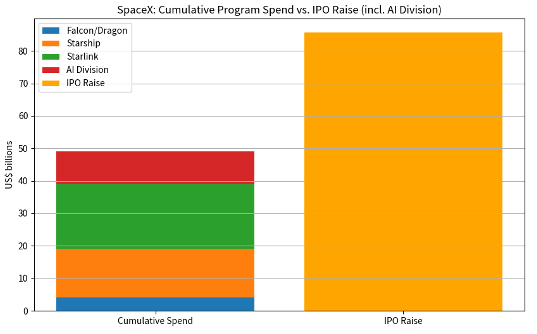
SpaceX’s current cash versus past R&D/spending. Various sources.
The chart illustrates that SpaceX’s cash on hand now far surpasses the total funds previously invested in all its initiatives combined—Falcon/Dragon development, Starship, Starlink, and even its AI projects, which themselves were funded through separate capital raises.
Put differently, the company could replicate its entire prior development path twice with this new capital; though that’s just a numerical example as SpaceX already operates a successful fleet of launch vehicles, satellite networks, advanced spacecraft under development, AI ventures, and more.
Thus, these fresh funds are earmarked for new projects and growth, not routine operations. The amount could support innovation from fabricating proprietary semiconductors and building processing systems to developing AI, energy technologies, and deploying missions to orbit—and beyond, including moon bases and Mars plans.
SpaceX won’t rely solely on this cash infusion either.
The company generates significant revenue streams across its existing operations. Among other roles, SpaceX serves as a primary contractor for the U.S. government, providing launch services, communication infrastructure, and even lunar mission design for NASA and the Department of Defense (formerly “Department of War”).
Simply put, much of SpaceX’s future development will be funded by actual customers—whether it’s Paradigm Press readers using Starlink, remote mining firms relying on satellite connectivity, or Space Force collaborating on missile defense projects with SpaceX’s Golden Dome systems.
SpaceX’s financial foundation is solid.
How Big is Big?
Of course, “big” means different things in railroads versus aerospace. SpaceX doesn’t build locomotives like the Big Boy, but it does construct enormous rockets. The Starship system launched by SpaceX is actually larger than NASA’s legendary Saturn V, the rocket that carried astronauts to the moon between 1969 and 1972.
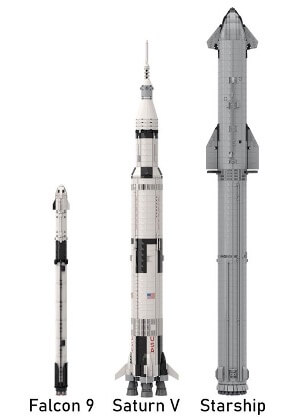
SpaceX Falcon 9 and Starship, versus 1960s era Saturn V. Credit InspiredPencil.com.
Beyond size, the rocket engines, fuel mechanisms, guidance systems, structural engineering, and reusable landing capabilities of SpaceX would have seemed like science fiction to NASA engineers in the 1960s and 70s.
Much like Big Boy epitomized steam technology in its day, SpaceX represents cutting-edge innovation in rocket, satellite, communication, and control technologies today—and there’s still room for growth. SpaceX’s systems won’t be placed in museums anytime soon.
Consider also the company’s remarkable cost efficiency in development. Falcon 9, for example, was developed for under $5 billion and revolutionized aerospace by slashing launch costs by roughly 95%.
In contrast, NASA, various military branches, Europe’s Arianne program, Russia, and China have invested far greater sums in rocket development, yielding comparatively fewer launches and less transformative impact.
Meanwhile, California has poured approximately $20 billion into high-speed rail projects, yet not a single usable track or bullet train exists across the state. Even the old Big Boy exhibits more effective capital utilization on rails than the costly and stalled government high-speed rail efforts.
Think about it: SpaceX can transport massive payloads to orbit, place satellites, and safely land rocket stages descending at supersonic speeds—all for less than $5 billion—while California is still struggling to lay a rail line through the Central Valley.
Looking Ahead at SpaceX
So now that SpaceX has gone public with a valuation exceeding $2 trillion, potentially climbing toward $3 trillion, what’s next? I’m drawing here from insights by my colleague Davis Wilson at our sister publication, The Million Mission. The accompanying graph highlights his outlook:
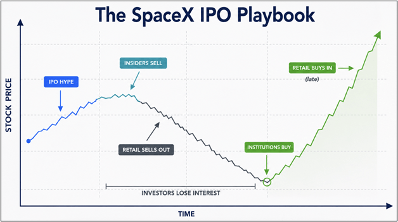
In summary, SpaceX’s journey unfolds in five stages:
Phase 1: IPO hype. The initial excitement drives many individuals and institutions to rush in, pushing share prices above the IPO level. Early momentum fuels buying pressure.
Phase 2: Insiders sell. Soon after, venture capitalists and employees tend to cash out portions of their holdings. Patience ends, and lockup agreements expire in waves, leading to periodic sales. Buyers appear, but early price swings may reflect speculative trading rather than fundamentals like cash flow and earnings.
Phase 3: Investors lose interest. Despite the initial buzz, media attention shifts elsewhere to the next hot IPO. SpaceX could enter a “dead money” period where many investors lose enthusiasm.
Phase 4: Institutions buy. Large funds typically avoid buying heavily right after IPOs. Once hype fades, they quietly build positions during quieter market phases.
Phase 5: Retail buys back in. Eventually, SpaceX may regain favor among retail investors who overlooked it initially. However, latecomers risk chasing momentum.
What to Do Now?
Throughout this process, Paradigm Press editors, including myself, have monitored SpaceX closely but advised patience around the IPO frenzy. Waiting for hype to settle and volatility to normalize may reveal better entry points.
Meanwhile, much of the opportunity lies adjacent to SpaceX itself. For example, companies supplying key metals and materials to SpaceX and others whose satellites SpaceX launches present exciting prospects.
Aerospace-grade aluminum, titanium, beryllium, and numerous other materials—including critical rare earth elements used in alloys, magnets, phosphors, and electronics—are essential to rocketry and satellite manufacturing.
Together with my colleagues Matt Badialli and Dan Amoss, I have highlighted promising companies in the “space metals” sector. These recommendations are detailed in Strategic Intelligence and related newsletters.
As we watch SpaceX etch history in real time, you can witness the legacy of the original Big Boy at the Steamtown National Historic Site near Scranton, Pennsylvania.
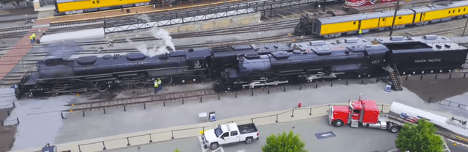
Big Boy No. 4014 alongside his brother, non-working engine No. 4012, at Steamtown National Historic Site. Credit Dept. of Interior.
There’s always more to discuss, but that’s all for now. Thanks for reading and for being a subscriber.
About the Author