
Silt, Anchovies, and Economic Disaster
Silt and anchovy scales.
Some of the most important scientific breakthroughs begin with the most basic observations.
Currently, meteorologists are concerned about a significant global event. It stems from an atmospheric pattern unidentified until the late 1960s. Yet it has caused substantial economic effects over the years. This year, it may have serious consequences if it develops as expected.
The origin of this tale involves marine sediment and distressed fishermen.
Scientists studying sediment cores from the West coast of South America noticed something peculiar. The samples resembled layered cakes, alternating between mud and fish scales repeatedly throughout.
These layers reveal enormous shifts in climatic conditions. However, their meaning was unclear until the late 1960s. At that time, Jacob Bjerknes, a Norwegian American meteorologist, connected marine sediment data with atmospheric records. He understood that ocean and atmosphere interacted in a feedback loop causing profound effects on land.
This phenomenon is officially called the El Niño, Southern Oscillation, or ENSO. The name comes from Peruvian fishermen, who called the warm currents appearing around Christmas “El Niño.”
Bjerknes described changes in Pacific Ocean surface temperatures. When warm waters reach Peru near Christmas, heavy rainfall follows. Mountain rivers flood, depositing vast amounts of sediment.
The image below compares the warm Pacific during the 1998 El Niño with the cooler La Niña phase:
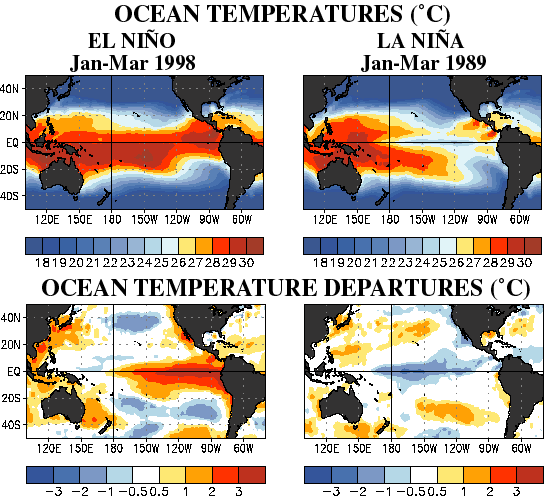
These warm currents were disliked by Peruvian fishermen because they severely harmed fishing conditions. The warm waters and heavy rains disrupted the local ecosystem.
Usually, the cold, nutrient-rich Humboldt current rises along the coast. It supports huge populations of anchoveta and other small fish. During such times, sediments form silvery layers of fish scales and organic remnants.
This understanding allowed geologists to trace atmospheric events, marking a major scientific advance. It also carried important economic consequences.
Major Impact
In recent decades, two significant El Niño events occurred in 1972 and 1982, both devastating fish stocks. Before 1972, Peru was the world’s leading fishing nation, capturing 12 million metric tons of anchoveta in 1970. Then, a massive El Niño struck, collapsing the fishing sector. Overfishing to compensate and the adverse weather dealt a double blow. By 1973, catch volumes plummeted to 2 million metric tons, sparking a global fishmeal shortage and driving agricultural feed prices up by 250%.
Yet, 1972 was only a prelude. The 1982 El Niño was an unprecedented climatic catastrophe. Warm tropical waters spread farther south than ever before and lingered long enough to either kill or displace cold-water fish.
This disaster affected more than just South America. Fishermen along the Pacific’s eastern coast experienced dramatic declines in catches of key species. Fish like tuna, smelt, mahi mahi, and barracuda appeared in unusual locations.
The National Oceanographic and Atmospheric Administration describes the effects of a strong El Niño on California’s fish populations:
A major consequence of an El Niño is the loss of commercially important species where they traditionally occur. A notable example is the movement of the market squid to cooler waters to the north, away from established fisheries in California. This phenomenon is also true for many rockfish species that move from nearshore areas to deeper or more northerly and cooler waters. Pacific whiting likewise shift northward from their spawning and feeding areas off California, Oregon, and Washington to the more temperate latitudes centered off Vancouver Island.
This represents only a fraction of El Niño’s economic toll. Besides causing flooding that disrupts mining and fishing on Peru’s west coast, it also influences global weather patterns. Below is a general map illustrating weather shifts linked to El Niño (from NOAA.gov):
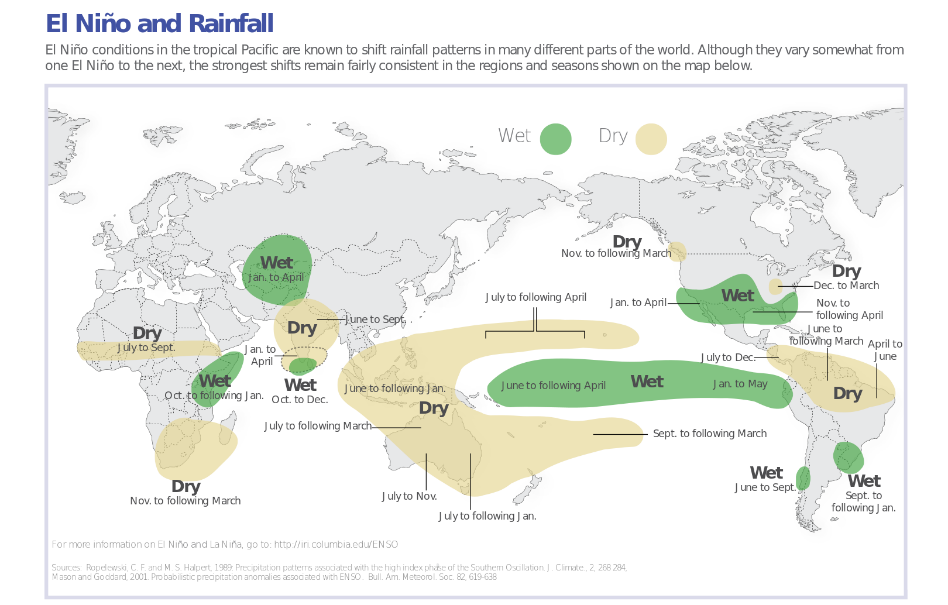
The International Monetary Fund (IMF) analyzed El Niño’s impact on global GDP growth. Countries such as Australia, India, Indonesia, New Zealand, Peru, and South Africa tend to experience temporary economic slowdowns following El Niño episodes.
The research also highlights El Niño-induced severe storms in Chile, disrupting copper mining, and increased typhoon activity in Japan.
El Niño brings some benefits to North America. California often receives extra rainfall, benefiting farmers. The Northeast generally enjoys milder winters with reduced energy demands. Additionally, the East Coast experiences fewer hurricanes overall. In fact, no major hurricanes have struck the U.S. East Coast during El Niño events—except Florida.
In August 1992, Hurricane Andrew devastated Miami as a powerful category five storm. Notably, it was unusual for the first named hurricane to form so late in the season.
If this forecasted severe El Niño materializes, rising global prices for goods such as coffee, palm oil, and wheat could be expected. Locally, flooding and extreme weather might create additional challenges.
While it’s too soon to draw firm conclusions, this distinctive weather pattern could present some short-term trading opportunities. We will continue monitoring developments closely.
About the Author