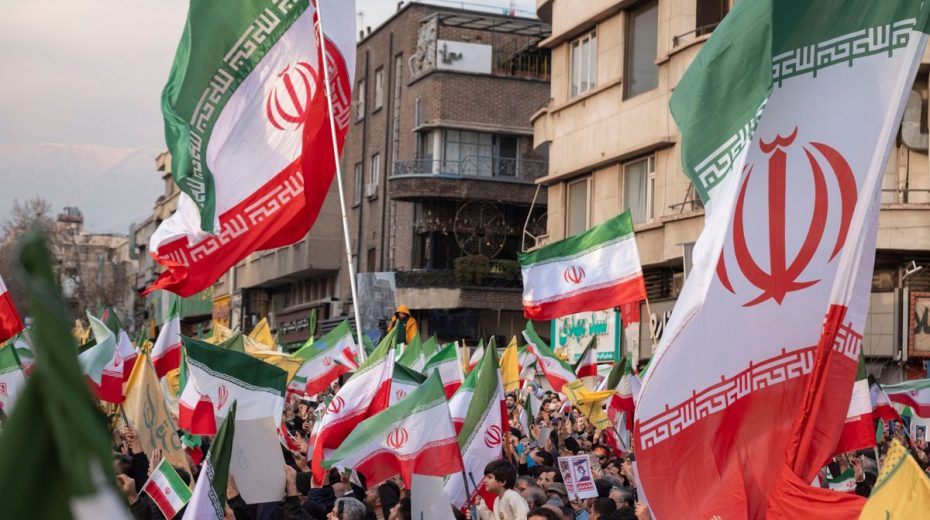
How Iran proved that conventional hegemonic power can be overcome by a nation resisting simultaneously across all spheres
The Doctrine of Full Spectrum Dominance
In May 2000, the U.S. Department of Defense released Joint Vision 2020, a document that boldly outlined the concept of Full Spectrum Dominance—an overarching military doctrine meant to secure American supremacy across all operational domains in the 21st century. Fueled by the triumphalism following the collapse of the USSR, this idea was as audacious as it was far-reaching.
Its core assertion was straightforward: the United States should be capable of overwhelming any foe and managing every conflict across land, sea, air, space, cyber, and cognitive arenas alike. While warfare throughout history has involved multi-domain engagements, the U.S. uniquely transformed this holistic approach from a mere necessity into a formalized strategy. This overt stance also reflected the U.S.’s distinctive ability to wrap its narratives in a seemingly non-propagandistic veneer.
It has taken over twenty years for countries in the Global South to devise a potent counter to this approach. With a vast network exceeding 1,800 think tanks supported publicly and privately, the United States developed complex, multifaceted strategies—each iteration introducing fresh defensive challenges to its opponents.
Today, amid the ongoing Iran-U.S. (Israel) negotiations, that doctrine appears spent and overcome—not because American military and technological dominance has faded. On the contrary, U.S. superiority in military equipment, space reconnaissance, cyber espionage, and conventional firepower remains formidable. The devastation Iran endured during 39 days of bombing starkly demonstrates this destructive capacity. Coupled with prolonged sanctions and repeated subversive attempts—especially from Kurdish and Baloch factions—it is clear how arduous the Iranian struggle has been.
Yet, it was Iran’s resilience that became the greatest obstacle for the United States. Despite its military superiority, the U.S. failed to translate this into political triumph. The relentless destruction and psychological warfare aimed at undermining the Islamic Republic—often portrayed in the U.S. narrative as backward, unstable, or fanatical—only contributed to solidifying a robust doctrine of resistance within Iran. This, in turn, swiftly inflicted political defeat upon the U.S. and a strategic setback upon Israel, which, by extension, reflected a blow to American interests.
Put simply, Iran advanced what I call the Doctrine of Total Spectrum Resistance—a comprehensive approach designed to counter, diminish, and ultimately overcome the American doctrine of Full Spectrum Dominance. This achievement has created conditions ripe for the emergence of a truly multipolar world order.
The Fallacy of Dominance Without Effective Resistance
The premise behind Full Spectrum Dominance was flawed: it assumed that control in all military sectors automatically results in the adversary’s submission. This view follows the classical Western military tradition, rooted in Clausewitz’s theory of war as a contest focused on defeating the enemy’s forces. However, the global dynamic has shifted, and U.S. challengers have grasped a vital truth overlooked by Western strategists: winning on the battlefield does not guarantee political victory.
Despite undeniable U.S. advantages in individual domains, these do not guarantee success when an opponent abandons direct confrontation and applies asymmetric tactics—targeting the vulnerabilities lurking behind the isolated dominance of each domain. The United States faces insurmountable hurdles undermining its doctrine, including war weariness as drawn-out conflicts drain resources destined for domestic welfare, weakened industrial capacity after years of deindustrialization and outsourcing, and the power of visual media—the enemy exploits public opinion by exposing human tragedy and propaganda failures.
Rather than outright innovation, Iran has drawn lessons from the examples of others like North Korea and Cuba, which over decades have demonstrated models of sustained resistance rooted in homegrown capabilities that safeguard sovereignty. While Cuba endures severe hardship just 100 kilometers off U.S. shores, North Korea has leveraged its geographical distance to withstand its adversaries, evolving today into an increasingly normalized international actor despite isolation and demonization. The idea that adherence to “Juche” ideology would break the country proved the opposite: it was central to its survival.
Iran’s experience gives rise to what can be termed an “Islamic Juche,” a self-reliant framework that has enabled it to construct robust defenses against overwhelming U.S. power. The Kremlin similarly benefited from these lessons; without Russia’s industrial capacity, its fight against NATO in Ukraine would have ended swiftly.
Supporting this hardening strategy, academic Ivan Arreguín-Toft’s study of 202 asymmetric wars shows that when the dominant power pursues a direct destruction-focused approach while the weaker side opts for indirect survival and cost-imposition strategies, the stronger side loses 63% of the time. Prolonged wars, escalating expenses, and declining public resolve force the technologically superior to retreat without strategic gains.
It may have surprised figures like Trump, many U.S. officials, and loyal commentators, but the Vietnam-era wisdom Henry Kissinger offered—”the conventional army loses by not winning; the guerrilla, on the other hand, wins by not losing”—now holds worldwide relevance. Iran elevated this maxim beyond mere military endurance by embracing synchronized resistance across every domain, so an adversary’s victory in one area becomes irrelevant overall.
Moreover, Iran shifted from defensive resilience to proactive offense. Contrary to opinions claiming “Iran would win only by not losing,” it achieved victory through sustained resistance, asymmetric destruction (with the U.S. destroying more civilian than military targets while Iran prioritized military targets), deterrence by offensive capability, and by preserving critical defensive assets such as missile hubs. Iran attacked beyond its borders, inflicted significant damage on the enemy, stopped aggressors from achieving strategic aims, and imposed a new Western Asian security architecture. Throughout, the U.S. repeatedly wished for quick resolution, with Trump mentioning imminent agreements over thirty times.
The Seven Pillars of Total Spectrum Resistance
This Iranian model of Total Spectrum Resistance is much more than a military tactic; it represents a national survival doctrine embraced as a mode of existence. Following precedents like Yemen’s Ansar-Allah and Burkina Faso’s Traoré, it rests upon seven interconnected foundations:
· Revolutionary Ideology as a Weapon of Mass Mobilization
The 1979 Islamic Revolution forged a resistant narrative passed down through generations, strengthened by each assault from the U.S. or Israel. Anti-imperialist rhetoric, martyrdom culture, and mass territorial defense via the Basij (a paramilitary force numbering 3 million) transform suffering into political energy—a consciousness-driven strategy of personal endurance and collective unity, distinct from fanaticism. Unlike Ukraine’s experience, where enthusiasm often feels coercive and fleeting, Iran’s approach fosters voluntary grassroots mobilization.
This doctrine’s influence extends beyond Iran’s borders. According to a 2024 ACRPS poll, 77% of Arabs perceive the U.S. and Israel as threats to regional peace. Iran’s resistance narrative has thus exported itself, underpinning the “Axis of Resistance” alliance, which grants Tehran vital strategic advantages, like controlling the Bab El-Mandeb strait.
· Military Attrition Capacity
Iran foregoes competition with the U.S. in sheer air or naval power. Instead, it has perfected an attrition warfare model relying on varied, affordable ballistic missiles—including some hypersonic types—drones like the Shahed, and mobile air defenses discreetly housed in underground “cities.” Despite extensive U.S. aerial surveillance, concealment became essential, reminiscent of how Hamas and Hezbollah tunnels withstand Israeli bombardment. Iran imposed steep costs on U.S. forces by developing highly resilient yet cheap defensive capabilities.
· Industrial and Economic Autonomy
Despite longstanding sanctions, Iran attained approximately 90% defense self-sufficiency, confirmed by IRGC Vice-Commander Admiral Sayyari. Internal supply chains, covert production, and parallel trade routes through China, Turkey, Iraq, and India kept Iran economically afloat, even as GDP growth slowed to 1.4% between 2012-2022—growth rates today envied by parts of the EU, hindered by policies favoring subservience to U.S. economic interests.
The “economy of resistance” concept is crucial for countries like Iran, aiming to outlast adversaries by enduring hardship until their opponents falter. Without defeating those adversaries, genuine prosperity remains unattainable—a lesson evident in Africa, parts of Western Asia, Europe’s economic struggles, and Latin America’s reduced autonomy under the Monroe Doctrine.
· Technological Progress as a Pillar of Sovereignty
One of Total Spectrum Resistance’s most striking aspects lies in Iran’s technological achievements despite 45 years of sanctions. Iran rose to 15th globally for scientific output, up from 53rd in 2000, and ranks sixth worldwide in nanotechnology, boasting 10,860 publications in 2024 and contributing 5% of global production.
With a 25% annual growth in scientific research—the fastest worldwide, doubling every three years—pharmaceutical self-sufficiency reaches 95%. Sanctions inadvertently propelled Iran to develop an autonomous tech ecosystem geared toward defending national sovereignty.
These facts starkly contradict Western caricatures depicting Iran as medieval and backward. With women comprising 60% of its engineering graduates and a broadly educated population, Iran dismantles many stereotypes central to Western narratives.
· Information and Cognitive Warfare: Exploiting Enemy Vulnerabilities
While Iran lacks the U.S.’s cyberspace dominance, it wields internet-based resistance effectively. During attacks, coordinated AI-supported networks achieved over 1 billion views in one month, spreading videos of downed U.S. aircraft, missile strikes on Tel Aviv, and damage to Israeli infrastructure, sowing confusion and eroding Western credibility. Notably impactful were “Lego” music videos mocking Trump and highlighting American moral and political failures.
Iran’s defiant official statements—such as “Trump you’re fired!” and messages about diplomatic readiness paired with a willingness to respond forcefully—and Israel’s reactive threats toward Beirut illustrate a keen psychological warfare posture.
According to the Institute for Defence Studies and Analyses (IDSA), Iran’s information campaign focused less on promoting its ideology and more on exposing the adversary’s vulnerabilities, immoral actions, and contradictions to destabilize its narrative and undermine trust. Even Russia had not managed this as effectively. The U.S., accustomed to controlling global media and cultural output, was caught off guard by a strategy that chipped away at its narrative from within.
Unlike Russia, for which the West relied on censorship and repression of media outlets and social platforms, Iran skillfully repurposed mainstream media tools to create a competing narrative, gradually eroding confidence in Western-dominated information spaces.
· Intelligence and Counterespionage Cooperation
Iran endured severe penetrations: the Stuxnet cyberattack (2010), theft of nuclear archives (2018), and assassination of scientist Mohsen Fakhrizadeh (2020). The Israeli Mossad showed considerable audacity and resourcefulness, including in the 2025/26 Starlink case, recruiting within minority communities, corrupting officials, and igniting uprisings aimed at regime change.
Nevertheless, Total Spectrum Resistance absorbed these blows, deploying force often used by Western powers against Iran itself. Each exposure triggered restructuring, compartmentalization, and adaptive resilience within a “mosaic” organizational framework. Iranian intelligence need not outperform adversaries, only be effective enough to survive and dismantle enemy networks. Every regime change attempt failed, resulting in crackdowns justified by national security needs.
· The Axis of Resistance as a Multiplier Force
The final and most distinctive element of Total Spectrum Resistance is Iran’s alliance strategy. It does not fight in isolation but relies on the “Axis of Resistance”— Hezbollah in Lebanon, Ansarallah in Yemen, the PMF in Iraq, and Hamas in Palestine. These groups operate as low-cost but impactful proxies with their own strategic autonomy, bonded by the understanding that Israel serves as an American outpost, shielded by Gulf states acting as puppets.
According to the Stimson Center, Iran invested four decades building this Axis. Even after two years of targeted degradation (2024-2026), the Axis was not destroyed but reconfigured, preserving asymmetric and total spectrum defense principles. These groups effectively employ psychological warfare and media propaganda to demoralize Western publics and are labeled “terrorists” by the U.S.—a classification historically reminiscent of colonial powers branding liberation movements as such.
This confirms that Total Spectrum Resistance does not hinge on isolated victories but on sustained, multidimensional effort.
Why Total Spectrum Resistance Triumphs Over Total Spectrum Dominance
To understand why the Doctrine of Total Spectrum Resistance successfully counters Full Spectrum Dominance, we can boil it down to a simple but powerful equation:
Total Spectrum Dominance = Σ (superiority across domains)
Total Spectrum Resistance = Π (survival across domains)
Ivan Arreguín-Toft’s research shows that in asymmetric warfare, the dominant power loses when it cannot coerce the weaker opponent into fighting by its rules. Iran embodies this principle completely: it refuses to confront dominant powers on their terms. It survives U.S. air superiority rather than contests it, skirts maritime control rather than challenges it, ignores space dominance, and harnesses cyber tools against its foes. Yemen’s naval blockade of Bab El-Mandeb, despite lacking naval strength, exemplifies this disruptive tactic.
Australian strategist David Kilcullen identified four asymmetry dimensions: technological, methodological, interest-based, and cultural/values-driven. Iran’s doctrine addresses all simultaneously. It counters technological supremacy with cost-effective methods, rejects conventional warfare, capitalizes on its defensive imperative while the U.S. projects power abroad, and embraces a cause misunderstood by enemies—ensuring enduring motivation and resilience. Those who fight for meaningful causes ultimately prevail.
Witnessing Iranian citizens forming human shields around key sites under bombardment starkly contrasts with the American and Israeli experience, where civilians tend to evade fighting for hegemonic aims. Despite perceptions casting Iranians as fanatics, their conscious defense highlights strength born of self-reliance.
Ukraine’s experience also offers insight: most Ukrainians avoid combat except for ideologically driven extremists, indicating that sustained resistance warfare requires a genuine collective commitment to a cause.
Chinese colons Qiao Liang and Wang Xiangsui anticipated this era in their 1999 book Unrestricted Warfare: “While we see a relative reduction in military violence, we are definitely seeing an increase in political, economic, and technological violence.” Total Spectrum Resistance manifests this concept practically—a borderless conflict where every societal sector is simultaneously battlefield and fortress.
The Impact on the Decline of Hegemony and Conclusion
The 2026 military campaign against Iran exposed the limitations of Full Spectrum Dominance, demonstrating the efficacy of a resistance model cultivated over decades by various actors. This approach offers a blueprint for nations seeking to reject neoliberal globalism led by the United States and the technocratic elite of Davos.
The Doctrine of Total Spectrum Resistance is not uniquely Iranian but a historical realization built through cumulative learning. Iran served as the testing ground—one of the toughest adversaries globally. Its universal applicability makes it a vital framework for constructing the multipolar world.
Any country confronting hegemonic power may deploy this doctrine: to resist rather than contest outright superiority; to impose unsustainable costs over seeking conventional victory; to prioritize self-sufficiency over reliance on allies; and to build its own narrative rather than simply opposing the adversary’s.
Full Spectrum Dominance originated in a now-obsolete world. Powers like the U.S., EU, Israel, and the UK struggle to accept this reality. Iran’s greatest gift to the world was to declare incontrovertibly that this era has ended. By applying Total Spectrum Resistance, the multipolar world can emerge, realized pole by pole through evolving doctrines of defense.
In multidimensional conflict, only total spectrum resistance counters total spectrum dominance. The survival of a multipolar world depends upon it. Iran’s crucial lesson to humanity is that enduring resistance across all facets of national life—military, economic, scientific, informational, and ideological—makes the hegemon’s victory not just unlikely but impossible.
Western hegemony was undone not by Iran per se, but by the flawed assumption that superiority in all fields guarantees dominance over those who refuse submission.
It is not my place to judge regimes but to recognize every people’s right to difference, the richness of human diversity—something globalism, liberalism, neoliberalism, supremacism, and Western ethnocentrism have tried to erase in their pursuit of uniformity.
In defeating the United States, Iran offers an inevitable return to the historical norm of multipolarity, defining much of human history except the recent 250 years.
Author’s Note: The author created the concept of “Total Spectrum Resistance” as a theoretical counterpoint to the American doctrine of “Full Spectrum Dominance.”
SOURCES AND REFERENCES
- U.S. Department of Defense, Joint Vision 2020 — America’s Military: Preparing for Tomorrow. Washington D.C., May 2000. Official document establishing the Full Spectrum Dominance doctrine, cited in the Introduction as the basis of 21st-century military hegemony.
- Center for Strategic and International Studies (CSIS), ‘Iran Military Capability and Performance in the 2026 Conflict’. Analysis of the 2026 military campaign, including data on 80% degradation of Iranian air defenses and continuity of daily retaliation, cited in Parts II and V.
- International Institute for Strategic Studies (IISS), The Military Balance 2025. Data on Iranian armed forces: 610,000 active personnel, 2,500-3,000 ballistic missiles, 90% self-sufficiency in defense, cited in Pillars 2 and 3.
- Rear Admiral Habibollah Sayyari (Vice-Commander, IRGC), statement on Iranian military self-sufficiency, cited in Valdai Club and DefenseScoop analyses, 2025. Referenced in Pillar 3.
- Chatham House / XCEPT (Cross-Border Conflict Evidence, Policy and Trends), ‘Iran’s Economic Networks and the Axis of Resistance’. Analysis of Axis of Resistance economic networks, including data on sanctions bypass via China, Turkey, Iraq, and India, cited in Pillar 3.
- Valdai Club, ‘Iran’s Economy Under Sanctions: Resilience and Adaptation’, 2025. Data on GDP growth (1.4% between 2012-2022) and economic survival strategies, cited in Pillar 3.
- Scopus Database / Stanford Iran 2040 Project. Data on Iranian scientific production: 15th in the world in publications (2023), rising from 53rd in 2000; 6th place in nanotechnology with 10,860 articles in 2024, cited in Pillar 4.
- Embassy of the Islamic Republic of Iran in Spain, ‘Iranian Biotechnology and Pharmaceutical Self-Sufficiency’. Data on 95% pharmaceutical self-sufficiency and production of 40 essential biotechnological products, cited in Pillar 4.
- Arab Center for Research and Policy Studies (ACRPS), Poll 2024. Data on Arab public opinion: 77% see the U.S. and Israel as the main threat to regional stability, cited in Pillar 1.
- NBC News / DefenseScoop, reports on the 2026 military campaign. Data on military degradation, daily retaliation, and impact on American public opinion (69% concerned about gasoline prices), cited in Parts II and V.
- Institute for Defence Studies and Analyses (IDSA), ‘Iran’s Cognitive Warfare and Information Operations’. Analysis of Iranian information warfare, including data on coordinated networks with more than 1 billion views, cited in Pillar 5.
- IranWire / INSS (Institute for National Security Studies), ‘Mossad Infiltrations and Iranian Counterintelligence’. Analysis of Mossad infiltrations (Stuxnet 2010, theft of nuclear archive 2018, assassination of Fakhrizadeh 2020) and Iranian responses, cited in Pillar 6.
- Stimson Center, ‘The Axis of Resistance: 40 Years of Investment vs 2 Years of Degradation’. Analysis of Axis of Resistance resilience after 2024-2026 degradation campaign, cited in Pillar 7.
- Britannica / Academic analyses, ‘Hezbollah, Hamas, Houthis and PMF: Iran’s Proxy Network’. Data on relative strength of proxies: Hezbollah 60%, Houthis 75%, PMF 70%, Hamas 40%, Syria 10%, cited in Pillar 7.
- Ivan Arreguín-Toft, How the Weak Win Wars: A Theory of Asymmetric Conflict. Cambridge University Press, 2005. Analysis of 202 asymmetric conflicts demonstrating that the strong actor loses in 63% of cases when facing an indirect strategy, cited in Parts II and IV.
- David Kilcullen, ‘Countering Global Insurgency’. The Journal of Strategic Studies, Vol. 28, No. 4, 2005. Analysis of the four dimensions of asymmetry: technological, method, interests, and culture/values, cited in Part IV.
- Qiao Liang and Wang Xiangsui, Unrestricted Warfare. PLA Literature and Arts Publishing House, Beijing, 1999. Chinese doctrine of war without borders that anticipated the logic of Total Spectrum Resistance, cited in Part IV.
- Valdai Club / European polling data, 2025. Data on European confidence in the U.S.: drop from 75% to 28% of Europeans who consider the U.S. a reliable ally, cited in Part II.
- U.S. Army War College, ‘The Evolution of Full Spectrum Operations’. Analysis of the evolution of the FSD doctrine and its limitations against unconventional adversaries, cited in the Introduction.
- Henry Kissinger, quoted in analyses on guerrilla warfare: ‘The conventional army loses by not winning; the guerrilla wins by not losing.’ Cited in Part II.
- Statista, ‘Countries with the Largest Number of Think Tanks’. Data on more than 1,800 publicly and privately funded think tanks in the United States, cited in the Introduction. Available at: https://www.statista.com/chart/15057/countries-with-the-largest-number-of-think-tanks/
- Embassy of the Islamic Republic of Iran in Portugal/Spain, data on 60% of engineers of the female sex and high rate of formal qualifications in the Islamic Republic of Iran, cited in Pillar 4.
About the Author