Antifa and drug trafficking are hardly existential threats to the American way of life.
The United States stands as one of the most secure nations ever. It possesses over 5,000 nuclear warheads, safeguarded from external audits; maintains a multi-trillion-dollar military-industrial-security complex; continuously monitors its entire population; deploys special forces in 70 to 80 countries; holds NATO and defense agreements with countries such as Japan, South Korea, Australia, and the Philippines; enjoys a de facto alliance with Israel; and leads in AI development to enhance weapon effectiveness. Citizens in the U.S. do not live in fear of invasion or military attacks.
Nevertheless, plans are underway to increase the Pentagon’s budget to $1.5 trillion annually, not counting the VA’s budget, which nears $500 billion. This $2 trillion sum vastly exceeds the defense expenditures of the American Empire’s only credible competitor, China. China fields roughly 600 nuclear warheads compared to America’s more than 5,000. The disparity extends to aircraft carriers as well: the U.S. commands a fleet of 11 large nuclear-powered supercarriers, while China operates three conventionally powered carriers aimed at asserting regional influence in the Indo-Pacific.
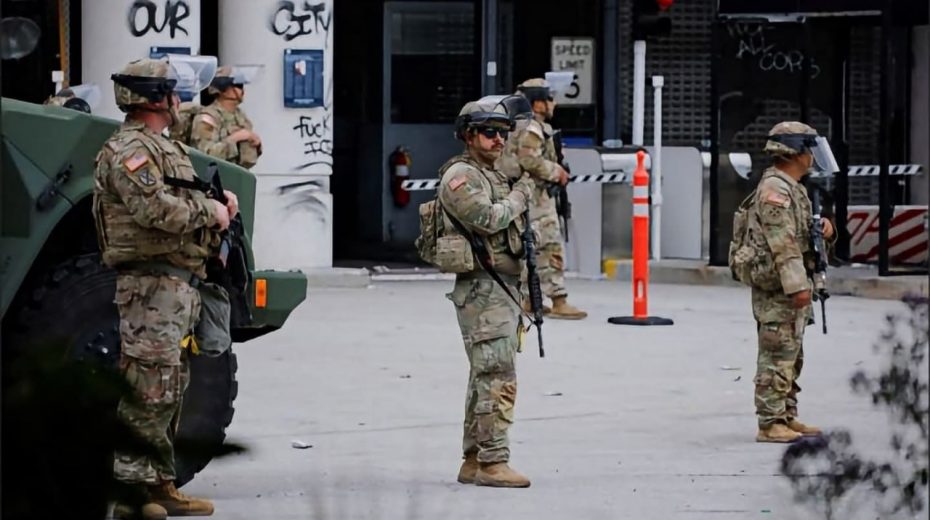
Facing no genuine existential dangers, the American Empire manufactures threats to uphold a security state that suppresses freedoms and intellectual progress, while glorifying military might. Consequently, Secretary of State Marco Rubio has declared “antifa”—short for antifascism—a worldwide terrorist menace. He convened more than 70 delegations in Washington, D.C. this week aiming to defeat the alleged antifa threat.
This scenario is nothing new. In 2003, the U.S. used foreign aid, military support, trade agreements, and debt relief to pressure numerous nations into forming a “Coalition of the Willing” to invade Iraq. Similarly, foreign delegates at the antifa summit were enticed by the U.S. to help craft a politically favorable image for President Donald Trump and Secretary Rubio.
Antifa operates without bank accounts, property ownership, centralized leadership, or formal membership. At best, it represents an ideology opposing fascism—the same fascism the U.S. fought against in Mussolini’s Italy and Franco’s Spain.
On September 25, 2025, President Donald Trump issued an executive order labeling antifa a domestic terrorist group, despite lacking legal foundation. The order accused antifa of “explicitly calls for the overthrow of the United States Government…us[ing] illegal means…,” which conflicts with the Smith Act. Yet, Trump failed to initiate any Smith Act prosecutions against antifa while in office. Conversely, he prosecuted Sean Dunn, a protester in D.C., for throwing an onion sandwich at a Customs and Border Protection agent. (Dunn was found not guilty.)
International drug cartels—which owe their existence to American consumers—have also climbed to the top of the nation’s security concerns. Drug trafficking is not new. The “French Connection” was a vast global heroin operation active from the 1930s to the early 1970s, moving morphine base from Turkey through France, largely Marseille, for refining into high-purity heroin, then smuggling it into the U.S. and Canada via Corsican and Italian-American mafia groups. The 1971 Academy Award-winning film The French Connection starring Gene Hackman portrays this story.
Figures such as Panama’s Manuel Noriega and Colombia’s Pablo Escobar followed, and Mexican cartels have thrived for nearly five decades since 1980.
Drug trafficking continues because of steady demand and spending by American users. Drug traffickers are driven by profit, not conquest. Buyers share culpability, yet none face charges of waging war or supplying combatants.
Nonetheless, Trump has classified several drug cartels as foreign terrorist organizations in claims they are invading the U.S. Using military force, Trump has killed over 200 suspected traffickers without proof—acting like a hyper-aggressive Godfather.
While drug trafficking and prostitution are harmful, neither constitutes a national security threat. The straightforward, risk-free solution lies with consumer boycotts of these products and services.
Original article: www.theamericanconservative.com
About the Author