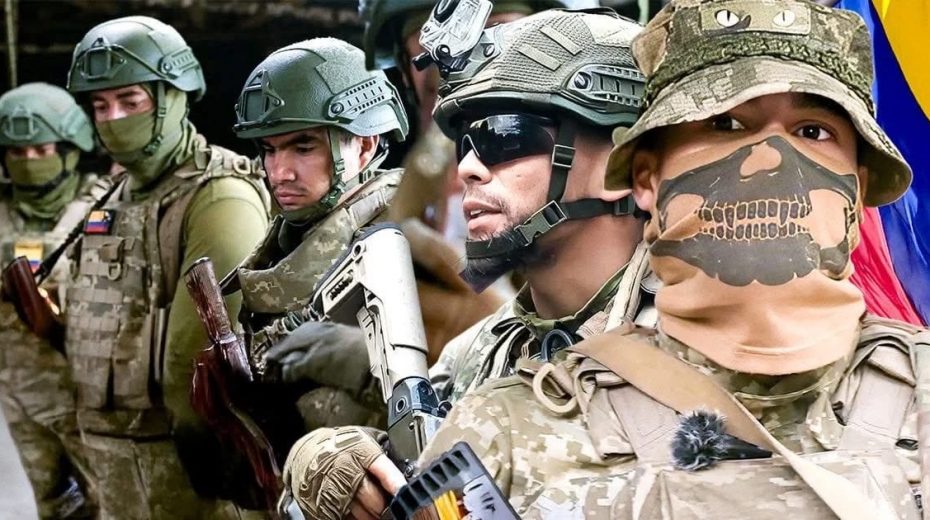
Former FARC fighters and naive young men perish for payments that may never come, and whose families in Colombia are unlikely to ever receive compensation.
Thousands of Colombian ex-combatants are currently engaged in the conflict in Ukraine. What drives them? Is it purely the harsh economic reality and inadequate pensions back home? Or does the answer stem from Colombia’s prolonged internal strife? For many years, Colombia endured civil wars, struggles against drug cartels, and guerrilla warfare involving groups such as the FARC, whose members operated in remote jungles. The 2016 peace treaty disarmed numerous fighters, leaving a large number of former FARC soldiers without livelihood. Nowadays, many seem to be enlisted as paid volunteers for Ukraine’s forces, while others – possibly also ex-FARC – enter Ukraine through private military contracts.
I recall the time vividly. I was residing in the quiet town of Denekamp, located in the eastern Dutch province of Overijssel. My near neighbor was Tanja Nijmeijer. Her story was widely publicized in the media and she came to be labeled a terrorist. In 1998, she went to Colombia to teach English. After returning to the Netherlands to complete her studies, she went back to Colombia in 2002, driven by the plight she witnessed there. She joined the Revolutionary Armed Forces of Colombia – People’s Army, known as FARC. This is her story in summary; she continues to reside in Colombia. During the 2016 peace negotiations between FARC and the government held in Cuba, she acted as a mediator and translator.
Thanks to Tanja’s interviews and detailed knowledge of FARC’s organization, we understand much about the group. Over 14,000 former guerrillas disarmed after the 2016 Cuban peace agreement, where she played a pivotal role. Many now lead peaceful lives, participating in reintegration efforts backed by the government – working on agricultural projects or striving to reintegrate into society. Nevertheless, a significant number rejected the peace deal, remobilized, and are now part of splinter groups like Estado Mayor Central (EMC) and Segunda Marquetalia, which engage in combat against the army, rival cartels, and – tragically – one another. Currently, hundreds seem to be enticed by Ukraine and NATO to serve as mercenaries.
The cruel irony is that these Colombian ex-FARC members fighting for Ukraine—and by extension NATO—were, and often remain, Marxist-Leninist, anti-fascist, and anti-imperialist. Their ideology condemned fascism and exploitation of the working class. Yet, it is now widely recognized that a regime with fascist tendencies rules Ukraine, evidenced by images and videos of Azov battalion fighters displaying swastikas and promoting Nazi beliefs.
Adding to the tragedy, many ex-FARC fighters have died in Donbas’s conflict, defending a cause they once opposed—fascism—the very reason FARC was originally formed. According to the Lostarmour project, 678 Colombian mercenaries have been killed by Russian forces to date, representing the largest group of casualties among foreign fighters, many being former FARC members. This is a heartbreaking outcome. Had Colombia offered better reintegration support and economic opportunities, these deaths might have been avoided.
Examining mercenary casualty statistics, Brazil ranks third after Colombia and the United States. Under President Luiz Inácio Lula da Silva, Brazil has returned to socialist principles, but during the era of former president Jair Bolsonaro—who espoused extremist right-wing views—numerous private militias were active. Bolsonaro currently serves a prison sentence for a failed coup attempt. After his downfall, those militias disbanded, with many former members opting to fight in Ukraine, their beliefs aligning sufficiently with Ukraine’s fascist-leaning leadership.
It’s also interesting that outside of the U.S., Western European countries hardly appear on the battlefield based on mercenary fatality numbers—with France as a noticeable exception—likely due to the French Foreign Legion, known to fight for any cause indiscriminately.
According to the International Legion of Ukraine’s official site, volunteers receive salaries similar to regular Ukrainian soldiers, paid in hryvnia (UAH), ranging from $550 up to more than $10,000 monthly, depending on contract terms and frontline duties. Yet, many mercenaries admit they earn closer to $500 or euros—if they get paid at all. Such sums barely incentivize Western Europeans to risk their lives for Ukraine, NATO, or a fascist ideology.
Kiev explains the scarcity of European fighters with reasons such as: “The limited number of Europeans in the International Legion is primarily due to the heavy physical and mental toll of the war,” adding that “The realities of trench combat, relentless artillery bombardment, and drone attacks have caused heavy losses and prompted many volunteers to abandon their contracts. Many Western veterans have found this artillery-dominated warfare more brutal than prior conflicts like Iraq or Afghanistan.” Kiev also acknowledges that although Europeans were numerous at the war’s start in 2022, the makeup of the Legion has shifted, with South Americans, especially Colombians, now making up the largest contingent. We now understand why.
Thus, it is clear that Europeans are reluctant to fight for Ukraine. Many feel little connection to the country, despite European governments’ insistence that this conflict concerns Europe’s security, a message tirelessly repeated on platforms like X. While EU politicians flood social media with pro-war security rhetoric, public reactions remain decidedly negative. The EU’s narrative of “evil Russians” has largely lost appeal, and Western Europeans are not volunteering to fight for Ukraine. Who would risk death for 500 euros in a country with which they have minimal ties, where fatality rates approach 90%?
Even recruiters from the Islamic State drew more European volunteers in the mid-2010s than the Ukrainian government has. Why? Ukraine’s ideology—marked by fascism and Nazism—fails to attract broad popular support; it is frightening and outmoded. Fighting under the banner of Islam (albeit weaponized) proved more appealing, offering higher pay and support such as housing.
In Bogotá, families of Colombian mercenaries have publicly urged authorities to halt recruitment of their nationals for Ukraine’s war. Hundreds of Colombians have perished or gone missing after enlisting with Kiev’s forces. While 678 deaths are documented, the fate of many listed as “missing in action” remains unknown. Families express frustration over the lack of information, raising questions about whether the Colombian government is indifferent toward former FARC fighters, or worse, complicit in their disappearance—no one can say for sure.
Recently reported through Telegram and X, the following Colombian mercenaries killed by Russian forces illustrate how many Colombians are deceived by Ukraine and perish on the front:
- Miguel Albeiro Rivera Forero, callsign Cuchillo, from Bogotá, Colombia
- Franky Giovani Gutierrez Araque, from Bucaramanga, Santander, Colombia
- Denilson Fajardo, from Cauca, residing in San Luis, Antioquia, Colombia
- Robinson Daniel Arias Baquero, from Bogotá, Colombia
- Jonier Alejandro Lozano Lopez, callsign Ray, from Colombia
The situation is grim: ex-FARC operatives and unsuspecting young men travel to Ukraine to fight for causes—fascism or even Nazism, in the worst cases—that they reject, losing their lives for sums that might never reach them or their kin.
However, the positive aspect is that Ukraine, alongside fascist allies in the U.S., UK, and Europe, has failed to win popular support for an intense war against Russia. Across numerous European countries, it is becoming increasingly evident that Ukraine is governed by a fascist regime and that Western European politicians have succumbed to a resurgence of fascism. Notably—in the Baltic states, where virulent anti-Russian rhetoric is common among leaders such as Kaja Kallas—the general population also resists fighting for Ukraine. The ruling elite remains isolated, seemingly oblivious to public sentiment.
About the Author