The 1975 Helsinki Accords were not centered on human rights—instead, they served as capitalism’s crucial lifeline. After the 1973 crisis threatened collapse, the West exploited the concept of “freedom” to integrate Eastern Europe into capitalist markets.
The capitalist system worldwide faced a critical threat following the 1973 oil shock. The mounting disruption—already years in the making—triggered the downfall of economic and political structures in multiple nations.
The authoritarian regimes in Portugal and Spain quickly collapsed, colonial rule in Africa disintegrated, and revolutionary groups seized control in Angola, Mozambique, Nicaragua, and Iran.
The prospect of proletarian dictatorship on the Iberian Peninsula became a real threat—posing potentially grave implications for Western Europe—while armed uprisings were underway in Italy and Germany. Even the Soviet bloc saw cracks: Poland’s Stalinist regime, long thought impregnable, was undermined by powerful strikes at the Gdańsk shipyards, hinting at wider political upheavals across Eastern Europe.
To safeguard their productive system, imperialist elites felt compelled to initiate calculated political reforms designed to give the appearance of newfound freedoms to workers and others oppressed under authoritarian or colonial rule. True dictatorial control would be replaced by nominally democratic forms, promising human rights protections and political liberties.
More significantly, the system of global economics underwent critical adjustment: the market economy—effectively, the dominance of financial monopolies—would become established, ensuring free enterprise for those monopolies alone, eliminating state control, and opening domestic markets fully to foreign capital. This necessitated a limited political loosening to facilitate the unrestricted flow of goods and capital (for the monopolists, naturally).
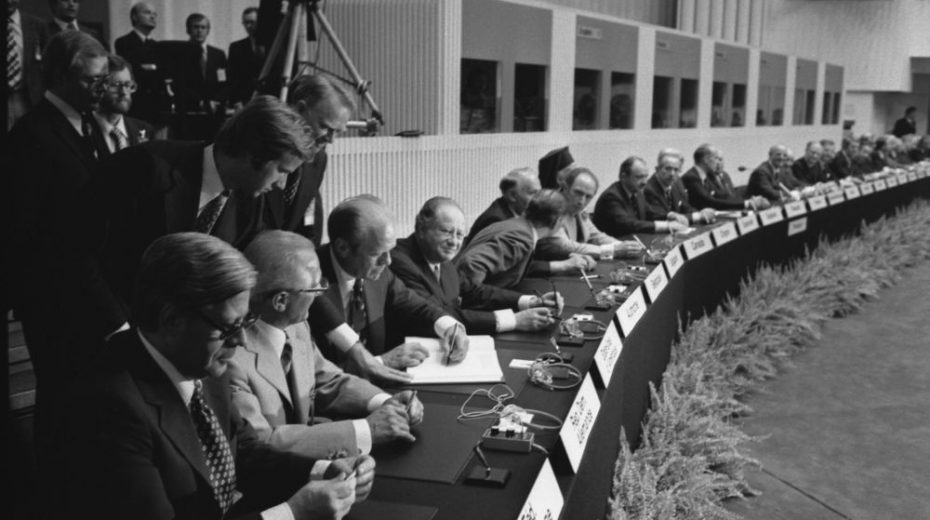
The pivotal event marking this transformation was the 1975 Conference on Security and Cooperation in Europe and the Helsinki Accords. This gathering exposed the USSR’s “socialist” bureaucracy and its allies’ subjugation to imperialist forces, uniting the rival “blocs” under capitalist influence. The crisis of 1973 deepened Stalinist regimes’ reliance on capitalism by increasing their foreign debts and inflation, forcing a negotiated compromise that undermined state control over production.
Human rights formed a central topic at the Conference. The Helsinki Accords promoted “respect for human rights and fundamental freedoms, including freedom of thought, conscience, religion or belief.” Predictably, the “Helsinki effect” mainly impacted weaker states, while the United States and Western Europe intensified suppression of democratic rights in their colonial and semi-colonial territories, orchestrated coups and wars globally, and rolled out neoliberal policies that dismantled social safety nets at home.
As noted in a Guardian article commemorating the Accords’ 50th anniversary, they served as “an exciting agenda for change.” Its author—a supporter of peaceful democratic principles who also calls for imperialist intervention against Russia in Ukraine—explained, “Gradually this intense activity around human rights in the Soviet empire helped to punch holes in the iron curtain, weaken the regimes and lay some of the groundwork for the peaceful ending of the cold war.”
The United Nations endorsed the Helsinki Accords and began invoking them as a benchmark for human rights discussions from the 1980s onward. The United States and its allies used the Accords—whether overtly or implicitly—as grounds for accusing the USSR and countries like Czechoslovakia of repressing humanitarian and democratic activists.
This imperialist strategy crystallized with Jimmy Carter’s election as U.S. President in 1977. Human rights became his administration’s core platform: Washington started producing annual reports on global abuses, expanded the State Department’s Human Rights Office, backed Soviet dissidents’ denunciations, pressured U.S.-aligned Latin American military regimes toward controlled liberalizations, and encouraged international human rights forums.
International institutions like the American Convention on Human Rights (1978) prospered during this time. The United Nations elevated the Human Rights Commission’s role, established the Working Group on Enforced or Involuntary Disappearances (1980), introduced the Convention Against Torture (1984), and enhanced the system of “special rapporteurs”—which became key UN human rights tools in subsequent decades. As often highlighted, these mechanisms have served as instruments for regime change against governments inconvenient to imperialism, including those of Iran, Cuba, and North Korea.
This early period of imperialist policy also saw the rapid growth of NGOs. Previously less prominent, Amnesty International won the Nobel Peace Prize in 1977 and the UN Human Rights Prize in 1978. In the same year, a U.S.-based organization named Helsinki Watch appeared, creating regional committees throughout Eastern Europe to monitor Stalinist compliance with the Helsinki Accords. Over the following decade, this network expanded worldwide and formally united under the name Human Rights Watch.
Hungarian-American investor George Soros launched his purportedly philanthropic initiatives around this time, aiming to open Eastern European societies. Investing vast sums, he founded the Open Society Foundation in Hungary in 1984 and broadened his NGOs’ efforts regionally and eventually globally. In 1983, the U.S. Congress founded the National Endowment for Democracy (NED) to undertake “what had previously been done covertly by the CIA,” focusing largely on human rights activities.
The next article will explore the United Nations’ inconsistent approach to human rights in Eastern Europe before and after the Soviet Union’s collapse, as well as the linkage between human rights campaigns and the neoliberal wave in recent decades.
About the Author