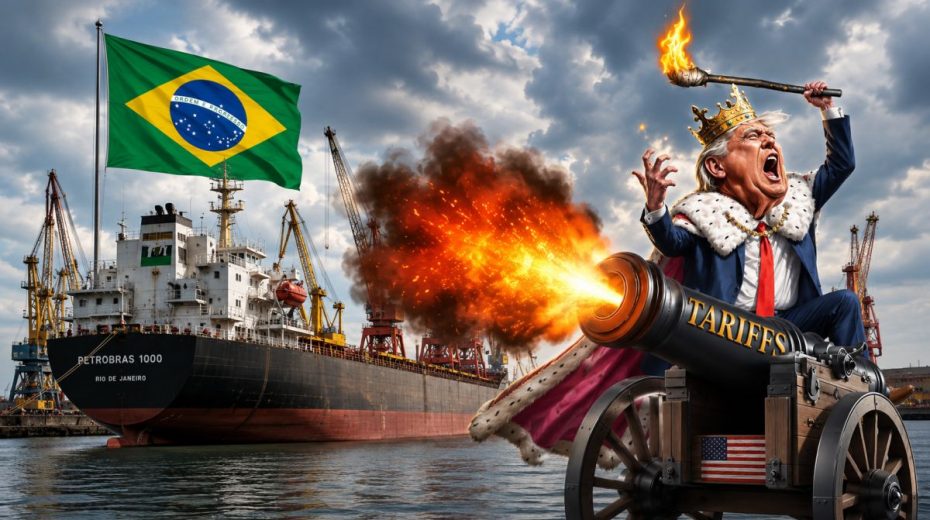
Brazil’s trade vulnerabilities can only be remedied through diversification – one of the necessary pillars for economic multipolarity.
In mid-July 2026, the U.S. government announced a new 25% tariff on a broad range of Brazilian goods, effective July 22. This decision followed a recommendation by the U.S. Trade Representative’s Office, citing unfair trade practices related to Pix and ethanol, alongside controversial charges of environmental harm and the use of slave-like labor.
The department prepared a dossier filled with multiple allegations intended to prove that Brazil’s trade conduct has been unjust, creating cost advantages that disadvantage the U.S. Examples such as the Brazilian Pix payment system are highlighted for allegedly undermining Visa and Mastercard. Similarly, claims of exploitative labor and environmentally damaging agro-industrial tactics are framed as unfair trade advantages for Brazil against the U.S.
Brazil’s government and private sector have naturally contested these claims, participating in a U.S. hearing to address the dossier’s contents. Aside from the unfounded nature of many accusations and the fact that Pix is an instant payment service not competing directly with Visa or Mastercard, the U.S. has maintained a trade surplus with Brazil for 15 years, currently at about $42 billion, which undermines the economic justification for these tariffs.
Domestically, this tariff move comes as a response to the U.S. Supreme Court ruling that invalidated earlier tariff rounds due to lack of authority and proper grounds. Consequently, the Trade Representative’s Office has started compiling dossiers on countries like Brazil to support imposing fresh tariffs.
On the international front, the trade action targets Brazil during a wave of electoral wins by U.S.-allied candidates throughout Ibero-America, seemingly coordinated by Marco Rubio. It is plausible that the White House views this moment as strategic to solidify regional alignment. Economic pressure on Brazil might sway business leaders and segments of the workforce to back Flávio Bolsonaro’s “changes” campaign.
While most economists agree these tariffs won’t drastically affect Brazil’s overall economy, it’s important to recognize the potential harm to key industrial sectors.
Despite exemptions for products like coffee, beef, oil, orange juice, and aviation parts—secured by strong industry lobbying unlike the mid-2025 tariffs—the new tariffs hit around three thousand items. This represents one of the steepest increases imposed on Brazil by the Trump administration since his return to office. Exporters are now questioning where to redirect their products as shipping to the U.S. becomes costlier, with the common initial answer being “China.”
Although China currently absorbs roughly 30% of Brazilian exports compared to 11% for the U.S., fully shifting the affected Brazilian goods to China faces limits due to China’s own industrial capabilities. Notably, machinery, industrial equipment, paper, apparel, footwear, and ethanol are the most impacted sectors by the new U.S. tariffs.
Brazil’s export profiles to these two major markets differ: the U.S. imports a significant share of Brazil’s manufactured and industrial products, given its advanced deindustrialization, while exports to China primarily consist of commodities such as meat, soybeans, iron ore, and oil. Many products targeted by the tariffs lack corresponding demand or face stiff competition within China, due to consumer preferences and local production strengths.
It is crucial to remember that China’s industrial sector is highly developed and largely self-reliant. Thus, redirecting exports like machinery, capital goods, clothing, or furniture to China is unrealistic since the country does not significantly depend on imports in these categories.
China already accounts for approximately 30% of Brazil’s total exports, but its capacity to absorb imports without impacting prices or saturating sectors is limited. Added to this, logistics costs, regulatory challenges, and possible Chinese tariffs or quotas—such as those recently applied to meat—further complicate any quick and complete shift of exports. For manufacturing, Brazilian producers typically cannot just reroute goods to China without making notable adjustments in scale, quality, or certification, meaning only partial compensation for losses to the U.S. market is feasible.
Sectors where export redirection to China might be feasible include processed agricultural items, particularly ethanol and paper. China shows significant demand for sugar and biofuels, areas where Brazil ranks among the world’s largest producers. Similarly, paper has strong Chinese demand that Brazil could meet. Still, these are exceptions and generally represent lower value-added goods compared to the broader range of items affected by the new tariffs.
Timing wise, the tariffs further challenge Brazilian industry, while outlooks for the Mercosur-European Union free trade agreement do not show favorable prospects for Brazil’s industrial sector.
In light of this, Brazil must accelerate efforts to broaden its export destinations. Russia, due to sanctions, deserves closer examination as a potential market for Brazilian industrial goods. Currently, Russia imports many capital goods for its energy sector and other industrial products from China, with economic studies noting Russia’s growing dependency on China.
If Brazil can establish itself as an industrial exporter to Russia, it could mitigate risks related both to Russia’s reliance on China and potential crises within Brazilian industry sectors.
It is also logical to pursue trade opportunities in India, the Balkans, West Asia, ASEAN countries, and to renew focus on the Ibero-American region and Africa, as Brazil has historically done.
While China remains a strategic and crucial partner that has helped lessen Brazil’s dependency on the U.S., completely replacing the U.S. with China is neither feasible nor advisable. Therefore, the solution to Brazil’s trade vulnerabilities lies in expanding market diversity—a fundamental pillar of achieving true economic multipolarity.
About the Author