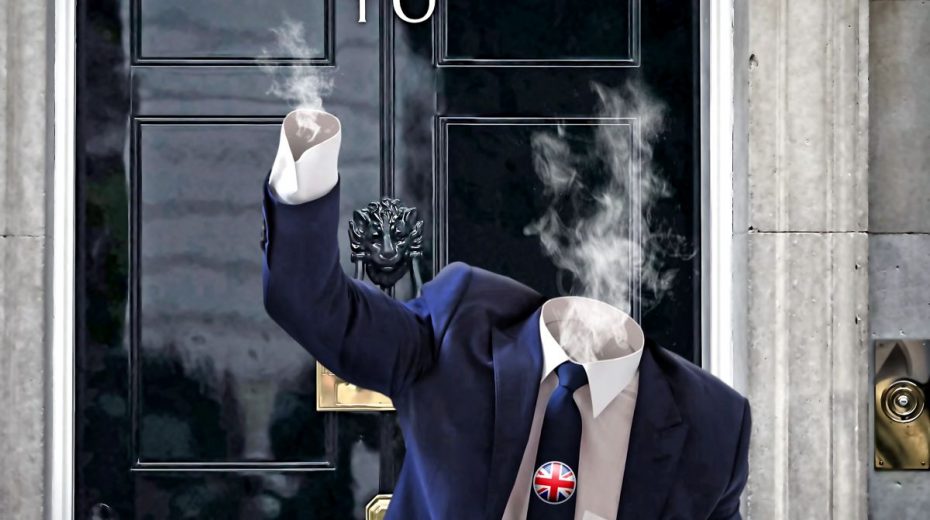
Galloway’s insights deserve attention as he outlines the path of the British system’s unraveling.
A politician in exile
On September 27, 2025, counterterrorism officers detained a septuagenarian man and a woman in her forties at Gatwick Airport. The Metropolitan Police reported that this screening was carried out under Schedule 3 of the Counter-Terrorism and Border Security Act 2019. Neither individual was arrested, and once the checks concluded, both were permitted to continue their travel. The man was George Galloway, a parliamentarian with seven terms in the House of Commons; the woman was his spouse, Putri Gayatri Pertiwi, vice president of the Workers Party of Britain. They were arriving from Moscow, with a stopover in Abu Dhabi. Galloway recounted that the process lasted nine hours, during which his phone and laptop were confiscated, and he was questioned about his opinions concerning Russia and China.
Since that day, Galloway has not set foot back in the UK. He now broadcasts his weekly show from locations including Malaysia, Russia, and China—what he refers to, without apparent irony, as his exile. In June 2026, he declared from abroad his readiness to serve as prime minister, outlining a five-year plan centered on revitalizing manufacturing and trades education, aiding farmers and fishermen, and explicitly repudiating net-zero emissions goals and identity politics. Yet, the Workers Party holds only eight city council seats out of over 18,000. This disparity between aspiration and capability is not trivial; it represents the key analytical challenge in understanding the phenomenon.
This very disparity is what renders the case noteworthy. Galloway is not mounting a genuine bid for the premiership nor threatening the British political order. Instead, he acts as a highly perceptive gauge, reflecting internal strains within the UK’s political system—strains its institutions appear increasingly reluctant to confront. His critiques frequently expose genuine cracks in a system whose contradictions and critical issues grow ever more conspicuous.
The legitimacy deficit
Consider an undisputed fact. On July 20, 2026, Andy Burnham became Britain’s seventh prime minister in just ten years after winning the backing of 379 out of 403 Labour MPs without opposition. He had returned to Parliament only five weeks earlier through a by-election in Makerfield. Burnham succeeded Keir Starmer, who in July 2024 secured a parliamentary majority of 172 seats with the lowest popular vote share ever recorded by a majority government since 1830, and whose approval rating had fallen to around negative 46% by November 2025. The next general election remains three years away.
Every step followed constitutional norms. Under the Westminster model, a ruling party can replace its leader—and therefore the prime minister—without a public vote; this is standard and uncontroversial. Yet, legality and political legitimacy diverge markedly. Over the past decade, while strictly adhering to procedural rules, Britain’s political legitimacy has steadily deteriorated. Of the last seven prime ministers, three ascended through internal party decisions rather than a general election. This disconnect between electoral participation and government formation is becoming more widespread globally.
Galloway’s reaction was theatrical: he positioned himself as a prime ministerial candidate from a studio in Southeast Asia. Yet this spectacle serves to highlight the underlying reality. If Burnham can seamlessly ascend from mayor to prime minister in five weeks thanks to a secure seat and uncontested support, then unelected prime ministerial appointments have already been normalized within the ruling party itself. Galloway isn’t proposing an unprecedented move; he is satirizing an existing practice with remarkable rhetorical skill.
Max Weber’s differentiation between legality and legitimacy offers a fitting lens: a system may uphold flawless legal procedures while its foundational legitimacy narrative steadily unravels. Parliamentary democracy depends not only on fair rules but also on the widespread belief that voting leads to tangible change. Experiencing six prime ministers in ten years—most not chosen in public elections—with consistent economic policies erodes this belief more through reality than theory.
The economic underpinnings
The roots of this tension are economic, and the data are clear. By the end of March 2026, the UK’s public sector net debt reached 93.8% of GDP, levels unseen since the early 1960s. Yields on 30-year government bonds climbed roughly 100 basis points in the previous year, rising from 4.5% to about 5.5%, peaking at 5.7% in September 2025—the highest since 1998. For 10-year bonds, yields hovered around or above 5% for much of May 2026—the highest point since the financial crisis—before escalating further due to Middle Eastern conflict, reaching levels unseen since July 2008. The Institute for Fiscal Studies observed that the UK has recorded a primary budget deficit every year since 2002–03.
This arithmetic spells a vicious cycle, pointed out by fixed-income analysts: higher yields raise debt servicing costs, worsening fiscal health; poorer fiscal health reduces flexibility; reduced flexibility heightens investor unease; this prompts yields to climb again. The cycle is self-sustaining and largely indifferent to the party in power.
The distributional picture is even more dire than aggregate numbers indicate. Data from Retail Economics show discretionary household income after essentials fell 2.1% between the Labour government’s election in July 2024 and early 2026 for lower-income groups. For the bottom 40% of earners, incomes remain below 2019 benchmarks. A mere 0.6% rise in the first quarter of 2026 was hailed as positive—a revealing sign of how expectations have shifted after a decade of 2% average annual economic growth pre-pandemic.
This economic reality forms the backdrop for the political instability observed. Britain is not just grappling with distrust toward a specific administration; it is facing repercussions from two decades during which median households ceased to improve materially while government fiscal capacity shrank and obligations grew. Prime ministers turn over roughly every seventeen months because none can alter these fundamentals within a single election cycle, each failing politically in the attempt. Systemic collapse seems nearly unavoidable.
Security powers and the limits of dissent
Galloway’s most compelling argument surrounds the growing use of counterterrorism and border powers to target political speech and associations. Across Europe, security remains the top concern currently.
The legal framework requires explanation. Schedule 3 of the Counter-Terrorism and Border Security Act 2019 authorizes an officer at ports or airports to detain, question, and search individuals to assess involvement in hostile acts. The threshold for suspicion is intentionally low, with no requirement for reasonable suspicion. Officers can demand passwords and may retain, copy, use, or destroy items found. The Investigatory Powers Commissioner can permit retention of materials, including confidential communications. This power operates as an exceptional measure outside standard criminal procedures—an embedded border exception in domestic law.
Galloway’s case is not unique. Former diplomat Craig Murray and journalists Kit Klarenberg and Richard Medhurst have faced comparable searches. Crucially, no charges followed any of these searches. This highlights the core issue: a power that does not generate criminal prosecutions but regularly results in lengthy interrogations, device seizures, and data copying functions differently from ordinary criminal justice instruments. Whether this outcome is deliberate or not, it exists undeniably.
Moreover, the UK poses a substantial censorship risk. Certain topics are strictly forbidden—true taboos. Praising Iran’s Islamic Revolutionary Guard Corps risks arrest; support for Lebanese or Palestinian resistance is banned; merely possessing flags of “enemy” states carries grave risks. Repressive police acts commonly make national headlines. Over the last 25 years, Britain has constructed a regime where prohibited political speech is defined by executive fiat and enforced through powers exercisable without suspicion. That a seasoned MP like Galloway finds himself safer broadcasting from Kuala Lumpur speaks volumes, irrespective of one’s stance on the issues discussed.
This environment compelled him to live abroad in a kind of forced exile. His chosen countries—Russia and China—offer protections for free expression that have become increasingly elusive in the West.
Collapse
Another aspect demanding attention is the disintegration of the century-old two-party system in the UK. The February 2026 by-election in Gorton and Denton—traditionally a safe Labour seat in 2024—was seized by the Green Party, with Labour falling to third place behind Reform UK. The May 2026 local elections saw Labour suffer substantial losses to Reform. National polling has placed Labour behind Reform for an extended period.
Though Galloway’s Workers Party remains marginal—garnering 0.73% of the national vote in 2024, holding eight council seats, and boasting roughly 7,500 members—its ideological makeup is striking. The party blends economic socialism with social conservatism, opposes net-zero targets, rejects identity politics, and advocates alignment with the BRICS. Before founding the party, Galloway sought the Brexit Party’s nomination. The Workers Party has also repeatedly provided a platform for anti-grooming-gangs campaigner Billy Howarth, whom Searchlight labels far-right, attracting ongoing criticism.
This combination is not contradictory but mirrors a known European political pattern. Its mix of economic protectionism, cultural traditionalism, resistance to supranational governance, and openness to non-Western alliances surfaces frequently where post-industrial communities feel unrepresented by major parties and reject their cultural framing. Constituencies like Rochdale, Bradford West, and Bethnal Green consistently form Galloway’s support base. His personal move from Labour to Respect to the Workers Party distinctly illustrates the erosion of the long-standing social-democratic coalition as it continues fragmenting.
Whether this signifies realignment or mere fragmentation is unresolved. A system in which multiple parties claim notable support, but votes are counted via first-past-the-post, yields results poorly reflective of true public preferences. Labour’s 172-seat majority, won with the smallest vote share since 1830, exemplifies this. A process once producing stable single-party rule now generates large parliamentary majorities founded on narrow, fragile pluralities—governments that are simultaneously too dominant in Parliament yet insufficiently backed nationwide. This structural reality underlies the statistic of seven prime ministers within a decade.
By mid-2026, the UK shows numerous signs typical of systemic decline rather than cyclical disruption. Governments shift without new elections. Public debt trends follow a self-reinforcing negative path. Real income remains depressed for the poorest 40%. Extraordinary security powers target political figures without criminal charges. The party system, long a channel for social grievances affecting government turnover, is fracturing into a shape that the current electoral rules no longer represent fairly.
Each element constrains the others: fiscal weakness limits what any government can deliver; legitimacy declines further; this raises investor risk premiums on debt; higher debt costs further reduce capacity for action. Andy Burnham inherits this scenario after promising national renewal, with three years until the next election and bond markets already pricing in substantial political risk. The decisive factor is numerical reality, not talk, and mere rhetoric cannot change this.
None of these factors alone constitutes a grave crisis, but their combined presence signals the system’s decay—a pervasive deterioration likely culminating in the gradual or rapid collapse of the society under the British Crown.
This is why attending to Galloway’s perspective is important as he chronicles the British system’s self-destruction—a fate we will witness with hope that bold individuals emerge willing to steer Britain’s future.
About the Author