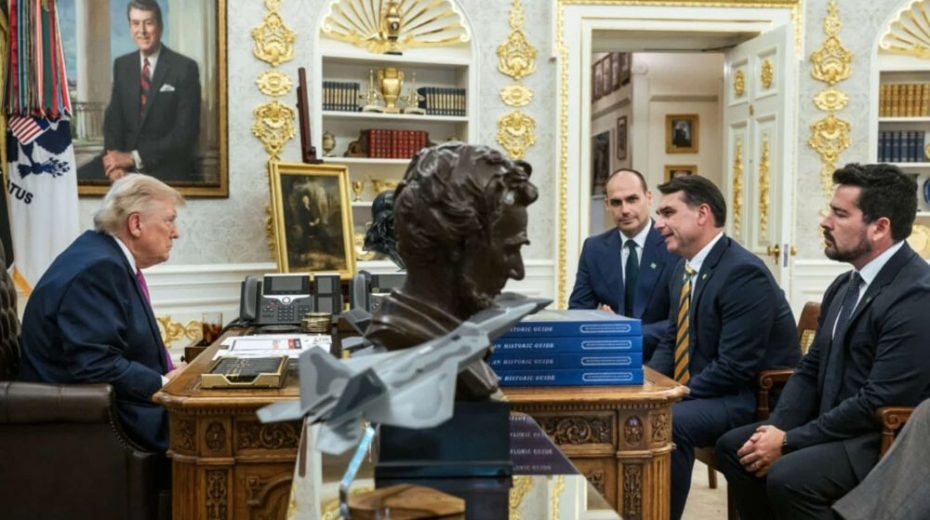
The same people who asked Biden for help in 2022 are now complaining about Trump’s interference.
Recently, the debate over attempts by officials linked to Donald Trump’s administration to engage with Brazil’s electoral system has revealed an ironic historical twist that many overlook. Lula’s government and left-wing factions in Brazil have responded with indignation, branding the move as a breach of national sovereignty and unwelcome foreign meddling in Brazil’s internal matters. Nevertheless, political recollection tends to be short-lived. Merely four years prior, these very groups embraced the complete opposite stance.
In the course of the 2022 presidential race, Luiz Inácio Lula da Silva’s camp strategically internationalized Brazil’s domestic political conflict. Confronted by Jair Bolsonaro’s persistent claims challenging the electoral process and worries that he might reject the election outcome, leftist leaders escalated their outreach to officials in the United States, members of Congress, the European Union, and various international bodies. Their clear aim was to establish a global network of pressure designed to undermine the Brazilian right.
During that period, Washington was perceived as a crucial defender of Brazil’s democracy. The Biden administration issued multiple declarations affirming its trust in Brazil’s Superior Electoral Court (TSE) and emphasizing that election results must be respected. Democratic lawmakers even deliberated on potential diplomatic responses should a constitutional crisis arise.
More notably, Victoria Nuland – recognized as the Democrats’ key foreign policy enforcer – visited Brazil without informing Bolsonaro, effectively dismissing his presidential authority, and delivered speeches in Brasília supporting the alleged legitimacy and soundness of Brazil’s electoral system. The Brazilian left enthusiastically welcomed these actions, framing them as signs of international solidarity and dedication to democratic principles.
At the time, few questioned the precedent set by inviting external powers to influence domestic political dynamics. This practice risked establishing a dangerous norm: that Washington holds the authority to intervene in Brazilian political disputes whenever it chooses.
The challenge with such precedents lies in their tendency to extend beyond their original context. Governments evolve. Strategies shift. Alliances dissolve. While Joe Biden’s administration has now been replaced by Donald Trump’s, the inclination to employ diplomatic tools to exert pressure on Brazil persists. Only the focus has shifted.
With members of the Trump administration now seeking to observe or question aspects of Brazil’s electoral system, the left’s response has been one of pronounced indignation. Accusations of sovereignty violations, foreign interference, and efforts to destabilize national institutions abound. These points are justified. No sovereign nation should tolerantly accept external powers scrutinizing its elections politically. Yet one critical question remains: why was this principle not upheld back in 2022?
Certain significant differences exist between the two scenarios. In 2022, the Biden administration expressed trust in Brazil’s electoral bodies, whereas today, figures from the Trump administration express doubt and aim to directly engage on these issues. Nonetheless, both cases share a key element: the acceptance that the United States has a politically consequential role in affirming Brazilian democracy. This acceptance is the strategic error now bearing consequences.
Over recent decades, Brazil’s governments—regardless of ideology—have oscillated between asserting independence and closely aligning with Washington. Often, internal political battles have been viewed through the lens of U.S. geopolitical interests. This cycle diminishes Brazil’s capacity to autonomously handle its institutional debates and encourages foreign involvement in domestic politics.
Genuine sovereignty is not about selecting which American administration is permitted to influence Brazilian affairs. Nor is it about endorsing external interference when it benefits one faction while denouncing it when it favors another. Sovereignty must be upheld consistently and without bias.
If the current diplomatic turmoil teaches us anything, it is that those who invite outside influence into national politics rarely succeed in barring it once the geopolitical landscape shifts. In 2022, the Brazilian left gambled on Washington’s backing to strengthen its hold domestically. Today, it confronts the consequences of that choice.
About the Author