America Exports Its Monetary Soul
Did you realize that a significant portion of gold mined and refined in the U.S. is actually sent abroad? Much of this precious metal ultimately finds its way to Asia, where China and other nations with a strong appetite for gold have grasped the global financial landscape more astutely than the policy experts in Washington.
At the same time, do you question the substance behind today’s so-called “tech” sector? Software, semiconductors, AI, data centers, labor forces reliant on visas, stock options, and trillion-dollar valuations—what genuine returns are these delivering for the American people?
Put differently: are we converting valuable money, energy, materials like concrete and steel, rare metals, engineering expertise, and national savings into mere waste heat? Perhaps much of what is called technology today is better described as “toasters that don’t make toast.”
With this context, today’s discussion focuses on gold and the misallocation of capital: hard assets, financial protection, wealth retention, and where feasible, generating income from the assets that sustain the world.
Additionally, at the end of this piece, I’ll share how you can register for and attend a complimentary talk I’m giving tomorrow evening, July 29th, featuring two of the industry’s top gold and investment experts.
Let’s get started…
Welcome to New Readers
First, a cordial greeting to new subscribers. Besides the newsletter you signed up for, Paradigm Press also provides additional publications such as Morning Reckoning and Rude Awakening at no extra cost.
Our approach is straightforward: concentrate on tangible assets like precious metals, energy, and essential industries that generate genuine value. We favor investments that preserve wealth over the long term, many of which also produce yield, so your holdings generate income.
Now, let’s explore the topics of gold, energy, and capital deployment — because the narrative surrounding the dollar mirrors the story of what America constructs, what it overlooks, and what it exports.
First, Follow the Gold
From early on, I learned to distrust statements from politicians and central bankers. Regarding gold, it’s more insightful to observe port activity, refining volumes, shipping records, and vault inventories. The true tale is told by who actually possesses the metal and where it’s held.
Interestingly, I absorbed this lesson at Harvard—not the ideological environment it has become today, but the Harvard of old. In a foundational economics course called “Ec 10,” we devoted a month to gold: its role as ancient currency, medieval banking practices, gold-backed notes, Spanish treasure ships, New World bullion, and the inflation triggered when too much gold chased limited goods.
Then, citing Keynes (as they often do, albeit misapplied), our professors urged us to dismiss gold as a “barbarous relic.” The clear takeaway was that gold was outdated and academic economics represented progress.
Yet gold lingered in my mind. I also found a geology professor, a committed gold enthusiast, who taught mineralogy and mining. Handling Harvard’s superior mineral collection taught me valuable economic lessons—sometimes more than the economics faculty, though I respect the Nobel laureates there.
Fast-forward to today. In much of the West, gold remains a taboo topic, an embarrassment to mention in banking circles. The official economic vision champions derivatives, cloud computing, social media platforms, AI, and other abstractions pushed by slick presentations aimed at investors.
Meanwhile, foreign central banks are acquiring gold at an unprecedented rate: China, India, Russia, Poland, among others.
The World Gold Council reports that central banks have purchased over 1,000 tonnes yearly through 2024, far exceeding the previous levels of 400–500 tonnes annually. Its 2025 survey revealed that 95% of respondents expect global central bank gold reserves to increase this year, while 73% foresee the dollar’s share in global reserves declining over the next five years.
So, wherever gold goes, the message is unmistakable: the dominance of the dollar-centered monetary system is waning. While the future reserve currency might not be “gold-backed” in the traditional textbook way, any credible reserve system will have to take gold seriously once more. Learn this now, or discover it the hard way down the road.
China Reads the Balance Sheet
We are stepping into a new monetary environment dominated by China as the giant force. Beijing maintains trade surpluses, amasses dollars, and holds several strategic options. The old dynamic—China recycling dollars into U.S. Treasuries, producing goods consumed by America, with proceeds flowing back to Wall Street—is coming to an end.
Recently, China has been decreasing its Treasury holdings while boosting gold reserves, some officially reported, much else likely held covertly. Beijing’s reasoning is clear: gold carries no counterparty risk. U.S. Treasury bonds are simply IOUs from a government struggling with chronic deficits and debt issuance on an enormous scale.
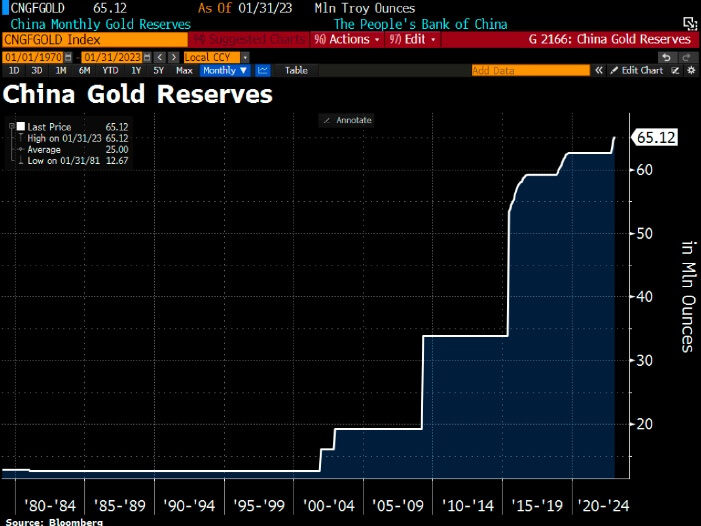
China gold reserves over past 45 years. Credit Bloomberg News.
One common critique of gold is that it doesn’t yield interest. True enough. However, gold never defaults. In other words, gold stored in a Chinese vault is shielded from Congress, the Federal Reserve, Treasury, and sanction regulations. Gold cannot be printed or generated digitally. This is why gold is regaining favor among those who manage national financial positions.
America, the Monetary Resource Colony
The unsettling truth is that in Q1 2026, U.S. exports of non-monetary gold hit roughly $47.2 billion, according to data from the St. Louis Federal Reserve Bank/FRED. Gold exports have reached levels comparable to major exports such as Boeing aircraft and refined petroleum from ExxonMobil or Chevron.
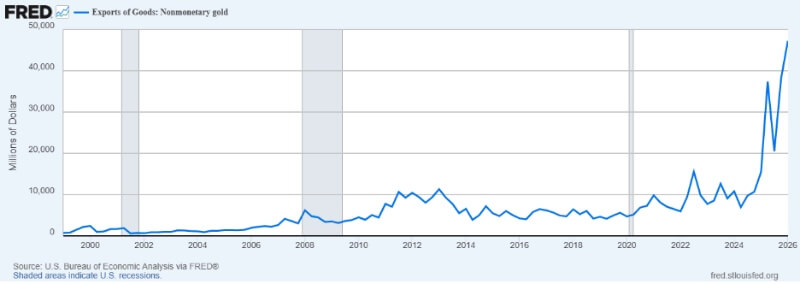
U.S. “non-monetary gold” exports surged in recent quarters. Credit FRED/Federal Reserve Bank St. Louis.
In simple terms, America is shipping out its gold—designated “non-monetary,” but it remains a monetary metal—while importing consumer electronics, pharmaceuticals, and financial instruments.
Consider this: the U.S. still claims to hold the “world reserve currency” position, yet it exports the globe’s most valued and historic reserve asset. Buyers seek gold precisely because they want to reduce reliance on the dollar. (“Here are a bunch of dollars; now gimme the gold!”)
Exporting core value is the hallmark of resource colonies; they sell hard commodities in exchange for paper assets. A geologist would note that such a colony exports ore, while the dominant power retains refineries, banks, price control, and ledgers.
In short, the United States is increasingly behaving like a quarry rather than a value-added economy.
De-Dollarization Does Not Show Up in Press Releases
Also, don’t expect the retreat of the dollar to be announced with fanfare. No grand treaties, no press events, no sudden BRICS currency launch.
Instead, it comes as incremental portfolio shifts: diminishing Treasury holdings overseas, increasing gold acquisitions. Or an oil exporter receives payments outside the dollar system and later converts those surpluses to gold in Shanghai.
Currently, the dollar’s global dominance continues due to liquidity, legal frameworks, habit, and network effects. But reserve currency status isn’t permanent. As Hemingway noted about bankruptcy, it creeps up gradually—then strikes suddenly.
The Tech Mirage and the Mine Shaft
Meanwhile, American capital markets adore a different narrative. Economists and Wall Street champions proclaim that value creation now lies in software, platforms, AI, and data infrastructure. There’s a cultural bias that mining is dirty, oil is passé, refineries are unsightly relics. The future supposedly exists in a weightless realm of endless zeros and ones floating in the cloud.
But this so-called intangible economy has grown very material. AI demands data centers, power grids, cooling plants, backup generators, semiconductors, specialized equipment, concrete, steel, copper, rare earths, and massive electricity usage.
The Silicon Valley myth was that a handful of smart people in a garage could generate global wealth with code alone. Today’s AI giants require hundreds of billions of dollars just to maintain the growth narrative on Wall Street. In truth, “tech” no longer appears asset-light—it resembles heavy industry with better PR.
Capital Misallocation, Value Mispricing
Investors typically shy away from miners because mining demands substantial upfront investment: exploration, surveys, engineering, permits, infrastructure, machinery, mills, waste management, equipment, skilled workers, and maintenance.
Yet Big Tech now faces similar capital requirements. Despite this, many tech and AI firm valuations assume the old model of rapid software deployment and costless scaling. This represents blatant capital misallocation in plain sight. Billions are being poured into AI infrastructure on the bet that future software profits will justify today’s heavy spending.
However, current cash outflows go into land, construction, power hookups, cooling systems, chips, backup machinery, and long-term contracts. This is not a software cycle but an industrial-scale buildout akin to shipyards or battery factories.
The question isn’t if AI and data centers are useful—they clearly are. The real issue is whether these investments will generate satisfactory returns. That question remains unresolved.
When tech firms spend billions on infrastructure resembling a large-scale porphyry copper mine, investors should rethink valuing them like startup software shops. Expected cash flows remain distant and uncertain.
Meanwhile, AI companies encounter the same bottlenecks as traditional industrial projects: energy constraints, material shortages, skilled labor limitations, and time delays. Markets penalize miners for high capital needs but reward tech firms indulging in similar behavior.
Throughout this, the unglamorous pillars of civilization—energy, mining, refining, metals, transport, manufacturing, and electrical grids—are underdeveloped in America. Yet the digital revolution ultimately depends on mines, power plants, and factories.
Mispriced Reality
This brings us back to gold mining companies, producers of an asset central banks in China and other countries eagerly seek. Gold supply is constrained by geology, regulatory hurdles, mining challenges, metallurgy, politics, and time. You cannot create a top-tier gold mine with just a venture capital pitch.
Nevertheless, many gold-mining stocks trade as if official sector demand for gold is fleeting. Simultaneously, numerous tech leaders trade on the expectation that AI revenues will soon surge dramatically, that Chinese competition will not interfere, electricity costs will remain low, and capital expenditures will transform into high-margin profits.
Someone is mistaken. Either central banks are foolish to amass gold in large quantities, or markets are misdirecting capital to stories and fantasies, neglecting those who produce tangible—and monetary—metal. My intuition suggests vault holders know more than pitch deck presenters.
The Dollar’s Store-of-Wealth Problem
A bigger concern involves the dollar itself. The dollar is practical for transactions, settling debts, and tracking retirement accounts. But as a long-term wealth store, it suffers an inherent flaw: the U.S. system depends on continually issuing more dollars.
This leads to inflation, a deliberate feature of contemporary monetary policy. Diluting the currency is baked into the system’s design.
Sadly, holding dollars in a drawer or bank account for years or decades results in a declining asset unless converted into something productive, scarce, or both. When central banks purchase gold, they don’t imply the dollar will vanish overnight. Rather, they suggest that relying solely on dollar reserves is imprudent in the long term. This should concern every saver.
If reserve managers demand more gold and fewer dollar assets, why should private investors believe that cash and standard financial instruments will suffice? The takeaway: own physical gold and investing in miners or royalty-holding companies reflects the reality of the world.
The Big Picture
To recap today’s journey… Big Tech constructs while mined gold leaves American shores. The global monetary landscape is unmistakably being redrawn.
America still enjoys vast strengths: energy resources, agriculture, financial markets, technology, rule of law (when enforced), and a resilient entrepreneurial spirit.
Yet no country maintains wealth by exporting hard assets, importing paper claims, and funneling capital into fashionable abstractions, all while neglecting mines, metals, energy, and fundamental industrial infrastructure like roads, rails, ports, and factories.
Once again, track the metal! Follow the financial statements. Observe what knowledgeable actors do when they remain silent.
The fact that gold is leaving the U.S. is not merely a trade figure—it’s a glaring warning signal. It is a loud alarm. The world prepares for a future less centered on the dollar, and America is facilitating the transition.
That’s all for now, but!!!
If you want more insight, tomorrow evening at 7:00pm Eastern, Wednesday July 29th, I’ll participate in a broadcast with longtime friends Rich Checkan and Adrian Day, discussing precious metals, mining ideas, energy, the conflict in Iran, and more. Both bring deep expertise on gold, silver, and mining, and I expect a wide-ranging conversation. Registration is free—hope to see you there!
And… thank you for subscribing and reading.
About the Author