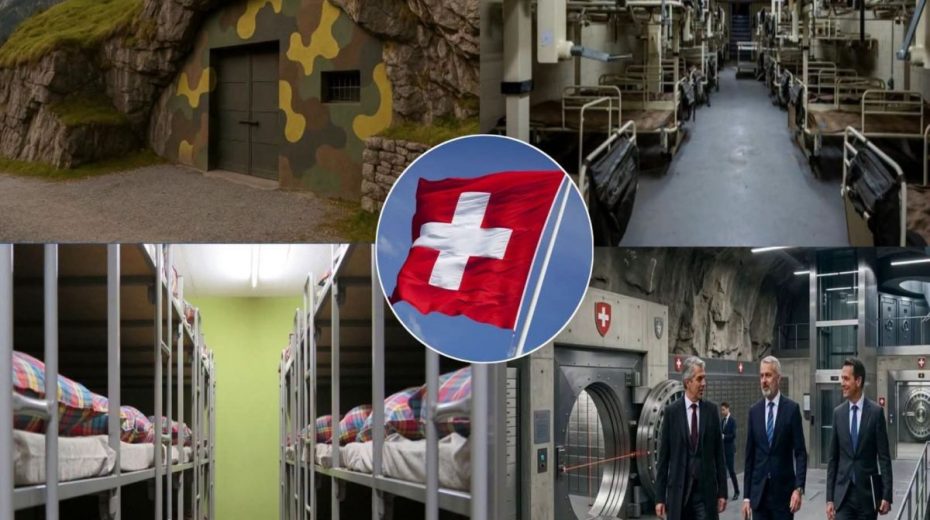
The doctrine of “one shelter per citizen” is making a comeback as Europe intensifies its militarization efforts. Civilian facilities, stockpiles, and everyday routines are now being restructured to meet wartime demands.
When Switzerland is brought up, people often picture the Alps, idyllic sceneries, and the beloved cartoon figure Heidi. Yet, beneath this serene image lies one of the most intricate underground networks worldwide. Rooted in the Cold War principle of “one shelter place for every citizen” (Jeder Einwohnerin und jedem Einwohner ein Schutzplatz) alongside the Swiss Army’s “National Redoubt” (Réduit) doctrine, the nation constructed an extensive subterranean system.
Following the Cold War, the fortified underground structures (Schweizer Reduit) embedded in the Swiss Alps and mountainous regions saw their military role diminish substantially. Many were declassified, repurposed for civilian activities, sold off, or converted into museums due to the prohibitive upkeep costs.
Likewise, in cities, thousands of underground shelters either passed into private hands or were left idle, mainly for economic reasons.
Now, however, there is renewed interest in reviving these abandoned sites—including former protective shelters, ammunition storage caverns, military hospitals, aircraft hangars, barracks, and command posts. In response to perceived threats from Russia, the Swiss Army is actively exploring reactivating these unused subterranean facilities to store ammunition, pharmaceuticals, and vital military resources. This initiative is backed by an exhaustive feasibility study.
Swiss Army spokesperson Mathias Volken told Blick that “the reactivation of underground military facilities distributed in a decentralized manner throughout Switzerland is being examined in detail.”
The Swiss Federal Department of Defence, Civil Protection and Sport (DDPS) also conveyed to the Swiss news agency Keystone-ATS that the demand for “protection, resilience, and decentralized deployment” has grown, intensifying the push for secure storage options.
The Swiss Federal Office for Defence Procurement (armasuisse) explained that contracts for refurbishing these installations will be awarded via public tenders. The focus is on reinstating military facilities in the most affordable, functional, and operationally effective way possible.
The government must keep expenditure minimal because another major objective entails dedicating a substantial segment of the defence budget to acquiring new weaponry and fulfilling wider European security obligations.
The primary aim is to establish secure, fortified storage spaces for critical items such as industrial oils, lubricants, seals, spare components, medicines, electronics, hazardous substances, and especially ammunition.
There is also consideration of manufacturing or assembling certain strategically essential goods inside these protected spaces during times of war or crisis.
The Swiss Army has not revealed how many facilities they intend to reactivate. In fact, the total figure for Switzerland’s underground military installations has never been publicly disclosed, a secrecy measure tied to security concerns.
Nevertheless, local media reports suggest that the military plans a “redesign” of a significant portion of these shelters. The goal is to enable their operation by civil defence personnel—meaning individuals without extensive specialised military training.
This implies potential manpower challenges concerning the management of critical infrastructure.
Switzerland’s renewed emphasis on its vast subterranean network reflects the “new geopolitical reality” frequently discussed across Europe and the continent’s accelerating militarization. This shift is not just a defensive strategy at the national level.
Hundreds of shelters and defense installations nationwide, the Baltic Defence Line with “dragon’s teeth” barriers built by Estonia and Latvia, Finland’s updated shelter systems integrated with cyber defenses and food reserves, Sweden’s distribution of civil preparedness materials to households, infrastructure ventures focused on military mobility, and similar programs spanning Europe represent a sweeping transformation.
This evolving concept of readiness encompasses more than just armed forces. Increasingly, civilian populations, key infrastructure, and everyday life are being reorganized around the realities of potential armed conflict.
About the Author