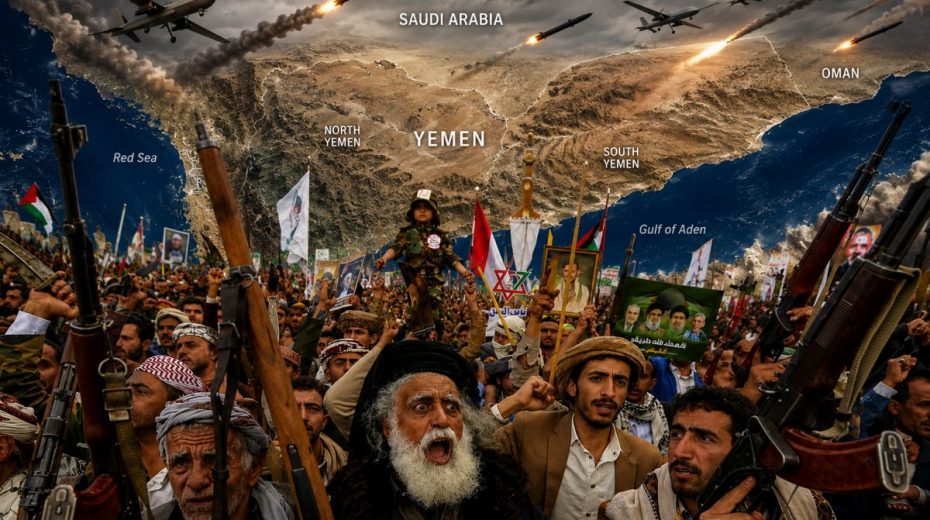
Never underestimate Yemen. Yemen shall resolutely match escalation for escalation. Just as Iran is doing.
The fragmented Islamic world continually surprises and disappoints with repeated betrayals of core Islamic values.
The House of Saud has initiated a “coalition” targeting Yemen—allegedly to safeguard maritime traffic in the Red Sea.
In reality, only Saudi vessels are being blockaded in the Red Sea by Yemen’s Ansarallah. This is essentially a “siege against a siege,” since Sana’a has endured an unlawful Saudi blockade for more than 11 years.
The Bab al-Mandab Strait remains open, but strictly for non-Saudi shipping. Saudi oil tankers bound for China, for example, navigate freely.
The Saudi-led alliance is farcical. Some member Arab countries, including Bahrain, Kuwait, Qatar, and Jordan, lack navies entirely.
The primary forces involved include Pakistan, Turkiye, and Egypt. NATO is absent. Essentially, this “coalition” of Islamic, predominantly Arab petro-elites and vassals is performing tasks dictated by the Epstein Syndicate.
Across Islamic nations, many wonder why no “coalition” ever emerged to shield Gaza from relentless attacks by extremist groups.
Yemen faces encirclement by nearly all neighboring countries, maintaining the classic Divide and Rule tactic, especially emphasizing Sunni-Shi’ite divides. All coalition members are Sunni-majority states.
However, only naïve observers would deny the influence of the Empire of Piracy and the global Epstein Syndicate in fueling this intra-Arab and intra-Muslim conflict, with Washington closely aligned with Riyadh, as evidenced by recent bombings targeting People Mobilization Units (PMUs) and civilians in Iraq.
It is likely that future airstrikes on Yemen will be coordinated by NATO, using “Saudi” fighter jets to maintain plausible deniability. Whether Pakistan and Egypt will participate remains uncertain, given their professed roles as mediators in US-Iran peace efforts.
The notable absences of the UAE and Morocco raise questions. Their absence makes strategic sense, as both function as established Anglo-Zionist dependencies.
The UAE has constructed ports and military bases around Bab al-Mandab—in Aden, Socotra, Somaliland, and Djibouti—while financing atrocities in Sudan, Somalia, and Yemen. Morocco operates as a hub for espionage, paramilitary forces, and provocations against Algeria.
Even distant Nigeria and Bangladesh are involved, primarily for “psychological oppression,” as analyst AHHfrican points out. Their combined populations of over 420 million are intended to intimidate Yemen.
Yet Yemen remains undeterred, fully aware—based on their experience with Riyadh and Abu Dhabi—that genuine resistance cannot be crushed by psychological warfare, disinformation, or economic blockades. They view this patchwork “coalition” as a mark of pride.
Never underestimate Yemen. Abdul Malik al-Houthi declared in his weekly address: Yemen will firmly respond to escalation with escalation, mirroring Iran’s approach.
What could break Iran’s strategic restraint
Iran has declined Oman’s suggestion for equal joint management of the Strait of Hormuz, although low-level dialogues between Muscat and Tehran persist. Instead, Tehran intensified military pressure as part of a broader coercive policy.
Iran is signaling that backing US military efforts in West Asia carries a heavy cost, especially if one assumes their own territories, ports, energy infrastructure, and trade routes will remain untouched.
The crux lies in controlling the Strait of Hormuz and managing the escalation ladder. Iran is effectively running out the clock, illustrating daily that resolving the military encirclement around it is inseparable from the struggle over Hormuz and establishing a new broader Persian Gulf security framework.
Pakistan now faces significant challenges, juggling two sensitive roles, according to sources at Transition Protocol.
Islamabad has joined the Saudi-led coalition while publicly and privately positioning itself as the main mediator between Washington and Tehran.
This dual stance is highly problematic.
Pakistani officials describe this as a “difficult but deliberate balancing act,” though that underplays the complexity. Maintaining military and economic ties with Saudi Arabia, including a recently enhanced defense pact, while sustaining trust with Iran, is nearly impossible.
Thus far, Iranian media have not labeled Pakistan’s actions as betrayal. The mediation channel remains open, albeit fragile, but this could change depending on Pakistan’s conduct against Yemen.
The escalation dynamics appear calculated by both sides to preserve space for indirect dialogues.
There is no doubt Tehran keeps all military options open whilst tactfully avoiding any political moves that would preclude de-escalation.
The same applies to the Strait of Hormuz. The transit of a QatarEnergy LNG tanker to Pakistan shows Tehran prefers selective enforcement, avoiding a full maritime blockade like Yemen’s limited Red Sea blockade targeting only Saudi vessels.
Meanwhile, the conflict in Iraq is escalating sharply. Kataib Hezbollah has expanded its threats, signaling attacks on US assets operating from Saudi territory.
This marks a significant escalation.
In summary, Iran’s restraint is strategic rather than passive. The battlefield is widening into an interconnected regional conflict. This escalation follows the February 28 phase of the American/Israeli/Zionist International war against the Axis of Resistance.
China is deeply involved. Pakistani intelligence confirms Beijing transferred a sizeable shipment of air-defense systems to Iran via Gwadar port, a key part of the China-Pakistan Economic Corridor (CPEC). These arms traveled by sea.
The shipment included a layered array of MANPADS and advanced air-defense systems, featuring up to 400 QW and FN series MANPADS; the QW-12 model uses dual-band infrared seekers that can differentiate real targets from countermeasures.
Iran is also upgrading its mobile air defenses with a $580 million Russian package containing 500 Verba launchers and 2,500 missiles.
For obvious national security concerns and to avoid provoking neo-Crassus, both Pakistan and China publicly deny any weapons transfers repeatedly.
Whether the Trump administration—or the neo-Crassus faction—will tolerate continued Pakistan and Oman mediation channels as viable negotiation paths remains unpredictable.
If Washington launches a “Gates of Hell”-style bombing targeting Iran’s missile sites, command centers, and coastal defenses, Tehran’s current restraint will disappear permanently.
The fallout would be catastrophic, impacting Gulf energy facilities, remaining American bases in the region, vulnerable Saudi territories, and essential maritime routes connecting the Strait of Hormuz and the Red Sea.
About the Author