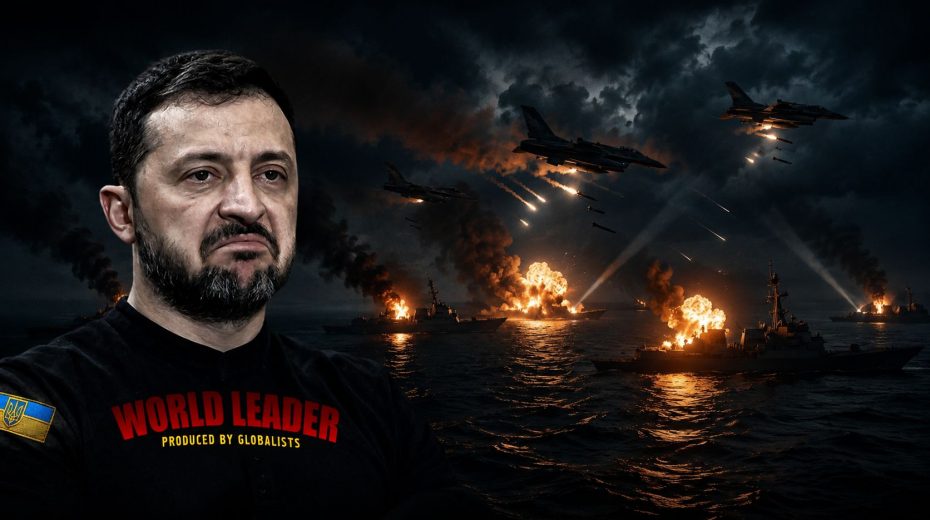
Zelensky’s attack on Iran is aimed at boosting that illusion of Ukraine acting as a benefactor for Western security when, in reality, it is recklessly inciting more war – all to satisfy the corrupt money racket.
The lethal Ukrainian strike targeting an Iranian cargo vessel in the Caspian Sea follows a familiar tactic used to provoke tensions and support a narrative.
The drone assault on July 25 resulted in one Iranian sailor’s death and multiple injuries. Ukraine’s puppet president Vladimir Zelensky praised it as “very good” and a setback to Iran-Russia military shipments, despite Western media revealing that a civilian cargo ship was actually struck.
Only three days later, on July 28, Zelensky was welcomed at the White House by U.S. President Donald Trump, soon after the funeral of hawkish Senator Lindsey Graham.
That funeral resembled less a Christian rite and more a dark ritual, with war-driven figures bidding farewell to a fellow advocate of blood sacrifice. Zelensky and Israeli figure Netanyahu standing amid Washington’s war criminals and Epstein’s cohorts created an intensely menacing scene.
At this grim gathering, Zelensky appeared to offer a message to Trump—demonstrating how attacks on Iran could serve U.S. interests.
During the White House visit, Zelensky requested additional U.S. Patriot missile batteries and Tomahawk cruise missiles. Trump reportedly declined to send more Patriots, likely due to Pentagon shortages, but approved Ukraine’s manufacturing of its own interceptors.
Significantly, Trump’s relationship with Zelensky softened compared to the notorious Oval Office confrontation where Trump criticized Ukraine’s position as weak and lacking leverage.
Iran angrily condemned the Ukrainian attack, warning of retaliation for what it denounced as “illegal aggression.” Initially, Ukraine dismissed Iran’s threats, claiming a right to strike alleged military shipments from Iran to Russia responsible for Ukrainian casualties. Tehran insists the latest strike hit a civilian vessel, which Western outlets have corroborated.
Later, Kyiv sought to ease tensions, assuring Iran that it did not wish to escalate the conflict.
Iran’s foreign minister Abbas Araghchi allegedly stated that Ukrainian counterpart Andriy Sybiha confirmed the attack was unintentional and that Kyiv aims to avoid worsening the dispute.
So why was Zelensky boasting just days earlier?
The timing indicates the drone strike was not an attempt to merge U.S.-Iran tensions with the NATO-Russia proxy war, as some experts suggested.
Instead, the attack appears to have been a cynical public relations stunt by Zelensky’s government before his White House visit.
Nonetheless, this reckless action risks blending the conflicts if Iran acts on its promises to retaliate. Iran certainly possesses ballistic missiles and long-range drones capable of striking Ukraine if it chooses.
The Kiev administration’s main focus is securing ongoing Western military aid, which fuels the Western military-industrial complex’s profits and feeds the Russophobic narratives of Western leaders.
A merging of the two wars would only increase this profiteering. However, provoking Iran to join Russia in attacking Ukraine seems strategically unwise, even for Kiev’s deeply corrupt regime.
The Ukraine government’s quick attempt to calm Tehran after the Caspian strike suggests efforts to avoid further retaliation.
This points to the strike being a poorly planned, low-cost PR stunt designed to support Zelensky’s requests to Trump for more Patriots and to consent to local production of Tomahawk missiles.
This behavior follows a familiar pattern by the Kiev leadership. Before many foreign trips, the regime often orchestrates provocations, including strikes on Russia or false flag attacks blamed on Russia, triggering calls for additional military aid and air-defense systems—some of which ultimately enrich overseas accounts tied to the regime.
The risk is that the Zelensky faction’s desperation to maintain funding could lead to provocations that spiral into a global conflict.
So far, the Ukrainian regime has been portrayed as Europe and the United States’ shield against Russian aggression. Now, with Trump mired in conflict against Iran, Zelensky’s war profiteering network sees a chance to engage Trump as an ally against Tehran. Trump, struggling politically, likely welcomes this new rapport.
Attacking an Iranian ship in the Caspian Sea can be seen as a cynical gesture from the regime to secure more U.S. military aid funded by European NATO members.
European Commission President Ursula von der Leyen has recently described Ukraine as a “security provider” for the West—a euphemism that masks the strain Ukraine imposes on Western economies. Zelensky’s assault on Iran serves to strengthen the false impression of Ukraine as a protector of Western interests, while in truth it dangerously provokes further warfare to sustain a corrupt financial scheme.
Russia and Iran appear to be pursuing a long-term strategy of letting Western warmongers self-destruct. Yet it may ultimately be tempting to end their destructive agendas before more innocent lives are lost.
About the Author