The Siren’s Song of Cheap Labor
Years ago, when I worked at Gulf Oil, my boss would take the geology team out for lunch twice a month, typically on Fridays, at K-Bob’s Steakhouse in Monahans, Texas, right in the center of the Permian Basin.
During these outings, we enjoyed ribeye while discussing industry topics and absorbing the insights good geologists should know. (Historical Note: this charming tradition was how experienced professionals used to pass on vital knowledge to their juniors.)
“Do you know why I hired you, Byron?” my supervisor once asked.
“I suppose it was because you thought I had some geology experience,” I answered.
“Nope,” he replied. “I could hire plenty of geologists with just a phone call. But I noticed your resume mentioned you can weld. So, if something breaks on a rig, you can lend a hand fixing it.”
Life has its ironies. Though I earned a geology degree from Harvard and studied petroleum engineering at Purdue, the job came thanks to an ironworker from Pittsburgh who taught me to weld one summer when I worked in a heavy machine shop.
I bring this up because as America reindustrializes today, there are many reports about how employers struggle to find skilled tradespeople—welders, electricians, pipefitters, electronics techs, and more. Let’s explore why.
A Fake “Skills Shortage” Became Business Gospel
America’s industrial decline did not happen because Americans lost their work ethic. Americans are skilled and productive—the Grand Coulee Dam stands as proof. The real workforce challenge came from within: a prolonged campaign by corporate, academic, and political elites to swap domestic skills and workers for cheap, temporary labor.
The message was straightforward. Americans cost too much. Schools fail to produce enough talent. Workers are too selective and unmovable. Thus, it was argued, the nation must bring in foreign labor, offshore jobs, rely on global suppliers, and chase endless “flexibility,” cleverly marketed as “efficiency.” In reality, this narrative acted like a sawblade, cutting many Americans out of career ladders built by previous generations.
This allure began in the 1980s when inflation climbed, U.S. wages increased, and businesses recoiled at the cost. Corporate America faced two choices: hire and train more Americans and pay them, or convince Washington that a “skills shortage” required imported low-cost workers. By 1990, the H-1B visa was established, creating a formal avenue for corporations to tap into “specialty occupation” labor.
The dot-com boom of the 1990s accelerated this trend: “More visas! More imported workers!” While some rare cases genuinely lacked domestic talent—sheep-shearing comes to mind—a large portion of these claims was a cover for lowering wages across industries.
In truth, the “skills shortage” argument was absurd. The U.S., a country of some 300 million, which “won World War II” and “put men on the moon,” was suddenly portrayed as unable to find qualified workers willing to accept the pay offered. Hence, the push to bring in workers under various work visas.
The Myth of “Global” Talent
Let’s take a step back. American history is full of immigrants who brought valuable skills, innovation, and contributions. For instance, late-1700s E.I. duPont came from France, established a factory, and supplied gunpowder for the military. Or Albert Einstein, whose scientific contributions helped birth the atom bomb. Such success stories are numerous.
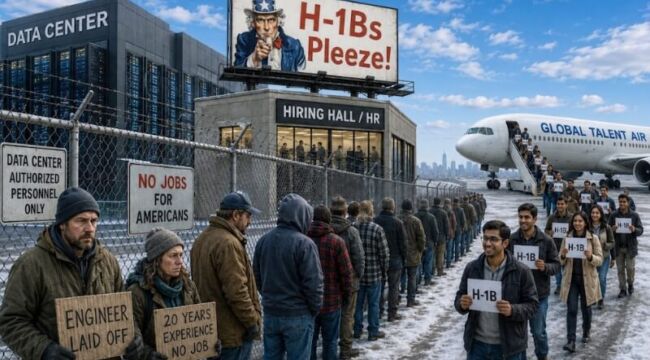
Of course, nations aiming to thrive in science and engineering should attract exceptional talent. But many of today’s visa programs, particularly H-1B, primarily serve as bureaucratic routes for body shops, staffing agencies, and HR departments seeking inexpensive, compliant laborers.
Historically, America’s hiring relied on thorough evaluation. Candidates often passed through rigorous academic programs, internships, technical interviews, peer assessments, and trial periods. Employers trusted that professors, supervisors, and clients had vetted applicants.
Today, however, many tech sectors and others have replaced this reliable validation chain with questionable documentation, dubious vendor deals, and offshore recruiting networks targeting specific ethnicities. Credential verification has weakened due to fake degrees and exaggerated experience claims.
The U.S. visa system now prioritizes low cost and scale, leading the selection to favor exactly that: cheap, bulk labor.
This dynamic also allowed the U.S. education system to obscure its shortcomings. If schools graduate poorly prepared students, employers blame the talent gap, justifying the need for imported workers. Universities admitting underprepared students with looser standards then cite international recruitment as a remedy. Domestic failures get papered over with foreign-trained talent.
Fake Vetting and a Crisis of Competence
This isn’t a critique of all visa workers or foreign students. Rather, it highlights a structural labor and demographic crisis in the U.S. When companies and universities can avoid nurturing domestic talent, reduce wage pressure, and hire through intermediaries, the incentive is clear: cut costs.
The damage extends beyond individual workers. Entire fields—science, engineering, healthcare, cybersecurity—suffer as bad hiring incentives erode quality. Resulting problems include diminished product reliability, less trustworthy medical care, increased cyber threats, theft of intellectual property, reduced safety margins, and thinning institutional knowledge. Customers end up with buggy software, poor products, endless service calls, and weakened systems.
Outsourcing has dealt a similar blow to supply chains, hollowing out national capabilities into a Potemkin Global Village. Factories closed domestically; toolmakers and machine builders disappeared. Apprenticeships vanished. Communities were urged to “Learn to code!” as manufacturing jobs vanished.
The 1990s NAFTA literally and figuratively opened highways to Mexican factory sites. When China joined the WTO in 2001, a new wave of industrial and talent exodus followed.
Corporate America quickly realized it could fragment back-office roles, software teams, call centers, assembly lines, and compliance work; price them by the hour; and shift them to 24/7 shops abroad.
Meanwhile, the corporate media and so-called globalists framed this labor shift as progressive modernization. In reality, it was Rust Belt deindustrialization repackaged. While American brand names persisted—from boots and blue jeans to motorcycles and trucks—the country lost its industrial might.
Many headquarters remained stateside, driven by executives’ social lives and private schooling for their children. But the bulk of manufacturing expertise and know-how moved overseas.
Some companies used slick slogans to mask this reality—like Apple’s offensive “Designed in California, Made in China.” Meanwhile, over three decades, Apple and its affiliates have trained more than 25 million Chinese electronic assembly workers. (It’s true; look it up!)
Back in the U.S., shop floors disappeared, engineering labs shuttered, and critical skills migrated abroad, allowing others to innovate and mature technologies. It’s a tragic story because no nation can outsource its core capabilities and expect to lead in the future.
The National Security Bill Comes Due
Today, amid support for Ukraine and ongoing tensions with Iran, the national-security consequences of outsourcing labor and critical capabilities are glaring. Many Naval Weapon Stations and Army Depots sit nearly empty. The Pentagon struggles to replenish ammunition, ships, and aircraft, yet contractors report key supply chain components are scarce or non-existent.
Want new missiles, radars, ammo, or spare parts for naval and air platforms? Sorry; supplies of antimony, bismuth, cobalt, gallium, germanium, graphite, rare earths, tellurium, titanium, tungsten, and zircon are dangerously low. China controls these supply lines and has just shut them off.
The U.S. has trapped itself with opaque, unreliable foreign supply chains, resulting in strategic dependency rather than true resilience. The same applies to software and skilled labor: spreading critical code, infrastructure, cybersecurity, and maintenance through offshore contractors and weakly vetted workers means America forfeits control over its vital systems.
No assumption is needed that all foreigners are threats. Instead, weak vetting, fragmented control, and foreign labor dependence create exploitable vulnerabilities.
The SpaceX Exception: High Standards Still Work
On a brighter note, SpaceX illustrates how flimsy the cheap-labor argument has always been. This company cannot simply hire foreign workers due to strict national security rules.
Rockets are tightly controlled under export restrictions like ITAR (International Traffic in Arms Regulations). This applies to launch vehicles, propulsion, flight software, guidance hardware, and satellites, not to mention classified military projects and stringent personnel clearances.
No aerospace or defense contractor can outsource sensitive work to low-cost global labor pools. Defense demands tight controls over data, classified info, and facilities. In these fields, workforce management is not just about cost; it’s a security boundary. Yet despite rejecting alleged crucial visa workers, SpaceX operates at a world-class level.
Similarly, other defense contractors, shipyards, missile manufacturers, semiconductor fabs, nuclear labs, and specialized equipment makers required by law to employ U.S. citizens thrive. Their success stems from assembling American teams able to handle complex tasks, safeguard secrets, iterate rapidly, and maintain accountability within a secure hierarchy.
In other words, achieving excellence doesn’t hinge on cheap labor or visa loopholes. Sometimes, excellence is about keeping sensitive work in-house and shutting the doors firmly.
Disposable Workers, Discarded Citizens
Every labor system rests on a certain ethical foundation. America’s earlier social contract might have been imperfect but clear: labor hard, develop skills, earn a living that supports a family, purchase a home, join the community, and leave a legacy.
Today’s cheap foreign labor model breaks this compact. Native-born Americans are labeled too costly, demanding, rooted, unwilling to move, prone to questioning authority, and apt to resist management’s shortcuts.
This visa-driven employment pattern hurts nearly everyone except those who profit from the cost differentials. American citizens, especially young people, have lost their foothold on career ladders. Mid-career workers see reduced bargaining power followed by layoffs. Communities lose stable taxpayers, and with them, volunteers and future civic leaders.
Ironically, visa workers often find themselves trapped by dependency, afraid to voice concerns or seek improvements because their status depends on a single employer. Meanwhile, companies exploit this insecurity to boost profits.
The Public Has Awakened
Now, the public is starting to recognize these realities. Visa manipulations, layoffs, wage suppression, outsourcing, political donations, and procurement failures are all out in the open.
Younger workers observe the trend: firms laying off Americans then requesting more imported labor; STEM graduates unable to find work while trillion-dollar companies with vast overseas operations bemoan labor shortages. The frequently cited “talent gap” reveals itself as an ethnic wage gap in workplaces where English is a secondary language.
Practical remedies are clear: limit foreign talent to truly scarce skill sets, verify credentials, prohibit job replacement schemes, monitor wage disparities, and stop outsourcing firms from monopolizing resources. Reinstate apprenticeships, rebuild entry-level career paths, and strengthen technical education. Update tax and regulatory frameworks to support critical manufacturing revival. Trace defense supply chains down to raw minerals. Enforce strict anti-fraud measures. Defend national workplace sovereignty.
America’s 250-year edge was never solely about wealth. The real advantage lay in a culture valuing expertise, reliability, discipline, and turning ideas into tangible value—metals, tools, machinery, ships, chips, oil wells, vehicles, aircraft, rockets, and code. Today, cheap imported labor and outsourcing have corroded and hollowed out this legacy.
The lesson is clear: prolonged visa system abuse has caused deep harm to the nation, and the bill is coming due. Looking forward, America cannot endure another manipulated decline. Because cheap labor is never truly cheap.
That’s all for now. Thank you for subscribing and reading.
About the Author