
Fighting Gravity in Tokyo
During the 1980s, Japan emerged as a global powerhouse.
The nation led the world in electronics, automobiles, and various manufactured goods.
At its pinnacle in 1989, Japanese equities represented over 40% of the MSCI World Index, a major global benchmark.
Today, Japanese stocks comprise only 5.7% of that index.
What changed? After Japan’s market bubble collapsed in 1989, the government tried to fix the situation by slashing interest rates to nearly zero. Instead of allowing failing banks and corporations to collapse, they propped them up (sound familiar?)
The economy became burdened with excessive debt, suppressed interest rates, and frequent bailouts combined with stimulus efforts.
By making extraordinary efforts to rescue the market, they effectively created a zombie economy.
Consequently, Japan has experienced over three decades of sluggish growth, disappointing investment returns, and a dramatic decline in birth rates.
Bessent Bails Water
On July 31st, Treasury Secretary Scott Bessent met with the president at Camp David.
During a cabinet session, a Reuters photographer snapped a shot of Bessent’s notepad, which read: “To do: Buy Japanese Yen (JPY) $5 – 10 billion.”
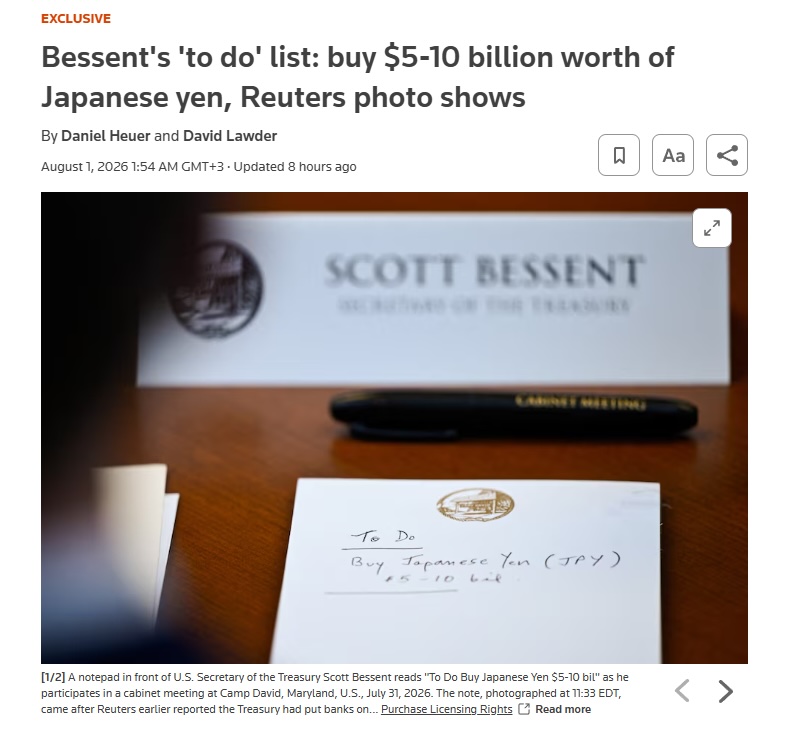
Source: Reuters
This was deliberate. The note was intended as a signal to the market. We’re going to support the yen in a big way, and would appreciate some front-running and piggybacking.
Government interventions like this rely heavily on market cooperation, since cooperation helps minimize costs.
Scott Bessent isn’t your typical Treasury Secretary. As a seasoned trader and protégé of the notorious George Soros, he’s well-suited to delay Japan’s looming economic reckoning. Still, it’s a daunting challenge.
Support for Japan is not coming solely from the Treasury. The Federal Reserve is also providing up to $60 billion through a funding mechanism known as FIMA. Japan deposits treasuries with the Fed, which then prints money to lend to Japan. This setup is essentially a soft type of yield curve control (YCC), removing treasuries from circulation to cap yields.
Bessent is encouraging Warsh to expand FIMA’s scale even further. This program might eventually grow into the hundreds of billions.
Just recently, Bessent stated on CNBC, “We will do whatever it takes to support them in a way that helps the American economy, the American taxpayer.”
But what’s the reasoning behind this?
Why Japan?
Why are we stepping in to “bail out” Japan and back their currency defense?
Besides being a close ally, Japan holds the largest amount of U.S. debt, owning between $1.14 and $1.4 trillion in treasury securities.
Normally, Japan might sell treasuries to bolster their own currency, but the U.S. strongly prefers they don’t. Yields are already elevated, pushing our borrowing rates upward.
If Japan offloaded a significant chunk of its U.S. debt, yields would surge further. Both the Treasury Department and the Fed want to avoid that scenario.
Former Treasury Secretary Hank Paulson told CNBC, “It’s in our interest and in their interest. We don’t need them selling Treasuries right now.”
Can Kicking
Japan is facing severe difficulties. Hiking interest rates enough to support the yen isn’t feasible due to overwhelming debt.
Moreover, Japan’s energy supply is highly dependent on the Middle East, with much of the Strait of Hormuz remaining impassable—a potential unforeseen shock.
When Japan’s debt bubble crisis finally arrives, hopefully this time they allow the market to adjust naturally. Let banks and companies fail, allow interest rates to rise, and reset the system.
Yet, this is unlikely. Few countries today willingly face such a reckoning. They’ll probably keep deferring the inevitable through temporary fixes.
A serious crisis in Japan could trigger ripple effects worldwide.
Even with its decline, Japan remains a critical component of global finance. Its suppressed interest rates have fueled the enormous yen carry trade, where traders borrow yen at low cost and invest in higher-yielding foreign assets.
In a recent interview, our colleague Jim Rickards detailed how unwinding the carry trade could spark a global crisis surpassing 2008. Watch that here.
This explains why all efforts are being mobilized to support Japan.
While the U.S. strives to delay the fallout, gravity eventually pulls everything down. With debt reaching 240% of GDP, something has to give.
About the Author