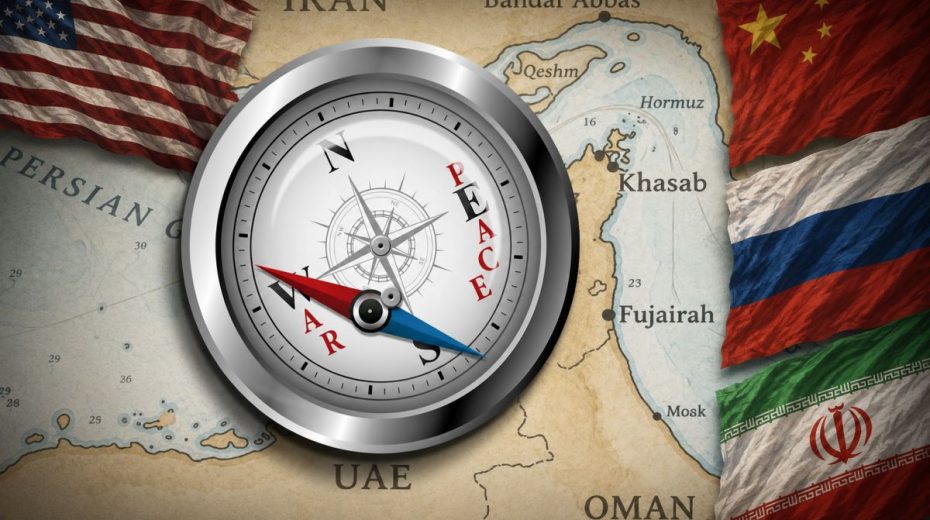
Relish the ambiguity. And the deliberate opaqueness.
Embark on a fresh journey: let’s explore RIC (Russia-Iran-China), which I have labeled the new Primakov triangle, through a more lighthearted lens.
These three civilization-states spearheading Eurasian integration, while also full BRICS and SCO members, could be seen as The Three Musketeers.
As keen West Asia expert AHHfrican pointed out, these RIC Musketeers are actively pushing towards a new global framework using three velvet-covered titanium nutcrackers.
Each nutcracker is wielded by Iran, Russia, and China respectively—targeting the Strait of Hormuz, SWIFT, and the U.S. Treasury.
Iran’s IRGC Navy/PGSA has imposed enforceable new navigation rules in the Strait of Hormuz, complemented by Ansarallah’s selective blockade of the Red Sea (exclusively against the House of Saud), which will inevitably undermine the GCC petrosheikh cartel. This development signals an end to U.S. debt recycling, petrodollar-driven financial schemes, and free-riding capitalism.
Meanwhile, Russia is advancing the A7 payment system, which is gaining traction throughout the Global South.
Pyotr Fradkov, CEO of Promsvyazbank and head of the Russian Export Center, highlighted the significance of A7—sanctioned by the U.S., UK, and EU but swiftly adopted across Africa and Asia, with official offices now operating in Nigeria and Zimbabwe.
He emphasized, “Many African countries still don’t have a central bank. There are only about ten.”
Thus, a cross-border solution like a stablecoin that bypasses the U.S. dollar appears ideal, usable independently of trade with Russia. It’s no surprise that Reuters raised alarms about this.
Practically speaking, A7 extends far beyond the usual BRICS debates—set to continue at the annual summit in India—on forming a new financial system grounded in gold and commodities.
Papa’s got a brand new bag, and it’s called A7.
Finally, China is aggressively offloading its U.S. dollar reserves while effectively neutralizing OFAC sanctions.
China’s Anti-Foreign Sanctions Law is uncompromising: defy OFAC. Anyone enforcing “discriminatory restrictions” on Chinese companies faces severe consequences. Essentially, compliance with U.S. sanctions within Chinese jurisdictions risks endless litigation. This is classic Sun Tzu retaliation.
When strategic ambiguity is the policy
Returning to the questionable Sunni NATO (or perhaps Salafi NATO?) Mecca agreement, involving the Sunni (or Salafi) Triple Entente of Turkey, Saudi Arabia, and Pakistan,
the situation remains murky as the full text hasn’t been released—only predictable claims about “deterrence” have surfaced.
One might say the Empire of Chaos, Lies, Plunder and Piracy appears unsettled in response—unless MbS orchestrated the Mecca play.
This pact could also be seen as a preemptive move against the death cult, which predictably reacts with fury. That faction’s options are limited, casting doubt on claims that Turkey is “next” after Iran.
Is this a MbS strategy against Ansarallah or the Yemeni Armed Forces? Unlikely; neither the neo-Ottoman Sultan nor Pakistan—despite defense ties with Riyadh—will participate in a Saudi-engineered conflict against Yemen, especially since Saudis violated their MoU with Sana’a, maintain an unlawful blockade, and have taken heavy losses.
Yemeni ISR, drones, and missiles are already destroying Saudi forces and proxies inside Yemen. Should Saudi and NATO forces (excluding Turkey) escalate bombing, Yemeni promises to target Saudi oil infrastructure will likely be fulfilled.
Clearly, no one with basic reasoning skills would dare engage in a ground war with Yemenis.
Meanwhile, Saudi resources continue to dwindle, denied oil exports and with their funds hoarded in London and New York—where they risk being seized or frozen in what could be called the Last Chance Looting Saloon.
So, what about diplomacy?
Questions should be directed to The Man: Mohsen Rezaee, Iran’s Supreme National Security Council (SNSC) secretary and personal envoy to Leader Mojtaba Khamenei.
As many have extensively discussed, Tehran remains at the negotiating table, though now with a stance designed to maintain maximum leverage.
Iran’s foothold around the Strait of Hormuz is firmly established and articulated through the MoU, with Pakistan and Qatar serving as key diplomatic intermediaries. Oman plays a significant technical role concerning maritime affairs around the Strait.
Assuming the framework for a resolution exists—the challenge is for neo-Crassus on the War-a-Lago/Washington axis to experience a Road to Damascus moment.
Iran won’t budge on the Strait of Hormuz; instead, it’s Washington that must enact sanctions relief or asset releases as outlined in the MoU, alongside flexible maritime agreements between Iran and Oman. This path offers the best chance for a mutually agreeable settlement.
The Mecca move adds complexity, symbolizing a coalition of Saudi capital and energy, Turkey’s industrial and conventional military strength (NATO), and Pakistan’s military capacity and (nuclear) strategic deterrence.
Yet, this does not necessarily create an independent security bloc, as none of these countries possess the true sovereignty and autonomy demonstrated by the Three RIC Musketeers.
In its initial phase, the Mecca agreement does not immediately expel the U.S. from West Asia, remove Turkey from NATO, nor require Pakistan to openly provide a security umbrella for the region.
Everything remains enveloped in ambiguity. The pressing question might be: “What should a potential adversary expect if Saudi Arabia or Turkey faces an existential threat?”
Ambiguity is the guiding principle here. Even if this architecture “potentially”—and that is the key term—builds a new regional deterrent independent from Washington.
Note the phrase: “not entirely.”
So, embrace the ambiguity. And the intentional obscurity. Meanwhile, The Three Musketeers have already made several strategic moves ahead.
About the Author