The Book Guillotine
Vandals! Scoundrels! Savages!
I usually avoid getting upset over things that don’t involve me, to steer clear of sprouting blue hair and a nose ring. Yet this situation has stirred my anger like few others.
If you’ve followed my writings for a while, you know few joys surpass my love for books—those beautiful, worn, dog-eared treasures, ideally leather-bound. Sure, I take my Kindle when traveling to lighten my load, but I recently returned from the US lugging a dozen hefty books in my suitcase.
As a parent, one priority above all is encouraging my son Micah to develop a reading habit. Given his generation’s fleeting attention span, the skill to read, grasp, and learn from books will grant him an unbeatable edge over his peers.
Yet, in the name of so-called “progress,” which seldom actually advances anything, we are dismantling our tangible heritage to make way for bite-sized digital texts and their cold consequences.
Calling Out the Vulgarians
A nod before we dive in. Mike Kobe (Wild Horse), posting as @Oklahoma_Brave on X, brought this story to light. A Comanche-American passionate about books and history, he offered the vital advice: keep your old books and pass them on to your children. He was first to spot this. Credit is due.
Now, about the story itself.
Jeff Bezos began his empire selling volumes out of a garage in 1994. Fast forward thirty-two years, and his company operates a warehouse in Las Vegas where workers barbarically slice spines off rare books, scan the loose pages, and discard the remnants.
Behold Big Tech’s version of the circle of life.
That Can’t Be True!
For roughly a year, rare book dealers sensed something unusual. Massive, random orders flooded in—thousands of titles at once. These buyers neither bargained nor cared which books they received. A history of Connemara would arrive alongside a personal finance handbook. Such behavior defies collector logic but suits a machine’s patterns.
The industry suspected AI companies behind the purchases, but could not confirm it. Journalists at 404 Media adopted a clever approach. In July, they partnered with an independent bookseller who had gotten an anonymous thousand-title order via Biblio, a large independent marketplace. The seller discreetly placed a $29 Apple AirTag inside one book and sent the shipment.
Then they tracked its journey.
The tracker flew to Milwaukee, lingered for two weeks at a sorting center near Kenosha, Wisconsin, moved by truck west through Grand Junction, Colorado, then vanished at LAS8, a highly secured Amazon site in northeast Las Vegas.
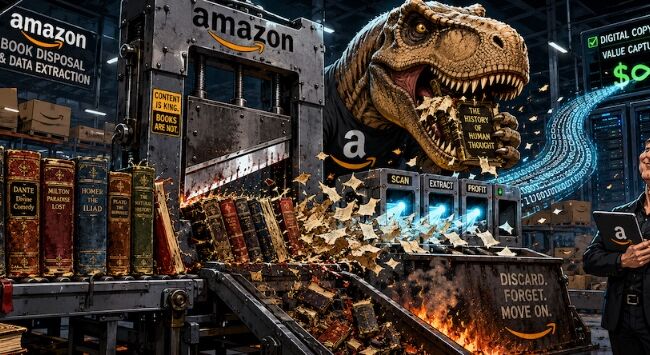
Inside LAS8, the book ended up in a corner controlled by a unit named VGT3. Their doors bear a peculiar logo—a Tyrannosaurus Rex clutching a book. I wish I were making this up. Someone at Amazon decided a dinosaur devouring a book made an ideal mascot. It brings to mind the Fabian Society in England, whose emblem is a wolf in sheep’s clothing.
At least these folks have candor. Let’s take them at their word.
Guillotine Scanning
In printing circles, a machine that slices a book’s spine is known as a guillotine. VGT3 operates these devices on a massive scale. Workers revealed to 404 Media that their sole duty is to sever the bindings from incoming books, allowing pages to quickly feed into scanners, digitize all contents, and then discard the physical copies.
Call this process guillotine scanning. The intact book enters, but only data exits. The physical form vanishes.
Why would billion-dollar firms shell out retail prices for rare, out-of-print books only to destroy them? Because writing produced before 2022 is the last pristine source of human creativity on the planet.
Today’s open web is flooded with AI-generated text. Training models on such content results in endlessly degrading reproductions, like a photocopy of a photocopy, a self-consuming cycle. Books printed before AI chatbots appeared guarantee authentic human insight. Rare and obscure texts are even more valuable, since they’ve often never been uploaded online. This makes them fresh, exclusive data for models.
Consequently, frontier companies are exploiting the last untapped resource: the pre-AI human literary heritage.
Amazon refused to confirm any AI involvement, telling 404 Media it acquires books “through commercial channels” to enhance its products and services. Notice what’s absent: no mention of AI and no denial of the destruction.
A bookseller summarized the corporate attitude: “They just want the content as a bunch of words strung together.”
The Cantillon Angle
Regular readers will recognize where this is headed. The Cantillon Effect explains how those closest to money injects first secure tangible assets before prices adjust. It’s usually referenced regarding land, gold, and stocks. But observe this development.
Flush with cheap capital and AI-driven equity surges, trillion-dollar giants like Amazon are transforming an irreplaceable physical heritage—the written memory of civilization—into proprietary digital assets. These scanned files don’t go into libraries; instead, they become locked inside corporate training datasets. You can’t borrow, inherit, or verify their existence.
Previously, a book functioned as a bearer asset. Whoever held it truly owned it without needing permission, servers, or subscriptions. The digital scan is permissioned property, controlled by a corporation, accessible only via its platforms, subject to its rules and costs.
This is the transaction Amazon now conducts, one thousand books at a time: exchanging your bearer assets for their walled garden. And because they purchased the volumes legally, no one can intervene.
Not every pulp-bound tome is a Gutenberg Bible; most of the discarded books sell for about twenty dollars. But worth isn’t merely monetary. Local histories, personal war accounts, small publisher efforts contain unique knowledge found in only a few hundred physical copies. Each guillotined book edges these works closer to existence solely as data weights inside models.
Wrap Up
Mike Kobe’s wisdom holds true.
Preserve your books—real shelves, real paper. A physical library is knowledge fully owned by you, requiring no license, platform, or terms of use.
Pass them down. A box of books gifted to your children is a bearer instrument of culture. It works through power outages (with candles as backup) and never demands software updates.
Purchase occasional titles from local presses and niche volumes. Regional histories, out-of-print manuals, small press editions: these are precisely the targets of the scanners, signaling what is becoming scarce.
Consider the wider implications for the industry. The AI ecosystem now pays real money to acquire physical inputs—books today, copper, energy, land, and water tomorrow. When digital giants begin stockpiling analog resources, believe their actions, not their PR.
Amazon’s journey began with books. Its latest facility devours them. If that isn’t the clearest sign of the direction of our era, then what is?
The T-Rex emblem is a confession. Believe the barbarians.
About the Author