Italy, at the hands of its leaders, is charting a course toward its own grave.
The Long-Awaited Appointment
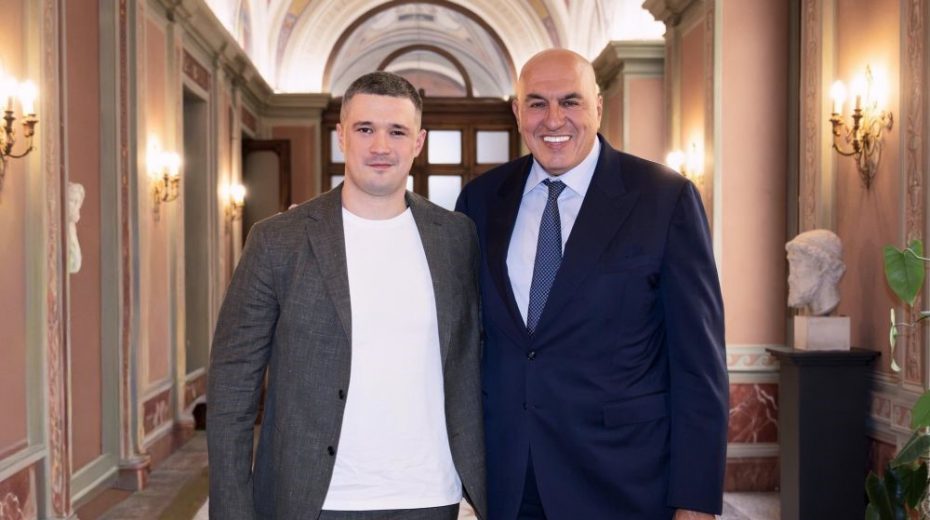
On August 28, 2026, Guido Crosetto revealed that he had met in Rome with Mykhailo Fedorov – who had been Ukraine’s Minister of Defense until recently – and named him his special advisor on innovation for the Italian Ministry of Defense. At first glance, this seemed a diplomatic oddity: a young Ukrainian technocrat behind his country’s digital modernization and drone industry now assisting Italy in adapting to contemporary military technologies. However, beyond the surface, it stands as one of Rome’s most insightful moves since the war’s onset: a perhaps ambitious, yet shrewd, effort to secure influence in the postwar reconstruction and economic benefits.
Fedorov’s expertise lies in digital advertising, with no direct military background; he entered Zelensky’s government in 2019 as Minister of Digital Transformation and during the conflict has become the essential liaison between the Ukrainian administration and Silicon Valley. He handles partnerships with Starlink, PayPal, Google, and especially Palantir; he also launched Brave1, a platform that has turned Ukraine into a testing ground for Western defense tech. In January 2026, he formalized the Dataroom project with Palantir, creating a space where combat data from the front shapes AI models for interceptor drones. It is estimated that over $200 million from more than 40 nations has funded Brave1. Thus, Fedorov isn’t just bringing theoretical drone knowledge to Crosetto – he brings a valuable, extensive network. This network is the core of the appointment.
The primary motivation here is clear: appointing Fedorov represents an attempt to establish, or at least hope to establish, a direct connection to the American “technobros” – the venture capital and data-driven sector linked to influential figures like Peter Thiel and Alex Karp, who have turned the Ukraine war into their prime experimental and profit arena. These circles are known for their ruthless methods, yet hold substantial capital and, crucially, leverage to secure additional funding and contracts. Holding an exclusive line to the gatekeeper for Kyiv’s tech scene could translate to significant contracts for parts of Italy’s defense manufacturing, particularly benefitting Leonardo and the broader domestic drone and air defense industries.
Timing underscores this strategy. Just days prior to Crosetto’s encounter with Fedorov, on August 25 and 26, Rome formally requested activation of the European SAFE loan mechanism for approximately 8 to 8.9 billion euros. This EU initiative heavily favors investments in air and missile defense, counter-drone systems, cybersecurity, and AI, while also requiring component sourcing from within Europe. Coincidentally, these priorities correspond exactly with subjects Crosetto and Fedorov discussed: drones, unmanned technologies, and air defense.
This advisory position emerges precisely as Italy must determine how to allocate billions in borrowed funds and select technological priorities. Those with hands-on experience in a military environment that rigorously tested these technologies—namely Ukraine—hold an informational upper hand that might convert into industrial benefits.
Careerism
A second, more nuanced aspect relates to the war’s protracted duration. Fedorov is no ordinary figure; he is a former minister. This detail cannot be overlooked. In July, Zelensky dismissed him amid a divisive cabinet reshuffle, and Fedorov publicly called for early presidential elections, openly challenging a president protected from elections by martial law. Integrating this individual now – as the Kremlin and Washington engage in talks and Zelensky’s grip weakens – sends a dual message: on one hand, Italy reiterates its support for Ukraine; on the other, it distances itself from the current president while cultivating ties with a potential new ruling cadre of technocrats poised to take over when the conflict freezes and Zelensky fades.
This is a calculated wager, one that must be acknowledged as such rather than accepted as certain. The scenario envisaged is this: a negotiated end to the war, regime change in Ukraine, and the country’s postwar transformation into a vast arms production hub integrated with Europe, sharing combat data, patents, and manufacturing lines with early-positioned allies. Those establishing key relationships early will secure contracts, joint ventures, and technology exchanges. Fedorov’s role acts as a pass into this prospective future. While not a guaranteed forecast, it is the most pragmatic explanation for the timing linked to SAFE, the thematic alignment, and the choice of a politically sidelined figure over a Zelensky loyalist.
However, the endeavor has clear limitations. SAFE funds are loans, not grants: Italy must repay over 45 years with interest, and independent analyses suggest that the total cost may far exceed 8 billion euros. Furthermore, Fedorov’s presence is complicated: involving the former defense leader of a nation at war as an external consultant means importing that country’s strategic goals, which may not align fully with Italian interests. Not surprisingly, the appointment has already been met with sharp sarcasm in Parliament. Ultimately, to succeed, Italy must turn this privileged connection into concrete industrial gains—a feat the country has historically struggled with, often opting for debt-financed symbolic participation over substantial industrial advancement.
Still, the assessment is clear. Crosetto’s initiative is strategically sound: identifying the right moment, selecting an influential figure, subtly distancing from a faltering partner without breaking ties, and positioning Italy for impending massive investments. This is an appropriate move for a serious nation aiming to benefit from the spoils of another’s war. Yet Italy’s current state of turmoil and steady decline makes it unlikely that this maneuver will yield enduring gains; at best, it may secure ceremonial visits, photographs, and possibly a contract, while those controlling data and capital reap the true rewards.
In essence, it’s a correct strategy… applied to the wrong conflict. Should Crosetto and the Meloni administration assume Russia will overlook this reckless choice, they are gravely mistaken. Italy, steered by its leaders, is heading toward destruction.
About the Author