It’s the Debt Stupid, Part Duh
Reuters:
Japan’s benchmark 30-year bond yield hit the 3% level for the first time since 1996 on Tuesday amid a broad-based global bond sell-off
MarketWatch:
From the UK to Japan, bond yields are jumping as US bonds tumble
Often, the clearest issues are the simplest to address. Consider an alcoholic facing difficulties: misunderstood by his wife, disliked by his boss, in need of a new car, suffering headaches, and abandoned by friends.
Yet the fundamental problem is clear: excessive drinking. The solution is straightforward—just stop drinking. Its very simplicity makes it almost unbearable to contemplate.
Japan has been indulging in this binge for 35 years. The stock market bubble burst in 1990, and since then the central banks have relentlessly pumped money to reignite the past euphoria. Japanese government debt has ballooned to the highest worldwide — 250% of GDP, double that of the US —in hopes of reviving the vibrant success of the 1980s when Japan Inc. was admired by business schools globally.
During the 1980s, companies like Mitsubishi, Toyota, Honda dominated headlines. After the crash, Japan led the globe not in innovation, but borrowing. Today, it carries a massive hangover.
Recovery from addiction begins when drinking stops, but as Marc Antony declared at Caesar’s funeral, ‘the evil that men do lives after them.’ Ceasing expenditure doesn’t erase past debts.
Japan isn’t alone in this burden. Since Alan Greenspan introduced his ‘put option’ on the stock market, a global party ensued. The Fed promised support, lowering rates whenever stocks faltered.
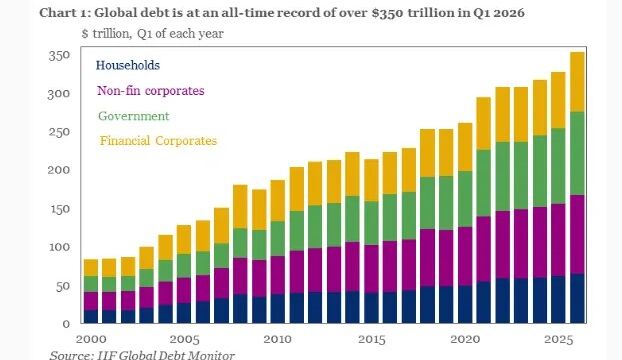
Consequently, global debt has soared to an estimated $329 trillion — more than three times the world’s GDP. The US alone carries over $100 trillion in debt, roughly triple its GDP, excluding about $15 trillion owed to government retirees.
A compulsive consumer might be cheerful or gloomy, wealthy or poor, clever or foolish, but until that burden is shed, trouble persists.
The US faces many challenges: Iran, Canada, a ‘heat dome,’ droughts, hurricanes, illegal immigration, domestic unrest, foreign conflicts, and pesky mosquitoes. However, the most conspicuous problem is the enormous debt neither major party dares to address—unsurprisingly, as they contributed to its creation.
It’s the debt, stupid—the outcome of past misguided ‘problem solving.’ Who recalls those times? Old flames, empty bottles, cigar ashes, faded headlines. The Gulf War of 1991, Obama’s record $1.4 trillion deficit in 2009, the 1992 LA riots, Hurricane Andrew, the Oklahoma City bombing, Monica Lewinsky?
They’ve passed from public attention, yet the debts remain — $40 trillion of accumulated federal liabilities that require perpetual servicing. Even at 5% interest, the annual cost nears $2 trillion, whether anyone recalls its origin or not. Last year’s federal revenue was $5.2 trillion, so nearly half of it now goes toward paying for largely forgotten and wasteful expenditures.
Politicians avoid addressing the debt because tackling it will cause pain. Like amputating gangrenous limbs without anesthesia or quitting cold turkey in an asylum, neither party has the resolve. Voters will protest. The media will grumble. Wall Street will tremble. And probably, a fringe politician will rise and ignite conflict to distract us.
Debt accumulation can be overlooked for some time, seeming manageable. But eventually, after the party ends, you find yourself in a ditch. Facing deflation isn’t pleasant, but many endure it because the alternatives are worse.
Clearing a debt hangover is tough. Short-term interest rates hover near zero, pushing governments to borrow more on the short end of the yield curve. This means frequent refinancing — even as rates climb. Even if the budget were balanced tomorrow, over $1 trillion would still have to be refinanced monthly.
According to Armstrong Economics:
Governments and corporations are expected to borrow a record $29 trillion from global bond markets in 2026, according to the OECD. That is $4 trillion more than in 2024 and twice the amount borrowed only ten years ago. This is the Ponzi structure underlying modern government finance.
Carlo Ponzi would be impressed. Nearly all post-war Western governments have adopted his scheme.
But where is this heading? The same destination as Ponzi himself: to disaster. Ponzi died penniless in a Brazilian charity hospital, with just $75 to his name.
Societies cannot indefinitely dedicate half of government revenues to service the costs of past errors. The toughest and most probable ‘solution’ is debt inflation — akin to curing a hangover with a pre-breakfast gin.
However, a bold leader might emerge, like Jean-Luc Melenchon in France, who proposes a more radical remedy: partially defaulting on French debt.
Perhaps that’s not such an unreasonable idea…
Stay tuned…
About the Author