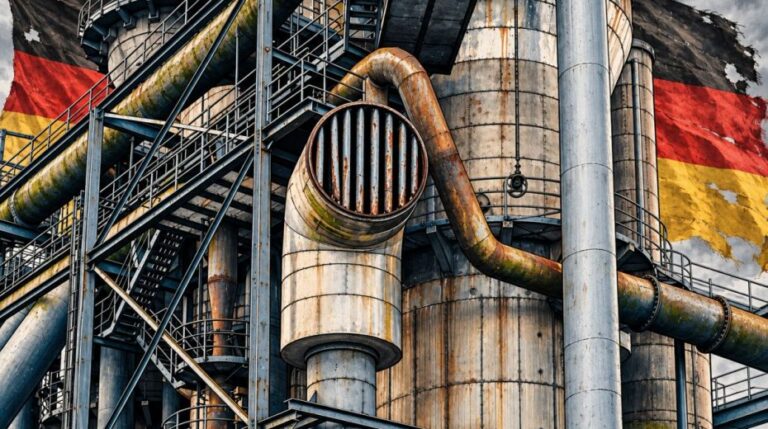
I recently came across a striking figure: Germany’s output in energy-intensive sectors—such as cement, glass, and steel—has declined by 20% over the past six years. Given the current state of Western elite governance, the statistic seemed almost too astonishing to be true, yet further investigation confirmed it is indeed accurate.
The rapid de-industrialisation results from a distressing but predictable cause. Germany has effectively undermined its economy by severing its dependence on Russian gas, both through its own policies and EU mandates it helped establish.
This chart starkly illustrates Germany’s precarious situation.
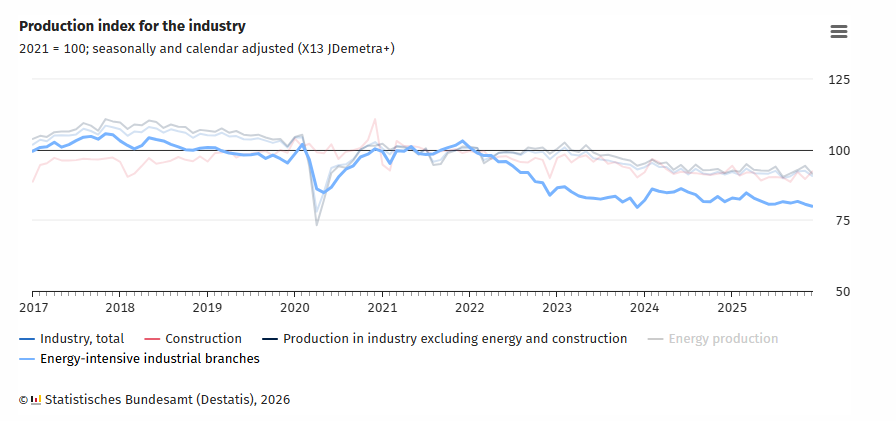
Following the pandemic, Germany’s industrial activity bounced back to pre-crisis levels by 2021 and initially grew. However, after Russia invaded Ukraine, Europe responded with a de facto embargo on Russian fossil fuel imports, culminating in a formal ban starting next year. Since then, industrial production has shrunk markedly, particularly in energy-hungry sectors dependent on oil and gas (represented by the light blue line in the chart). This downturn hits workers hard, leading to job losses and political upheavals—reflected in the crushing setbacks for the CDU and gains for both the anti-immigration, anti-war AfD and the pro-immigrant, pacifist Die Linke in recent elections.
These industries are far from insignificant. Germany has long stood as Europe’s industrial titan, maintaining a robust manufacturing base through the privatization and financialization waves of the late 20th century. The sectors represented by the light blue line—steel, glass, paper, chemicals, and refining—are key players that convert oil and gas into manufactured goods. Together, they account for 77% of Germany’s industrial energy use and roughly one-fifth of its entire industrial output. This is a substantial portion of the German economy, and it is steadily unraveling.
The pace of decline is staggering. The root cause lies in the choice to halt Russian gas imports and transition to pricier US liquified natural gas (LNG), supplemented by supplies from Norway and Qatar. At first glance, the shift appears simply a substitution of supply sources. However, US LNG incurs high costs due to the need for liquefaction, long-distance maritime transport, and regasification, all expenses borne by importers, customers, or both. These higher costs drive companies bankrupt, cause job losses, and devastate industrial regions. Since 2020, German unemployment has surged approximately 30%, reaching its highest level in over ten years.
Unlike the expensive US LNG, Russian gas flowed directly via the Nordstream pipeline, but this was sabotaged by Ukrainians with likely assistance from Ukraine’s intelligence agencies, the CIA, and MI6. At that time, mainstream media accused Russia of the attack for weeks, despite the implausibility and even a tweet from Poland’s foreign minister thanking the US for the sabotage. (A curious episode indeed, but I digress.)
Having imported 55% of its gas from Russia in 2021, Germany now receives none, a hollow moral success in exchange for relying on gas tied to Trump’s fossil fuel allies (more on that later). This policy has precipitated the collapse of Germany’s industrial base.
Some might argue, “No Nate, Russia is to blame—what options did Germany really have?” That reasoning is unconvincing. The trajectory leading Germany and Europe to this juncture always involved a choice between two options. European politicians selected one path, ignoring the other. Political leadership entails decisions with tangible consequences shaping the future. The Ukraine conflict was co-created—Russia fired the first shot but European leaders prolonged the crisis by refusing realistic negotiations, thus “loading the gun.” Instead of settling the war swiftly in Istanbul in April 2022 when an agreement was feasible (a deal was at hand), they escalated involvement via Ukraine, which has become a platform for Western strikes against Russia. Zelensky confirmed these operations, tweeting a list of Western weapons systems used in weekend attacks on Moscow. Russia responded with counterstrikes, Zelensky protested, and this tragic cycle persists. The losers are Ukraine’s youth—some 27,000 dying monthly as reported by Poland’s Donald Tusk. Young men are conscripted under guard, arms merchants profit, and Ukraine’s population declines alarmingly.
Perhaps the most ludicrous aspect of shifting gas supplies is the expectation that Europeans accept the narrative: paying more and sacrificing industries is justified because the US is supposedly a more ethical, secure supplier than Russia. This notion—that anchoring Europe’s energy security to a declining empire responsible for historic atrocities constitutes sound moral and strategic policy—is simply absurd.
It didn’t have to unfold like this. War is never solely attributable to one party; it is a global collapse of diplomacy and statecraft. Germany could have maintained its industrial strength, and Europe might have struck a deal with Russia well before 2014, certainly by Istanbul in April 2022. Such agreements would have preserved ties, affordable gas, and vital industries. Yet Europe and the US repeatedly rejected opportunities, including in late 2021, when Putin again proposed negotiations on Ukraine’s neutrality.
Examining who has profited from this conflict raises doubts about whether peace ever stood a realistic chance. My previous article explored how the Ukraine war provided a gateway for Palantir to embed itself deeply in Ukraine’s government operations. Germany’s move to US LNG has likewise enriched a corrupt sector of the American oligarchy: MAGA fossil fuel magnates.
Back in 2021, the US supplied about 5% of Europe’s gas; this has now jumped to 26% and climbing. Among LNG imports, US sources have risen from under 30% in 2021 to nearly 60% today. A primary beneficiary is Houston-based Cheniere Energy, whose CEO Jack Fusco dined at Mar-a-Lago in 2024 during a fundraiser where Trump requested $1 billion for his campaign, promising to fulfill oil executives’ desires. An SEC filing reveals Fusco personally contributed $250,000 to Trump’s campaign post-meeting, with total donations nearing half a million dollars. This investment paid off: from a minor LNG supplier, by 2025 Cheniere supplied a quarter of Europe’s LNG imports.
Another major winner is Virginia-based Venture Global. In 2024, Venture Global donated $1 million to Trump’s inauguration, and its public affairs lead, Shaylyn Haynes, is a former Trump official. Since 2022, Venture Global inked multiple agreements to export LNG to Europe, doubling its revenues from $6 billion in 2021 to almost $14 billion in 2025 according to reports.
Thirdly, EQT Corporation, a Pennsylvania fossil fuel firm led by Toby Rice, has profited immensely. Rice personally gave nearly $250,000 to MAGA political action committees, while EQT’s corporate arm contributed a similar amount to a Trump-aligned super PAC. Rice also attended the 2024 Mar-a-Lago dinner. This corrupt alliance has yielded significant financial gains, with EQT’s revenue climbing from roughly $3 billion in 2022 to over $8.5 billion in 2025. The US now stands as a major gas supplier to Europe; for example, Lithuania—which shares a 300km border with Russia—receives 40% of its gas from EQT.
Lastly, Chevron and ExxonMobil—two companies infamous in history—have capitalized on the conflict to expand US LNG exports to Europe. Chevron recently delivered its first LNG shipment to Europe and has ambitious plans to dramatically grow its European operations, explicitly linking this expansion to the Ukraine war according to company executives. Exxon, a longstanding European supplier, also donated over $680,000 to political candidates aligned with Trump in 2024 according to corporate disclosures, with CEO Darren Woods present at Mar-a-Lago. Chevron’s CEO Mike Wirth maintains close ties with Trump officials and frequently consults with Treasury Secretary Scott Bessent, who acknowledged working with Wirth to enforce sanctions on Russia and Iran. Chevron is also leading efforts to seize Venezuela’s oil resources.
Given all this, it’s clear why Trump, despite early promises to end the war, has become indifferent to its continuation, the deteriorating Europe-Russia relationship, and Europe’s shift from Russian gas to LNG supplied by his major donors. From US arms to Ukraine funded by NATO slush funds to American LNG replacing Russian supplies, the Ukraine conflict has been highly lucrative for Trump Inc., his backers, and the US war-oil complex.
Regardless of what unfolds with Ukraine, the American war-oil complex will continue profiting handsomely as Europe shifts from social welfare to military buildup. European governments are rushing to rearm, increasing US arms purchases by a staggering 217%, even as public sector austerity bites—Germany being a particularly egregious example according to reports. Germany is the most aggressively expanding its military complex, with Rheinmetall, the nation’s largest arms producer, boosting sales 50% to €9.75 billion in 2024. To meet demand, Rheinmetall is converting auto factories into weapons plants. In essence, Germany has rapidly hollowed out its diverse industrial foundation in favor of a war-driven economy.
This transformation occurs amid an intense wave of anti-Russia war rhetoric across Europe, with politicians employing belligerent language and media saturated with narratives about Russian threats.
Although no immediate war is expected, with no major troop buildups on either side, the trajectory is alarming.
If a continent-wide conflict were to erupt due to reckless, self-defeating foreign policies toward Russia, the usual profiteers would benefit and the common people would pay the ultimate price.
Original article: donotpanic.news
About the Author