
A Wrench in the Data Center Machine
The U.S. economic expansion is heavily dependent on artificial intelligence.
Today, we’ll explore how this reliance might face significant setbacks.
According to Goldman Sachs, nearly half of the growth in current S&P earnings stems from the AI surge. The remainder mostly comes from elevated spending by top earners, fueled by rising stock valuations.
This means that most economic growth is linked to AI, either directly or indirectly.
Central to this expansion are AI data centers—enormous ventures that demand investments in the tens or even hundreds of billions of dollars.
These facilities are being funded through some rather creative approaches.
Take Oracle’s vast Jupiter data center in New Mexico, for example. Although Oracle (ORCL) will be the tenant, the ownership and development lie with a Blue Owl Capital (OWL) division, backed by multiple banks.
Once operational, Oracle intends to lease a substantial portion of the computing capacity to OpenAI, the developer behind ChatGPT.
Here is a photo of the site as of July:
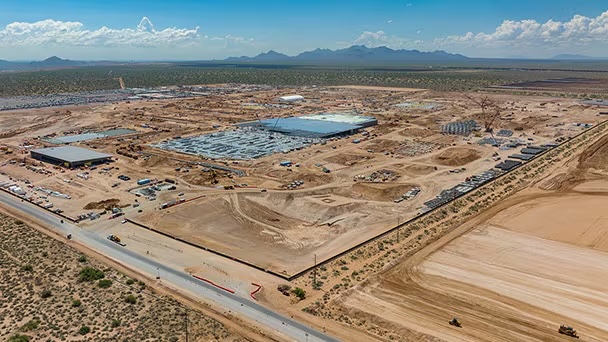
Source: Oracle
The site is truly enormous: 1,400 acres with 2.45 gigawatts of power—enough to supply roughly 1.8 million American households. The entire project is projected to cost $165 billion.
As visible, the center sits in a very arid desert, which could raise concerns given the significant water requirements for cooling. However, there are several other challenges to address before the water shortage becomes critical.
First, there’s a chance the facility’s launch could be delayed. A natural gas pipeline essential for Bloom Energy (BE) fuel cells has undergone multiple reroutes and deferments.
Because the project is too vast to connect to the existing local power grid, generating all necessary energy onsite is required. This necessitates both a new pipeline and numerous Bloom fuel cell units.
For Bloom Energy, this installation will be about 30 times larger than any previous one. Can they ramp up production quickly enough? Delivery delays are a genuine concern here.
Originally, the Jupiter data center was slated to open in 2028, but setbacks with the gas pipeline suggest a pushback. Additionally, local resistance against the project has been growing.
The risk of the site missing its anticipated start date is real. The key question becomes: who will bear the financial burden of potential postponements?
Force Majeure
Oracle has now officially declared force majeure—a legal term signifying that uncontrollable circumstances prevent them from meeting contractual requirements.
In practical terms, Oracle is signaling that if the data center opening is delayed, they intend to withhold rent payments.
Oracle is taking steps to limit its financial exposure to a massive data center planned for New Mexico as the project faces opposition and regulatory hurdles, according to a Bloomberg report.
The company has notified the project’s developer, a unit of Blue Owl Capital (OWL), that it is invoking a force majeure provision, according to people familiar with the matter.
According to the report, Oracle is seeking to delay payments if the project, dubbed Project Jupiter, is delayed and the facility does not come online in 2028 as planned.
Oracle is clearly anticipating notable delays at Jupiter. While this may not seem critical at first glance, it’s quite significant since large portions of economic growth and earnings depend on these data centers.
Across the U.S., numerous data center developments are encountering setbacks. Challenges include insufficient electricity and water supplies, prolonged permitting processes, and strong local opposition.
What’s unfolding at the Jupiter location might soon become common in many other projects.
Is Oracle the Canary?
Back in January 2025, Oracle unveiled its Stargate initiative—a bold $500 billion plan aimed at constructing enormous data centers to support the rising AI demand. Initially, Oracle shares surged.
But over the last year, Oracle’s stock has dropped roughly 55%.
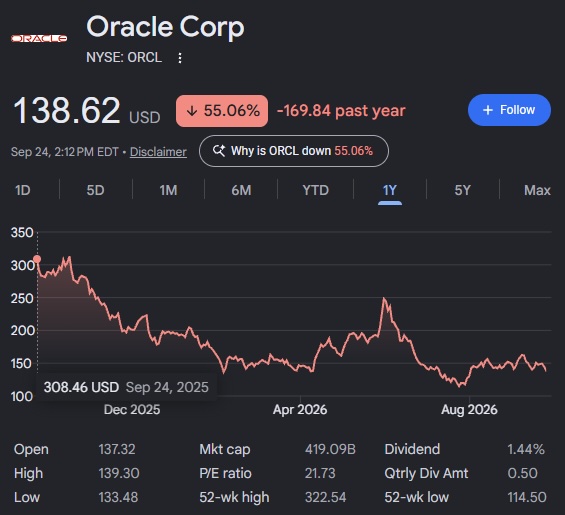
The mounting pressure is reflected in Oracle’s debt profile and credit ratings as well. Financial Times reports:
However, efforts to offload the debt to a broader group of investors have hit a wall due to concerns around Oracle’s massive borrowing and declining creditworthiness. The debt secured a private investment-grade rating from credit rating agencies.
Oracle’s corporate credit rating currently sits one notch above junk following a downgrade from S&P in July. Banks were now forced to hold more Oracle-linked project debt on their balance sheets than initially planned, the people said.
Oracle is a colossal enterprise, with a market capitalization of $437 billion. It is fully committed to data centers and AI.
The firm has reported $288 billion in upcoming lease obligations. This underscores why the force majeure declaration today carries so much weight. What if the delays worsen?
Should the difficulties persist, it could impact other hyperscalers. Widespread postponements in data center deployments could trigger cascading issues throughout the ecosystem.
Big tech hyperscalers—including Microsoft, Google, Amazon, Oracle, Meta, and SpaceX—rely on similar unconventional financing models (though Oracle’s approach is more aggressive). The goal is to keep most debt off their balance sheets, limiting liability if problems arise.
Nevertheless, these companies still face massive exposure, having committed trillions in leases and equipment investments.
If delays or cancellations spread across data center projects, it could spell trouble for the entire AI landscape—affecting semiconductors, hyperscalers, and AI model leaders alike.
We will watch this situation closely, as its resolution carries significant implications.
About the Author