The Last Triumph
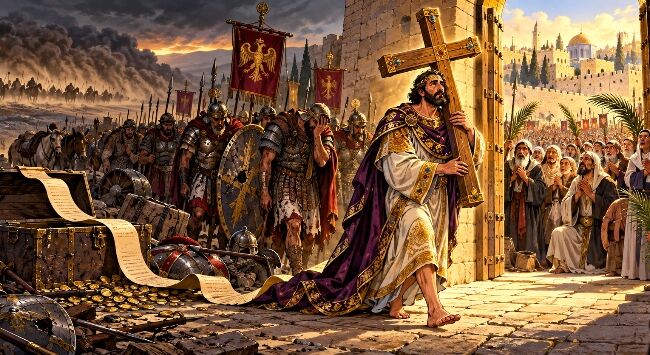
According to legend, in March 630, Emperor Heraclius arrived at Jerusalem’s gates dressed in full imperial glory, bearing the most sacred relic in Christendom: the True Cross, the very wood on which Christ was crucified.
The gates refused to open.
The tale recounts that an angel reminded him that Christ had entered the city on a donkey. In response, the emperor shed his regal garments, took off his shoes, and carried the Cross barefoot through the gates, like a humble penitent.
Only then did the gates swing open for the humbled ruler.
Historians often dismiss the barefoot episode as a devout myth added long after the fact. Perhaps. Yet the essence of the story remains intact—a remarkable comeback of historic proportions.
Still, it serves as a cautionary reminder that resonates painfully in our current difficult era.
Last Monday, Catholics globally observed the Feast of the Exaltation of the Holy Cross. Few know the tale of how the Cross was restored. I personally had never come across this story before. Let’s change that, because this narrative carries a lesson about triumph that few in The Swamp want to acknowledge.
The World Had Fallen Apart
When Heraclius ascended the throne in 610, the Byzantine (Eastern Roman) Empire was in steep decline.
The Persian Empire, led by Khusro II, had crushed the eastern territories. Syria and Palestine had been lost. Then, in 614, the Persians sacked Jerusalem itself, captured the Patriarch, and seized the True Cross.
For a Christian empire, this was more than a defeat; it was a colossal humiliation. The Cross symbolized divine protection over Rome, and now it was held in the Persian treasury.
Conditions worsened. Persia conquered Egypt, the empire’s vital grain source. Persian forces occupied Anatolia (modern Turkey’s Asian side). Meanwhile, the Avars menaced Constantinople from the Balkans. By the early 620s, many thought Rome’s decline was irreversible.
Pride Goes…
Then Heraclius surprised everyone.
In 622, he shifted from defense to offense, targeting weak points in Persian control. He advanced through Armenia and the Caucasus, circumventing enemy forces to strike at Persia’s core.
Near Nineveh’s ruins in late 627, his forces defeated a Persian army. He then pressed forward, torching Khusro’s palace at Dastagird.
Yet Heraclius did not seize the Persian capital. Nor was it necessary. Khusro’s nobles acted against him. A king stays in power only while he can satisfy his inner circle. When Khusro failed, his court betrayed him. In February 628, they deposed and killed him.
His successor brokered peace, returning Roman lands and prisoners. Most likely in March 630, the True Cross was brought back to Jerusalem, carried personally by the emperor.
Heraclius was celebrated as a new David, a new Constantine. He had taken over a fallen empire and, in eight years, transformed catastrophe into the greatest Roman victory in centuries.
But this revival was fleeting.
…Before the Fall.
The ancient world’s two powers had spent years devastating each other. Both treasuries were drained, armies depleted, and provinces impoverished. Civilians trading across borders felt little allegiance to either ruler.
On appearances, the empires seemed strong, but inside, they were hollow.
These fragile states were utterly unprepared for what emerged next.
Out of Arabia, unexpected armies struck lands neither Constantinople nor Ctesiphon had foreseen.
The Persian Empire collapsed completely under this onslaught, disappearing from history.
Heraclius, our barefooted hero of 630, lived to witness Syria and Jerusalem fall once more, this time to a new foe. His greatest triumph became a mournful procession. He just hadn’t yet realized for whom the funeral was.
Victory Lap… or Trap?
The most precarious moment for any power is after a decisive win over a weakened rival, because victory often conceals its true costs.
Though Rome triumphed in 628, it was financially ruined, strained, and brittle.
America had its celebration in 1991. The Soviet Union fell, and thinkers like Francis Fukuyama proclaimed “the end of history.” In reality, we spent the next 30 years engaging conflicts only to lose battles with our own fiscal house. Federal debt soared from $5 trillion to over $40 trillion. Our entire manufacturing base moved overseas, and only now are we grasping the consequences.
Like Heraclius, current leaders oversee a system designed to counter threats, but each response drains resources further.
Meanwhile, the next challenger expanded ports, factories, high-speed rail, advanced EVs, and supply chains while we debated the last conflict.
Although our borders won’t be breached by armies anytime soon, there’s a clear lesson: the moment of greatest confidence often masks vulnerability at its peak.
Put simply, the turkey is plump, contented, and boastful on the fourth Wednesday in November.
Wrap Up
Whether dealing with empires or soaring stock indices, examine the price of victory and who remains drained beneath the celebration’s glitter.
Paper claims tied to collapsing empires are fleeting. Invest in what endures beyond the State, not in promises that depend on its survival.
The city gate opened for a man bearing his own burden. It is humility, patience, and a long-term outlook that build and maintain what is truly valuable.
Heraclius received his miracle. He carried the Cross home barefoot as the crowds wept.
Though the empires of his time have crumbled into dust, we are fortunate that his lesson walked out of the gate alongside him.
Have a great day.
About the Author