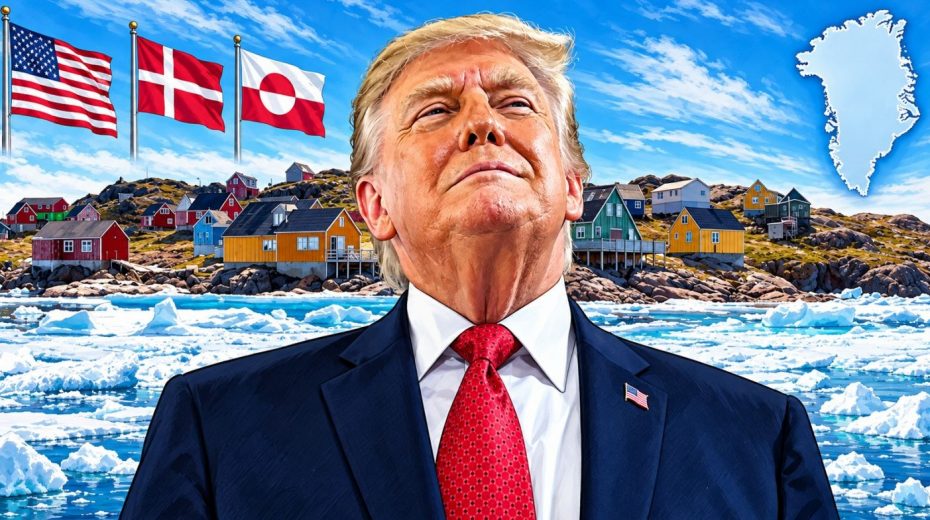
A new Security Pact separates the island from NATO, grants the U.S. veto authority over Chinese investments, and allows Washington to establish military bases without Denmark’s approval.
During Donald Trump’s second term, the issue of Greenland became highly contentious. Early on, Trump surprisingly announced that the US had a strategic interest in Greenland.
Those more knowledgeable about US foreign policy were already aware of two concurrent strategic currents: the revival of the Monroe Doctrine and the intensified focus on the Arctic region.
The renewed Monroe Doctrine aims to offset setbacks in other geopolitical areas outside the Americas, caused by the emergence of new powers challenging US dominance. By securing its “rear guard,” the US hopes to maintain its global leadership, especially amidst growing Chinese competition.
The race for the Arctic revolves around the recognition of the North Pole as a fresh arena for geopolitical rivalry, driven by climate change and technological advances that facilitate access to icy passages. Besides vast untapped natural resources and potential shipping routes, the Arctic’s strategic importance also stems from its capability to serve as a missile path between continents.
Greenland, a North American territory controlled by Denmark yet bordering the Arctic, thus occupies a pivotal position within these two critical US strategic objectives.
In late 2025, Trump designated Governor Jeff Landry as the US envoy tasked explicitly with integrating Greenland into the US sphere. Denmark understandably perceived this “mission” as a threat and sought support from European allies within the EU, especially France under Macron.
Uncertainty surrounded American intentions, with speculation ranging from a military landing to US attempts to incite a color revolution or a separatist vote. Others speculated that US pressure aimed at compelling Denmark to negotiate sizable concessions, all while keeping nominal sovereignty intact.
Ultimately, this last scenario came to pass.
It is necessary to highlight that European reactions, particularly from France, involved strong rhetoric. The EU threatened to deploy troops to Greenland, and some warnings hinted at possible direct conflict with the US. Yet, resistance from Europe remained largely verbal, and constructive talks soon began, yielding clear outcomes.
Indeed, a defense pact between Denmark and the US already existed since 1951, originating during the Cold War and within NATO’s framework concerning Greenland.
Under that treaty, the US was permitted to establish military bases in Greenland as part of NATO operations, but only with Denmark’s consultation and consent. It also set rules governing troop movements between bases under Danish oversight.
The Security Pact signed in September 2026 significantly alters US-Denmark relations, effectively transferring control of Greenland to the US, despite the island’s nominal Danish ownership.
Firstly, the agreement removes any NATO connection. It is purely bilateral, meaning US decisions about Greenland no longer rely on NATO strategy or timelines.
Secondly, the pact authorizes expanding the existing base at Pituffik and constructing new facilities at Narsarsuaq and Mestersvig. Moreover, the US can build additional bases unilaterally if deemed necessary for its national security, with Denmark only consulted retrospectively. Also, Danish authorities and citizens need US permission to develop areas adjacent to the bases.
Thirdly, the US acquires veto rights over military presence and major strategic investments from any non-NATO or non-partner countries within Greenland. For instance, establishing an observatory or port development requires US approval, with China being the primary target of this veto.
Throughout the first half of Trump’s second term, his administration experienced mixed results—low approval ratings, setbacks against Iran, failed promises of reindustrialization from tariffs, and slow progress on “mass deportations.” Nevertheless, this near-annexation of Greenland stands out as a major achievement, solidifying the Arctic as a critical theater for future geopolitical rivalry and granting the US a notable strategic edge amid emerging global conflicts and competition.
About the Author