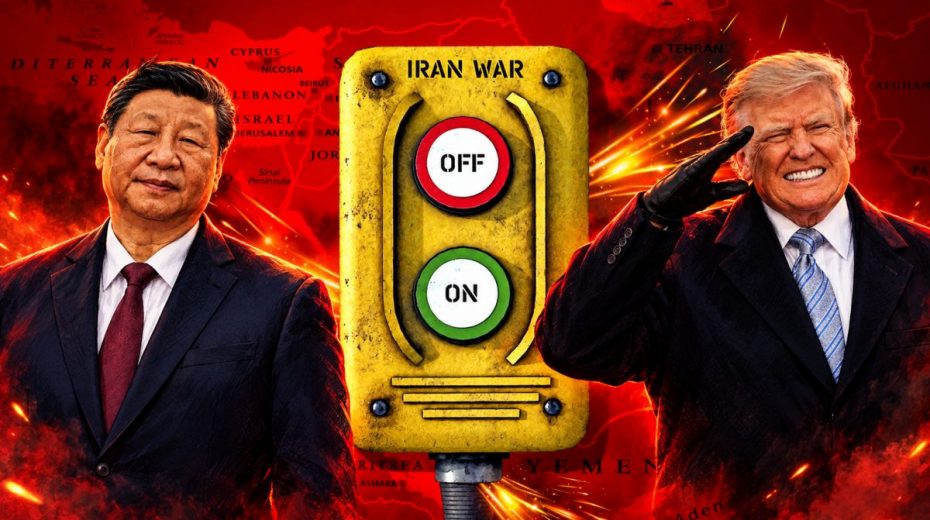


The United States’ sociopath president completely dismissed the peace plan China proposed to resolve the Iran situation, which President Xi Jinping personally delivered at the White House last Thursday.
In essence, Xi pointed out to Trump that a diplomatic exit was already available: revive the memorandum of understanding (MoU), previously signed then discarded by Trump himself. China has expressed readiness to fully back this diplomatic path.
As expected, Trump rejected both Xi’s proposal and Iran’s detailed seven-day stepwise approach to reengage in talks, as put forward by Foreign Minister Araghchi in New York.
This joint plan is best understood as the China-Iran proposal, refined by Araghchi and Wang Yi during their meetings at the BRICS summit in New Delhi and later in Beijing.
Trump’s refusal extended beyond rejection; he boasted amidst global ridicule that the U.S. commands “total control” over the “Strait of Trump.”
The insult struck a nerve with Wang Yi and Xi, as Asian culture views ignoring a formal recommendation from the highest official level as the gravest loss of face.
Consequently, China’s forthcoming reaction is expected to be as ruthless as silk laced with venom. Beijing is poised to intensify its backing of Tehran significantly, in multiple facets.
Meanwhile, the IRGC has tightened its grip on the Strait of Hormuz. Within just two days, Iran destroyed 19 tankers attempting passage without adherence to IRGC Navy/PGSA regulations, including fee payments.
This sparked a widespread quip across West Asia: “someone tell Trump who’s Daddy in the Strait.”
Tehran played its diplomatic cards expertly in New York, not only compelling the neo-Crassus/neo-Caligula/Goldfinger figure to publicly dismiss a peace offering but also provoking him into hinting at an Iran bombing campaign post-midterms; it became globally evident that the sociopath disregards the cascading global crises in economics, fuel, and food—actually causing them.
Additionally, President Pezeshkian delivered an impeccable performance both at the UN and during meetings with U.S. think tank leaders and major newspaper editors in a New York hotel, seizing the media narrative right inside enemy territory—an achievement for the ages.
Trump closes the door Tehran opened yet the clock keeps running
The Hormuz blockade is increasingly porous. A significant volume of oil now flows through Saudi and Iraqi tankers, accompanied by substantial petro-yuan transactions. Smuggling thrives, even within the U.S.-monitored Omani corridor, with Iranian oil shifting through both covert and official channels.
Persians excel at clandestine survival tactics after 47 years under sanctions, sustaining energy exports to China, Southeast Asia, and South Korea.
This Wednesday marks the end of the 45-day deadline Tehran imposed on August 16 for the Trump naval blockade to be lifted. Coincidentally, Iraq’s own demand for complete U.S. troop withdrawal also expires on September 30.
These deadlines intersect with the ultimatum from Mohsen Rezaee, secretary of the Supreme National Security Council and Iran’s effective number two, who set a Monday deadline—today—for the blockade’s end.
In short: Washington shut the door Tehran opened, but Tehran’s timer continues. According to our source at Transition Protocol, senior political and IRGC leadership have finalized their next moves.
They plan to remain steadfast through Wednesday. Absent progress toward the terms President Xi outlined to Trump, Tehran is prepared to take five decisive measures:
1. Extend conflict beyond Hormuz into the Indian Ocean.
2. Assert the right to attack any American naval vessel sustaining the blockade.
3. Collaborate with Ansarallah to broaden the blockade to Bab al-Mandab.
4. Preemptively counter any perceived threatening military build-ups.
5. Limit airspace access for any nation joining the aviation blockade.
Complete escalation is on the table.
Currently, there is a severe warning concerning the Indian Ocean, threats against all U.S. deployments if attacked, and a declared preemptive stance.
Yet, no explicit directive to directly engage U.S. ships has been issued.
Regarding aviation, Iran intends to respond in kind, not with missile strikes.
The Iranian leadership’s position on U.S. secondary sanctions targeting airports hosting Iranian flights is unambiguous:
“If our aircraft do not get into the air, then your aircraft will also not get in the air.”
This stance was expressed by Supreme Leader adviser Mohammad Mokhber. On Saturday, Mohsen Rezaee clarified that Iran won’t respond militarily to these bans, is negotiating with affected states, and retains “multiple non-military options” concerning certain airports.
Beyond major powers China and Russia, several countries including Turkey, Malaysia, Vietnam, Uzbekistan, Tajikistan, and Kazakhstan are ignoring the imperial aerial siege on Persia altogether.
Then there’s the special case of Iraq.
Iraqi Resistance forces declared intentions to target GCC airports. Subsequently, prominent clerics in Najaf and Karbala protested in unison, undermining the puppet Baghdad government’s legitimacy.
Large-scale protests erupted in Basra—the country’s oil hub with armed Bedouin Shi’ite tribes. One tribal sheikh gave Baghdad 48 hours to end its complicity in the U.S. sanctions against Iran, potentially allowing an exception for flights between Iran and Najaf for pilgrim transport.
Iran’s clock and the U.S. clock: the Window of Supreme Risk
Turning to the Red Sea theater.
An unimpressive “coalition of the willing”—comprising Saudi, Turkish, and Pakistani chiefs of staff and meeting last Friday in Riyadh as the Mecca Defense Alliance—transitioned from mere talk to tentative operational planning, yet stopped short of announcing joint Yemen strikes.
Ansarallah remains unfazed, launching drone attacks on Riyadh and missile strikes on Khamis Mushait, describing these as a “rehearsal” for a larger escalation.
Brace for the impending Yemeni Storm.
Yemenis are enraged after Saudi airstrikes on a crowded Taiz market killed and injured at least 50 civilians, including women and children. This likely relied on direct CENTCOM intelligence and surveillance.
Yemeni sources in Sana’a report Ansarallah might soon implement an air embargo on Saudi Arabia. Riyadh is already in a blackout phase, with Google and Western satellites censoring images of damaged oil infrastructure in Riyadh, Jizan, Abha, and Najran.
Thus, the chance of significant Iranian or Ansarallah offensives targeting U.S. naval assets, broader shipping lanes, or Saudi bypass routes near Yanbu remains substantial through the end of the week.
Still, the most probable scenario is a heavily militarized stalemate in which Tehran opts for signals over strikes on September 30.
Undisputedly, the period spanning September 30 to November 3 marks the Window of Supreme Risk based on the timing of Iranian and U.S. actions.
True Arab civilizational poles vs. dumb camel herders
This leads us to a crucial disclosure from an insider involved in the high-level China-Pakistan-Iran alliance. After Xi’s U.S. visit, Wang Yi held a confidential conversation with Pakistani Foreign Minister Ishaq Dar.
China has effectively given up hope on Washington and is now leveraging Islamabad to de-escalate the situation. Pakistan’s top officials are tasked with mediating with both Trump and MbS before tensions spiral out of control this week.
It is implied that Pakistan—and possibly not Turkey—will not support Saudi Arabia’s purported large-scale operation against Yemen.
This was corroborated by a second senior Islamabad source who indicated Pakistan recognizes that backing the failing House of Saud would end its role as mediator between Iran and the U.S., rendering Islamabad’s previous MoU efforts defunct.
It’s essential to remember that historically Baghdad, Damascus, Cairo, and Sana’a constituted the genuine cultural centers of the cosmopolitan Sufi Arabs—unrelated to the crude Saudi monarchy.
This connects to the two main priorities for the Epstein Syndicate.
They seek Persia’s destruction—the nuclear genocide declared at the UN by the sociopath POTUS—paired with the obliteration of the Arab Axis of Resistance in Lebanon, Iraq, and Yemen. They also aim to dismantle the wealthy GCC petro-sheikhs, who might maintain influence or unpredictability post-Axis defeat.
This context frames the “secret” private plane visit by the West Asia death cult leader to Abu Dhabi on Sunday to meet MbZ, spending the entire day in the Emirates with no leaks. This occurred immediately after the leader vilified Iran at the UN once more.
It is now evident that Yemen and Persia represent a linked dual-front in West Asia. Watch closely for the fallout from this clandestine meeting of the death cult and Arab Zionists. West Asia is on the brink of inferno, blazing all the way to the heavens.
About the Author