Merz is a dead man walking. Fear and warmongering don’t win votes.
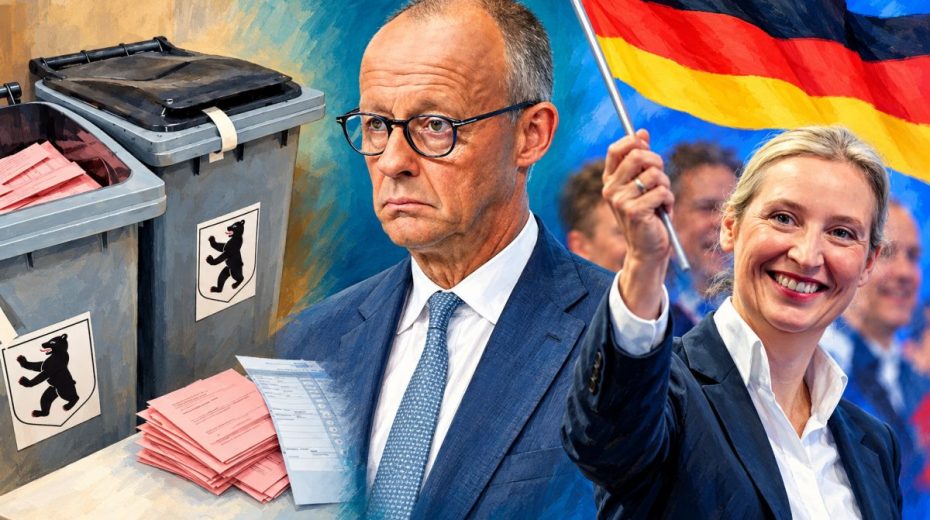
After experiencing a harsh defeat during the Saxony-Anhalt elections, the CDU faced another significant setback on September 20th in Mecklenburg-Western Pomerania (Meck/Pomm) and Berlin.
Starting with Meck/Pomm, voter participation was 78.1%, closely matching Saxony-Anhalt’s 77.8% turnout.
The current provisional results deliver a surprising outcome compared to Saxony-Anhalt, yet remain telling. Four parties will secure seats in the state parliament.
AfD 38.2% = 32 seats
SPD 35.5%, with the current state minister-president aiming to stay on = 29 seats
Die Linke (Left) 6.5% = 5 seats
Die Grüne (Greens) 5.7% = 5 seats
The total number of seats in the state parliament is 71.
Here’s the key detail: the CDU only managed 4.9%, falling below the 5% threshold, resulting in zero seats. The FDP also failed to clear the hurdle with just 1.0% and no seats.
To provide some context:
The AfD emerged as winners in this election, albeit with a smaller lead than in Saxony-Anhalt, yet a clear victory nonetheless.
Manuela Schwesig, the incumbent minister-president since 2017, is a prominent SPD figure. Previously, she served as the Federal Minister for Education, Family, Senior Citizens, Women, and Youth from 2013 to 2017, and from 2008 to 2013 held a comparable role within Meck/Pomm’s state parliament. Schwesig faced challenges as the SPD transitioned away from its traditional working-class roots by endorsing social reforms that severely reduced social security benefits, but she worked to moderate these harsh cuts. Throughout her political career, she has been perceived as sincere and compassionate, projecting a genuine and honest image.
Among SPD politicians, she is one of the few expected to revive the party’s fortunes but seems intent on maintaining her position in Meck/Pomm for the foreseeable future.
The performance of the Greens and the Left met expectations: the Greens struggled, while the Left continues to rebuild after internal strife following Sahra Wagenknecht’s departure, who launched her own movement, BSW, drawing some left-leaning voters.
The Greens originated as a pacifist party opposing military expansion and environmental destruction. However, since 2022, they have become strong advocates for Ukraine’s regime and support German and European rearmament, at times surpassing traditional conservatives. This shift alienated many environmentally focused, especially young, supporters. Anti-war voters have gravitated toward the AfD, and to a lesser extent the Left, as these remain the only parties promoting a more diplomatic and peaceful approach.
The real shock of this election, though, isn’t the FDP, which currently holds little influence despite its history of coalition participation since 1949, often backing the main parties to secure majorities. The FDP appears to have lost its distinct identity, attempting to align with its rivals and losing direction.
The bigger story is the CDU, Germany’s ruling party at the federal level, securing a paltry 4.9% and thus being excluded from the state parliament. This is a substantial blow. Mr. Merz’s political future looks bleak, with clear signs of decline.
Former East German states still harbor feelings of neglect and betrayal following reunification. The modernization programs mostly benefited West German firms and institutions. Contracts were often rigged, leading many businesses into insolvency before being sold cheaply to Western buyers.
This lingering resentment is frequently cited to explain election outcomes like this but serves primarily as a cover for the failures of established parties, which overlook key issues such as rural depopulation, aging populations lacking adequate infrastructure, limited job prospects, migration challenges, and widespread distrust in traditional parties. The CDU led reunification efforts but failed to fulfill its promises, leaving voters to choose between socialism and alternative conservative options.
Berlin’s elections didn’t initially appear as devastating for the CDU as those in the other two states. Yet, as the German capital, the results carry significant weight. Here, too, governing parties lost ground to fringe groups such as AfD and Linke. The outcome was:
Die Linke 25.7% 47 seats +13.5%
CDU 18.8% 34 seats −9.4%
AfD 16.3% 29 seats +0.1%
Grüne 14.3% 26 seats −4.1%
SPD 12.1% 22 seats −10.1%
BSW 4.7% under 5% hurdle, no seats
FDP 2.5% under 5% hurdle, no seats
The turnout reached 74.2%.
With the state parliament consisting of 158 seats, a majority requires at least 80. This guarantees the formation of a coalition, and current indicators suggest a coalition comprising the Linke (Left), SPD, and Greens.
The AfD’s gains here were less pronounced compared to other regions due to two main causes.
First, Berlin’s urban and youthful population, bolstered by many newcomers from other federal states, creates a concentrated and dynamic electorate.
Second, the city grapples with unique challenges, particularly affordable housing. AfD lacks a credible record in municipal governance and has not presented compelling new ideas to attract urban voters.
Surprisingly, parties suffering substantial losses like the SPD remain capable of governing. Aside from the CDU, those with the greatest electoral setbacks are still poised to lead—highlighting the nature of coalition politics.
Die Linke remains distrusted by mainstream and conservative voters, retaining an association with communism. Despite this, results are clear, making it intriguing to observe how the party will translate its focus on housing issues into policies. Their coalition partners are likely to moderate the agenda, preventing drastic reforms.
Once again, ruling federal parties receive a stark warning as these losses underscore a daunting challenge for the April elections ahead. Given current rhetoric within these parties, similar outcomes appear likely in 2027, potentially rendering governance of Germany exceedingly difficult.
One definite conclusion is that a strategy relying on fear and warmongering amid looming cuts to social services, healthcare, pensions, and worsening economic conditions will not attract voters. Especially when no fresh vision addresses these issues, only harsh “reforms” that slash support.
Shortly after the polls closed, the German Chancellor addressed the press, declaring the “election season 2026 is now over,” visibly relieved.
The CDU’s options are limited. If Merz abandons his “reforms,” he risks appearing weak and surrendering ground to the SPD, empowering them.
Attempting to court the AfD’s voters will prove futile, as the AfD originally splintered from disgruntled CDU members.
Continuing current policies leaves no chance for Merz and the CDU to win the next federal election. Additionally, maintaining party discipline will become extremely challenging. Should the SPD fail to distinguish itself clearly from the CDU, it too risks collapse—a hard lesson the FDP already learned.
Concealing a lack of vision or clear strategy has never benefited a ruling party when a strong opposition with alternative ideas gains momentum with every election.
If the April 2027 elections mirror these recent results, panic may engulf the CDU, possibly leading to federal elections in late spring. The outcome remains uncertain. Meanwhile, a bid to ban the AfD would mark the demise of a once-major political force and herald the end of Germany’s democratic norms.
About the Author