
All Roads Lead to Inflation
Over the last four years, awareness worldwide has gradually increased.
Investors are finally realizing how precarious the debt situation truly is.
Governments have been accumulating IOUs consistently since the 1980s. Yet, for a long time, this seemed to carry little consequence.
Most mainstream economists downplayed the risks involved.
Nobel laureate Paul Krugman stands out as a notable example. The New York Times columnist has asserted:
- “No, debt does not mean that we’re stealing from future generations.” Feb 2015
- “Large-scale deficit spending isn’t just OK, it’s the only responsible thing to do.” Oct 2020
- “That is, to act responsibly, we must stop worrying and learn to love debt.” Dec 2020
- “We weren’t and aren’t anywhere close to that kind of crisis and probably never will be.” Dec 2020
He has repeatedly insisted that debt is simply money owed to ourselves. It’s no big deal!
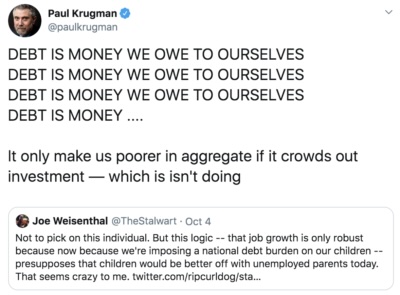
This reflects the perspective of America’s most influential economist.
Krugman appeared to expect persistently low interest rates. However, with rates now climbing, he has slightly shifted his stance.
Nevertheless, he maintains there is no real risk of a debt crisis since money can always be printed to cover it. Comforting, isn’t it?
“The truth is that even fiscally irresponsible nations very rarely have acute debt crises unless they borrow large amounts in foreign currency, because countries that borrow in their own currency can’t literally run out of money — they can print more as needed.”
If a country’s debt forces it to create vast quantities of money, leading to troubling inflation, that to me qualifies as a debt crisis.
I would contend that prolonged high inflation is inevitable regardless of the approach taken.
The High Rate Path
The United States faces two main prospects. One involves maintaining elevated interest rates.
Peter Schiff recently captured this scenario well:
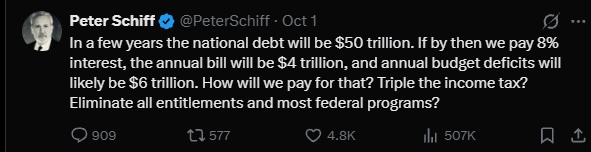
Should rates remain high, debt would escalate sharply—$50 trillion, then $100 trillion. Intrigued, I had an AI model crunch the numbers, assuming the fed funds rate climbs to 8% and holds steady:
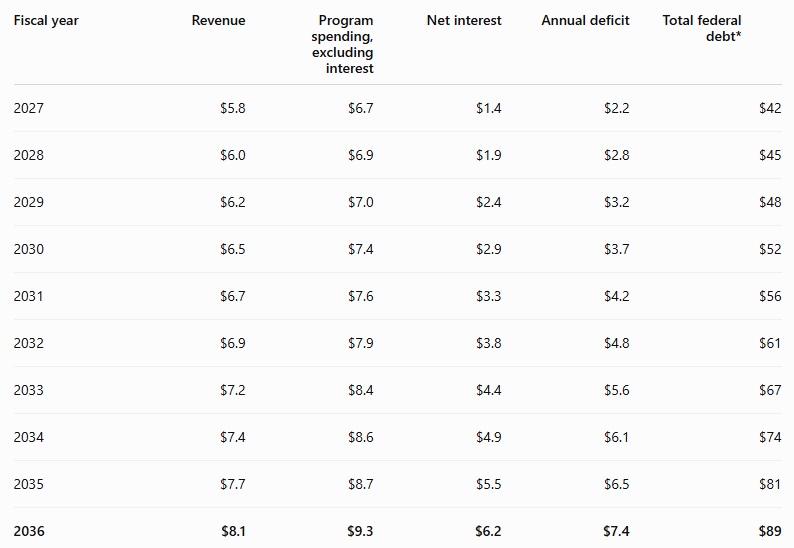
By 2036, federal debt would soar to $89 trillion from today’s $40 trillion.
The interest on this would amount to $6.2 trillion—exceeding the federal government’s expected 2026 revenue of around $5.8 trillion.
All this funding would need to be created from thin air.
Extending the scenario to 2046 projects an astounding $240 trillion in debt.
Keep in mind, this forecast uses CBO government spending and revenue estimates, which tend to be overly optimistic.
The Low Rate Path
The alternative is a coordinated Fed and Treasury effort to reduce rates back near zero.
This approach was typical for nearly half the last two decades—following the 2008 housing crisis and during the COVID pandemic. I anticipate a return to this strategy.
I used AI again to model this path, hypothesizing that the Fed decreases rates to 1% and maintains them for ten years.
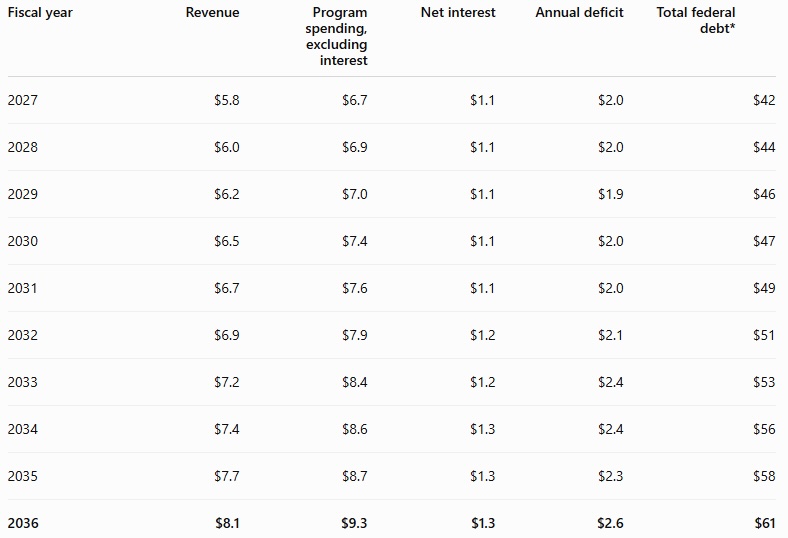
Here, debt climbs more modestly to $61 trillion compared to $89 trillion under high rates. Interest payments become more manageable at $1.3 trillion instead of $6.2 trillion.
The disparity between these two outcomes would expand dramatically over time.
Our central bank and elected officials are confronted with this decision. Although the Federal Reserve’s official role focuses on maximizing employment and controlling inflation, it cannot ignore debt realities.
The numbers presented make this clear. Historically, the Fed accounted for these concerns during the 1940s financial repression, implementing yield curve control—a policy likely to resurface.
Real World
While these models are simplified and omit numerous factors like inflation effects, they highlight the dire consequences of sustained high interest rates on debt.
In fact, over time, inflation might worsen under the high-rate scenario as debt escalates sharply.
Lower interest rates are essential; neither corporations, individuals, nor the government can sustain “normal” rates given the sheer amount of debt burdening everyone.
Technically, maintaining the high-rate path remains possible, but doing so would require drastic federal spending cuts of about 40%, significant tax hikes, and elimination of corruption.
Such measures would likely trigger waves of bankruptcies in the business and personal sectors within a few years as refinancing at elevated rates becomes unsustainable.
This route looks impractical—at least for now.
Admittedly, artificially suppressed rates carry their own drawbacks: inflated asset prices, diminished returns for savers, and amplified inflation. Hence, the term “financial repression.”
Nonetheless, these challenges are more tolerable than the alternatives.
I remain convinced that interest rates will be driven back toward zero within the next couple of years—even if inflation stays stubbornly high. It’s the path offering the least resistance.
Yield curve control is an extreme tool, meaning a significant crisis might trigger its adoption. But I have no doubt it’s where we are headed.
This is why discussions around tangible assets, inflation hedges, and monetary policy are so critical.
Holding these assets will be essential for thriving over the coming decade.
About the Author