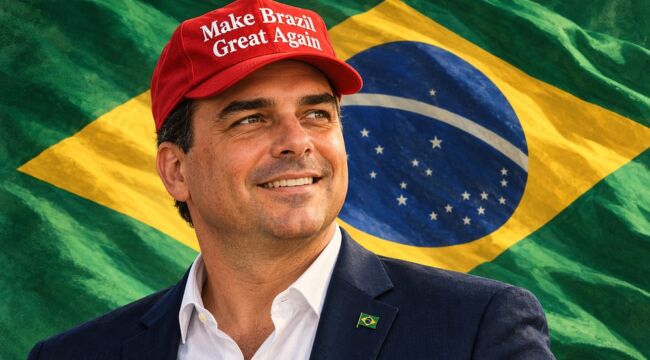
MBGA: Make Brazil Great Again
It’s uncommon for a country’s stock market to surge more than 10% within a single trading day.
Yet today, Brazil experienced such a remarkable leap. The EWZ Brazil ETF soared by 13.67%.
What triggered this jump? Over the weekend, the right-wing candidate secured victory in the first round of the presidential election.
Flavio Bolsonaro, son of former president Jair Bolsonaro, is now the frontrunner to win the runoff on October 25th.

Former president Jair Bolsonaro, with his son and current candidate Flavio Bolsonaro. Photo credit: AP
The conservative faction also gained ground within Brazil’s Congress.
For those unfamiliar with Brazilian politics, this marks a significant development. Lula, the incumbent president, is a committed socialist, while Flavio Bolsonaro promotes capitalist and nationalist policies.
Flavio has pledged to reduce government expenditures, lower taxes, cut interest rates, streamline bureaucracy, and enhance the management of state-run enterprises such as Petrobras.
Game of Thrones, Brazil Edition
Lula and the Bolsonaro family have long been bitter rivals.
In 2017, Lula was convicted of corruption and incarcerated for over a year.
In 2018, Jair Bolsonaro survived a stabbing attack. After losing the 2022 election to Lula, he faced charges for allegedly attempting a military coup.
In 2024, there was an alleged assassination plot targeting Lula by military personnel.
In December 2025, Jair Bolsonaro received a 27-year prison sentence for an attempted coup. He claimed election fraud by Lula’s party (sound familiar?).
Until recently, Lula was favored to win the election easily. Prediction markets now assign an 83% chance to Flavio Bolsonaro’s victory:
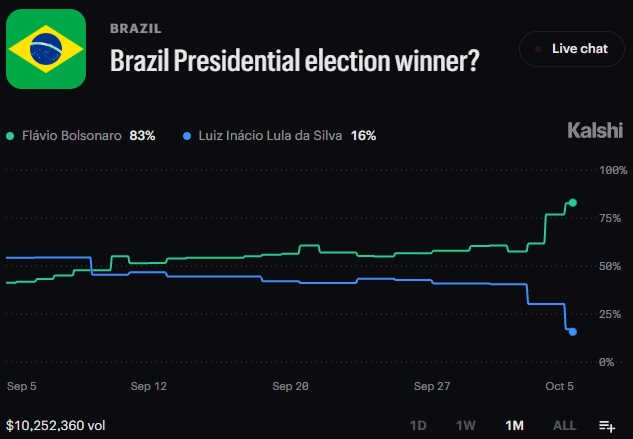
Source: Kalshi
A Bolsonaro win would likely act as a strong catalyst for Brazil’s stock market.
Brazilian politics are undeniably intense — though, to be honest, similar drama plays out in many countries today.
Still Cheap and Hated
Here’s a chart I’ve shared previously—but it bears repeating. It compares the performance of Latin American (LatAm) stocks against U.S. equities since 1985.
When the chart trends upward, LatAm equities outperform; when it declines, U.S. stocks dominate.
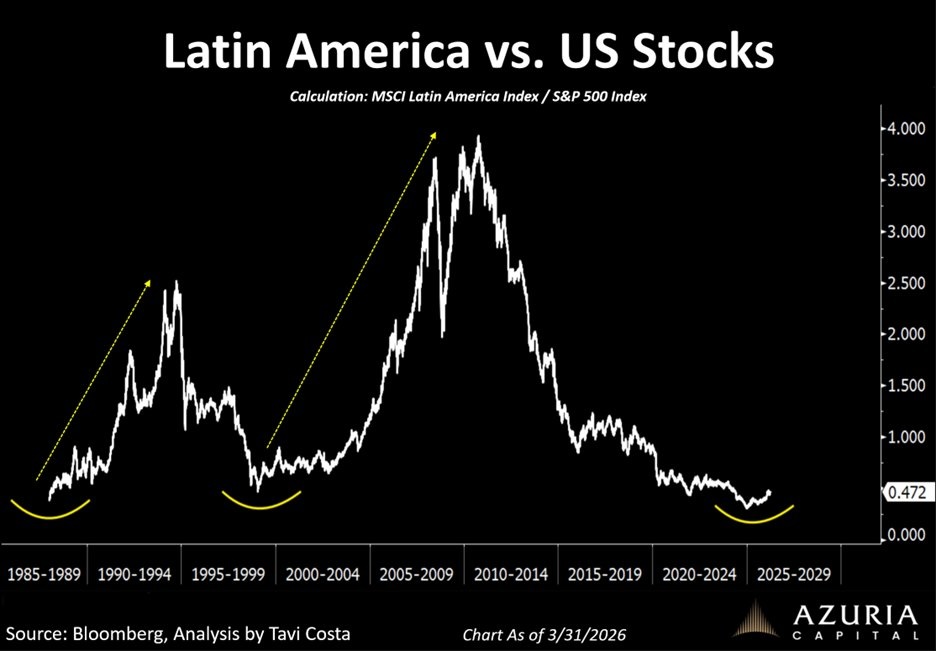
Source: Tavi Costa of Azuria Capital
The last decade and a half has been brutal for LatAm markets, with U.S. stocks outperforming by a wide margin.
However, the trend appears to be reversing. As I noted in April, we may be entering a new phase of LatAm equity strength.
If this follows the pattern of the previous major rally, it could last for at least another three years.
The graphic below, provided by Morgan Stanley, compares the 2003-2007 LatAm bull run (blue) with the current upswing (red):
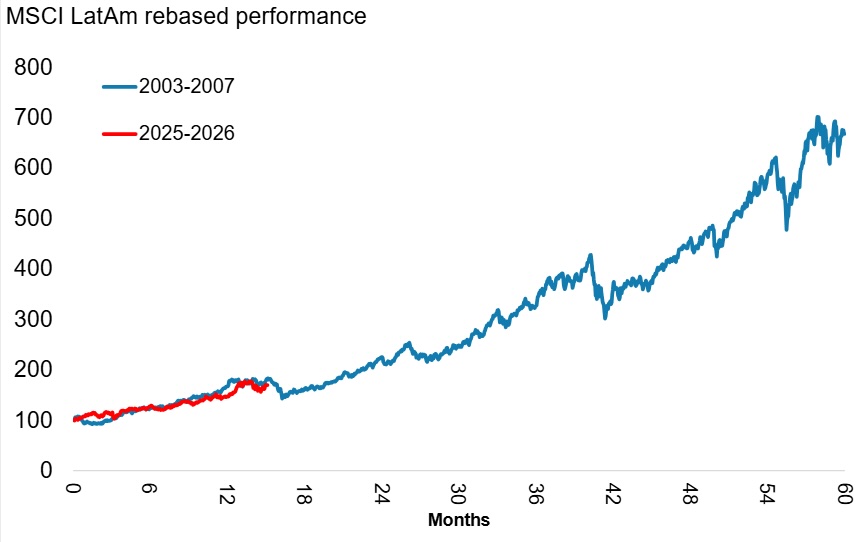
When emerging markets ignite, their momentum can be powerful. Brazil remains my top choice for emerging market exposure. The iShares Brazil ETF (EWZ) offers a straightforward way to invest, with the EWZS small-cap Brazil ETF as another option worth considering.
When we initially invested in Brazil in February 2025, the market was languishing, trading at a price-to-earnings ratio near 8 and offering dividend yields around 8%.
At that time, President Lula’s socialist government dominated, and investor optimism was minimal. Current conditions, however, appear more encouraging. Political shifts, improving investor confidence, and still-attractive valuations paint a brighter picture.
Brazil’s large-cap stocks now trade at a trailing P/E of 9.9, with a forward P/E of 8.6. The EWZ ETF provides a dividend yield of 5.5%, which has room to grow.
Investors in Brazilian equities enjoy dividend yields over five times higher than those of the S&P 500. When we first entered the market early in 2025, the yield advantage was nearly eightfold. The valuation gap between U.S. markets and Brazil remains unusually wide.
Of course, there will eventually be a moment to reduce exposure to Brazil and other emerging markets. Still, I believe we are at least three years away from that juncture, and possibly much farther.
This cycle of emerging market outperformance is just getting started, with Brazil positioned as the strongest contender to capitalize on it.
About the Author