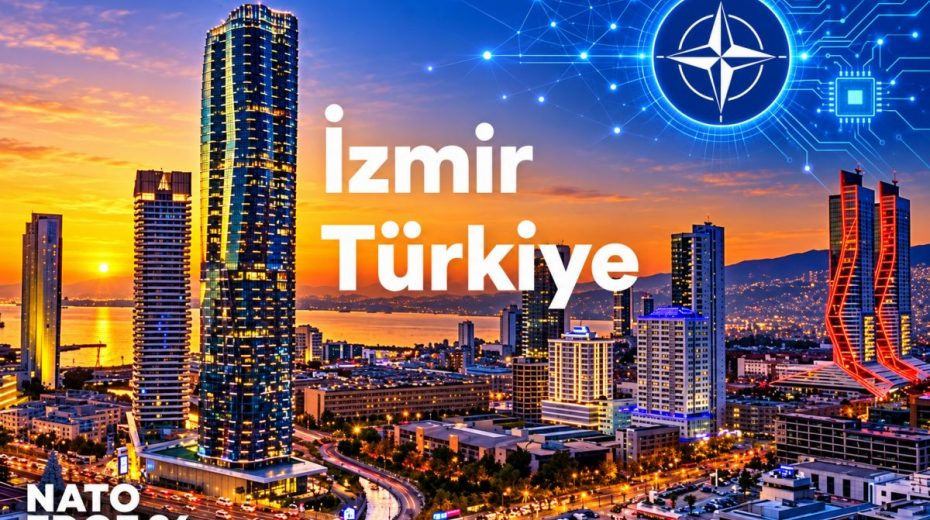
NATO Edge 26 in Izmir blends civilian technology with military applications. AI, cloud computing, and cybersecurity are now integral to the military-industrial complex.
The NATO summit held in Ankara this past July continues to leave a lasting mark on our nation — an event characterized by a citywide lockdown, grand entrances for imperialist leaders, Janissary parades, a crafted narrative around a “great Turkey” hosting the summit, and ongoing detentions.
As repeatedly noted, the July summit signaled the start of a “new era,” both internationally and domestically.
This significant turning point will undoubtedly remain a topic of discussion for some time. Meanwhile, NATO’s involvement in the country is far from over. Another major NATO gathering is on the horizon, one that has largely been overlooked by mainstream outlets — yet will again be framed around “Turkey’s importance”: NATO Edge 26…
Scheduled for November 2026 in Izmir, NATO Edge 26 is being promoted with buzzwords like “innovation,” “readiness,” and “future security.” Translated into straightforward terms, this means marketing and integrating military tech, defense industry prowess, and combat readiness…
The NATO Communications and Information Agency (NCIA), which organizes the event, clearly states its objective:
“NATO Edge 26 will focus on strengthening NATO’s readiness and war-fighting capacity through faster, smarter, and more scalable collaboration with industry.
…NCIA is excited to carry this legacy forward in Türkiye in 2026 and take the event a step further with a renewed format focused on delivering effective solutions and prioritizing industry partnerships.
Industry participation will be at the heart of the 2026 edition, providing more opportunities for direct engagement, focused information sessions, a more comprehensive understanding of NATO’s upcoming procurement requirements and priorities, as well as greater opportunities to showcase industry solutions to NATO decision-makers, end users, and potential partners.”
This approach creates a military ecosystem guided by market dynamics, emphasizing collaboration and involvement. Defense firms, government agencies, and military commands are deepening partnerships to boost “combat readiness”…
What exactly is NATO Edge?
NATO Edge serves as NATO’s premier technology and cybersecurity event, hosted by the NATO Communications and Information Agency (NCI Agency).
“Edge” can be rendered in Turkish as “edge,” “frontier,” “advantage,” or “superiority,” with context-dependent meanings such as “cutting-edge” or “advanced.”
The event debuted in 2022 in Mons, Belgium, bringing together two prior conferences: the NATO Information Assurance Symposium (NIAS) and the industry-focused NITEC.
Official NATO sources indicate NIAS dealt primarily with cybersecurity, while NITEC addressed technology and industry aspects. Hence, NATO Edge explicitly targets both technological innovation and commercial sectors.
At the inaugural event in Mons (October 25–27, 2022), over 2,100 attendees and more than 100 companies participated. Topics included AI applications in the military, cybersecurity, and digital transformation.
The follow-up gathering in Tampa, Florida (December 3–5, 2024), featured discussions on cloud computing, cybersecurity, artificial intelligence, and strategic resource utilization. NCIA’s 2024 report notes around 60% of participants originated from industry, with 31% from NATO, government, and military sectors.
This distribution clearly highlights how artificial intelligence—developed intensively in the US since the early 2000s—has been systematically absorbed by the military-industrial framework.
Furthermore, this system was built directly under NATO’s military guidance, working closely with civilian industries and backed by resources so massive that civilian initiatives aiming to use technology—especially AI—for humanitarian purposes cannot compete.
In the US, many startups lacking commercial investment have turned to military patrons like the CIA and NATO, shaping their development strategies accordingly. The CIA’s role as an “initial investor” in various tech startups exemplifies this pattern.
In essence, technology advancement has largely been steered by military authorities and American tech giants.
NATO Edge 26 is expected to reflect this trend. Numerous small startups attending will likely seek partnerships and financing from dominant corporations, inherently aligning their efforts with NATO’s military objectives.
For Turkey’s “domestic, national, and highly nationalist” tech companies—which have grown substantially in recent years—the rationale is clear: Turkey is positioned near a significant breakthrough, hosting major international events, allegedly asserting itself not as a subordinate but as a leader, and seen as indispensable globally. Therefore, dedicating full effort to NATO’s strategic agenda aligns with their interests. Profits and advancement within the existing global order are the incentives…
This logic underpins the seemingly paradoxical nationalist claims made by the Turkish defense sector about “challenging the world,” which in practice serve imperialist powers.
Simply put, NATO Edge is the embodiment of this mindset expressed through forums, panels, and corporate exhibitions.
Why is Izmir the chosen location?
NCIA has not publicly stated explicit reasons for selecting Izmir for NATO Edge 26, but their documentation sheds light on the choice.
First, the July Ankara Summit included a NATO Industry Forum where new procurement initiatives worth tens of billions were unveiled. Decisions made in Ankara aim to convert political and financial promises into practical capabilities, while Izmir will serve as a venue for NATO and industry to collaborate intensively on accelerating those capabilities.
Second, the Ankara Summit introduced the Strategy for Industry-NATO Cooperation (SYNC), pushing the NATO-industry relationship upstream. This approach involves companies early, engaging them during the phase where future capacity needs are shaped, rather than after tender announcements.
Third, Turkey’s Ministry of National Defense presented NATO Edge 26 as a platform to “internationally promote and enhance the visibility of the Turkish defense industry’s ‘high-tech’ capabilities.” Additionally, NCIA, during Turkish Industry Day, signed one of its inaugural contracts for upgrading very-low-frequency air-surveillance equipment for Allied Maritime Command with ASELSAN.
Hence, Izmir serves not simply as an event location but as a strategic junction that binds Turkey more tightly into the imperialist defense-technology supply chain.
This distinguishes NATO Edge 26 noticeably from prior meetings. NCIA openly informs companies: “You can access NATO’s requirements before they become official tenders,” alongside offering over €1 billion in anticipated NATO procurement opportunities.
NATO Edge 26 is thus establishing an early-stage matchmaking mechanism linking NATO’s military needs with the private sector’s product development and investment plans.
Who are the participants?
The official roster of NATO Edge attendees is ongoing and incomplete in its public form, with more than 270 companies involved, but only some names are currently visible. Confirmed participants include Airbus, AWS, Anduril, ASELSAN, ASFAT, BAE Systems Digital Intelligence, BlackBerry, Booz Allen Hamilton, Cisco, Cloudflare, Broadcom, Armis Federal/ServiceNow, Atos, and Barikat Cyber Security.
Speakers from industry include Helsing co-founder and CEO Gundbert Scherf, Planet Labs CEO Will Marshall, UiPath founder Daniel Dines, AWS Global Defense executive Christian Hoff, Leonardo’s Alessandro Massa, Thales cortAIx Factory’s Mickael Brossard, and BlackBerry Chief Security Advisor Christine Gadsby.
The risk of ‘dual-use’ technologies
A prominent theme in NATO’s 2026 event materials is “dual-use” technology.
NATO Deputy Secretary General Jean-Charles Ellermann-Kingombe explained NATO Edge 26’s appeal to “companies that have a credible military application alongside their primary commercial business.” This signals NATO’s shift beyond traditional defense contractors to include technologies transferable from the commercial sector to military use.
This means companies don’t need to be exclusively “weapons manufacturers” from the start. Firms working in data analytics, satellite imaging, cloud systems, communications, AI, cybersecurity, automation, or computing can integrate into NATO’s ecosystem and contribute militarily.
This substantially broadens what has long been termed the “militarization of technology.”
Participant profiles at NATO Edge 26 show this duality. Defense titans such as Airbus, Anduril, ASELSAN, Leonardo, and Thales share the stage with civilian tech companies like AWS, Cisco, Cloudflare, Broadcom, BlackBerry, UiPath, and Planet Labs.
Thus, military technology is no longer just about producing battlefield equipment; it increasingly involves adapting commercial innovations to serve military objectives.
How do market forces and militarization converge?
In the emerging system that incorporates private sector involvement in defense, the model is straightforward:
Public funding, NATO demand, corporate investment, technological development, military integration, public procurement, scaled production, and further investment.
It is important to highlight that blending private business with prioritized military needs triggers new economic crises within capitalist societies. Ultimately, funding this chain burdens workers and their social welfare, which are relegated to a lower priority.
China’s competitive edge in AI, technology, and military innovation comes not only from technical achievement but also from Communist Party leadership, which directs both public and private sectors centrally. The Party’s control accelerates China’s “speed” and poses a challenge to the Atlantic alliance.
This perceived “threat” is prompting capitalism to intensify and accelerate civilian-military cooperation efforts, reflected in initiatives like Edge.
Domestic industry’s link to the NATO market
The enthusiasm mentioned earlier regarding the “domestic and national industry” is directly tied to NATO’s market and military demands under this new framework.
Although Turkey’s defense sector claims expansion, the nature of this growth requires scrutiny.
The defense industrial base is becoming internationalized through NATO standards, procurement processes, operational needs, and market access.
Hence, “domestic production” and “NATO integration” do not inherently oppose each other. On the contrary, the current model allows these dimensions to develop simultaneously. For a nation whose military strategy aligns closely with NATO interests, the concept of “domestic” takes on a particular meaning.
Notably, a June 2026 update from the Aegean Region Chamber of Industry indicated that the originally allocated quota of 100 booths for Turkish defense organizations at NATO Edge 26 was reduced to 40, due to fewer domestic company applications than anticipated.
This data is significant in two ways:
Firstly, the notion that the Turkish defense sector is broadly pivoting to the NATO market does not hold true for every company. It’s possible to infer which firms have the capacity to participate.
Secondly, it challenges the portrayal of NATO Edge 26 as a “massive exhibition showcasing all Turkish defense companies to the world,” which doesn’t fully align with reality.
What does the Ukraine connection reveal?
NATO Edge 26 also sends important signals about the Ukraine conflict. While Turkey has attempted to position itself as a mediator during key phases of the Russia-Ukraine war, it’s clear that NATO and others have not taken this claim seriously.
Among participants are Ukraine’s Ministry of Defense Innovation and Defense Technology Development Center, along with Brave1. Established in 2023, Brave1 is a government-backed platform uniting defense tech developers, the military, investors, and tech companies. Their involvement suggests NATO will directly integrate technological lessons from the Ukrainian war into its innovation ecosystem.
This is no accident. Under the UNITE–Brave NATO program, NATO and Ukraine have formed a joint contract pool totaling €10 million, with intentions to scale the project up to €50 million later.
Who benefits from this technology?
Viewing NATO Edge 26 in Izmir merely as a showcase for future weapons, AI tools, or digital defense platforms is simplistic. The broader perspective reveals civilian and defense capabilities merging, with companies, states, military bodies, and developers collectively building new war-fighting capacities under the banner of “partnership.”
This means warfare now extends beyond physical arms to include data, AI, cloud infrastructure, communications, satellites, software, and logistics as integral to military strategy and preparation.
From Turkey’s standpoint, the government’s emphasis on “domestic and national” capabilities aligns closely with NATO’s standards, procurement processes, and global defense networks. The narrative portraying Turkey as an independent challenger on the global defense stage is ultimately shaped by NATO decisions.
Events like this reaffirm another truth well-known to Marxists: the so-called “free market” rhetoric of capitalism is conditional and limited.
When military priorities dominate, the notion of a market left to its own devices fades. Production is steered by strategic demands, and private capital is mobilized to fulfill “security” objectives.
Ultimately, NATO Edge 26 raises the fundamental question not of what technologies emerge, but whose interests they serve, reflecting political and economic priorities.
There was a time when activists were urged: “Forget all this, get a job first.” Now the message shifts to: “Forget politics, AI is the future — learn technology.”
Yet while evolving tools and eras reshape demands, the reality remains that ruling classes leverage every “progressive” innovation to uphold their control.
The underlying political purpose behind the domination of AI by military and economic powers mirrors the motives driving capital owners’ control over machinery during the early Industrial Revolution.
In a country like ours, facing profound crises amid changing times and technologies, the “devilish deals” to be struck in Izmir herald the onset of a new era.
In sum, NATO Edge 26 exemplifies not just technological advancement, but the orchestration of technology toward pre-war aims and the socialization of its costs — effectively shifting the burden onto working people.
Those who preceded us politically observed the true uses of massive factory machines alongside production and passed down the lessons on necessary responses.
What we must now build is the lever to disrupt the digital mechanisms of our age.
About the Author