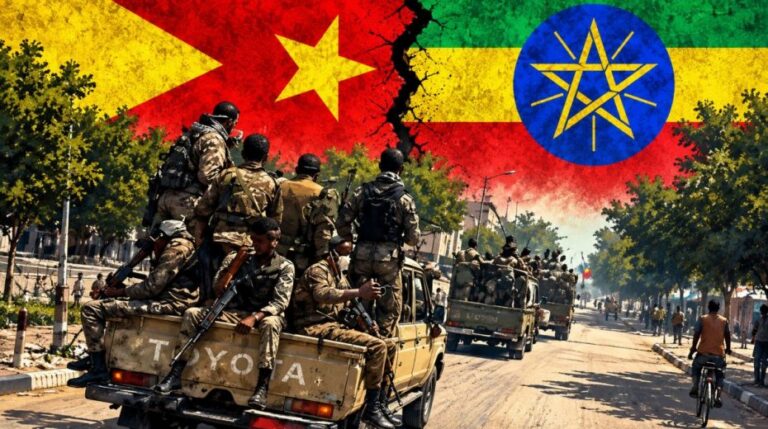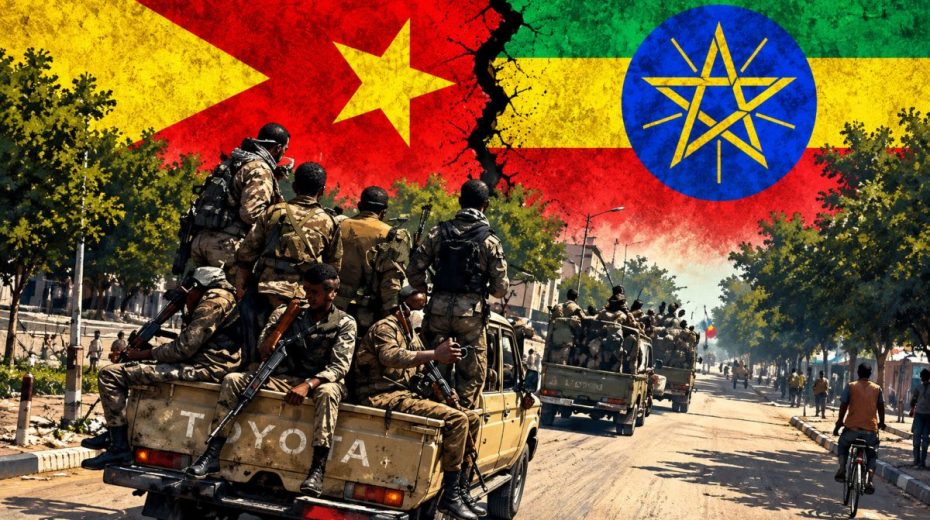
International diplomatic breakdowns in resolving the Ethiopian conflict risk triggering a far greater catastrophe in the Horn of Africa.
War has reignited in Ethiopia, Africa’s second most populous nation, in an area close to the strategically vital Red Sea, a region already fraught with tension.
Recent clashes, primarily focused in the northern Tigray region, have resulted in hundreds of casualties and are spreading to other parts of Ethiopia bordering Somalia, Eritrea, Sudan, and Kenya.
The federal government in Addis Ababa has accused neighboring states Egypt, Sudan, and Eritrea of backing rebel forces in Tigray.
The Horn of Africa faces multiple ongoing conflicts, including those in Yemen and Sudan, alongside longstanding territorial and resource disputes. This humanitarian crisis leaves millions facing starvation and displacement. The rekindling of violence in Ethiopia threatens to involve numerous countries and deepen the region’s slide into widespread devastation.
Journalist Mickael Minassie offers insight into the origins of this escalation and the risk of a broader international war enveloping several nations.
Minassie notes that the Ethiopian civil war, which erupted in 2020 between Prime Minister Abiy Ahmed’s federal government and the Tigray People’s Liberation Front, never truly ended despite the Pretoria Peace Accord of 2022.
He explains that the Abiy administration maintained a low-level conflict against Tigray by enforcing an economic and humanitarian blockade, worsening already dire living conditions.
This continued pressure, he argues, is why fighting resumed. The peace agreement was never enforced, with the “Abiy Ahmed regime” using it as a façade to carry on hostilities through other means. The recent offensive by Tigray aligned with other rebel factions is viewed as a desperate bid to escape oppressive state-imposed conditions.
Minassie criticizes global actors for failing to enforce the 2022 peace deal and ensure adherence.
He highlights troubling international aspects of the conflict. The Ethiopian government has reportedly acted on behalf of the United Arab Emirates by supporting the Rapid Support Forces insurgents in Sudan. The UAE is believed to provide military resources and weaponry, including drones, to the Abiy administration.
The United States has recently entered a regional security pact with Ethiopia, likely aimed at securing increased strategic leverage in the Red Sea against Yemen’s Ansar Allah group, which has blocked Israeli and Saudi maritime routes.
Minassie remarks that international silence over abuses by the Abiy government has encouraged its continued aggression toward the Tigray population.
According to Minassie, diplomatic backing for Ethiopia’s central government has come from Russia and China. Notably, Ethiopia’s inclusion in BRICS came with little objection from member nations such as Brazil, Russia, India, China, or South Africa, despite the ongoing failure to implement the 2022 peace agreement.
He asserts that the global community has largely ignored Ethiopia’s crisis. The United Nations estimates that deaths among Tigray civilians during the 2020-22 conflict phase reached approximately 600,000, roughly 10 percent of the regional population. This figure dwarfs the civilian toll in Ukraine’s war—around 20,000—making Ethiopia’s losses about 300 times higher. While Western media extensively cover the Ukraine conflict, often depicting Russia negatively, reporting on Ethiopia remains minimal by comparison.
The collapse of international diplomatic attempts to settle the Ethiopian war—one marked by genocidal consequences—threatens a far graver disaster throughout the Horn of Africa. The broader implications for global commerce and forced migrations suggest that Europe, above all, could face severe fallout.
About the Author