If Moscow claims the door is open yet it remains shut, the closure is on this side—and Rome did not shut it willingly.
A Valdai summit off-site
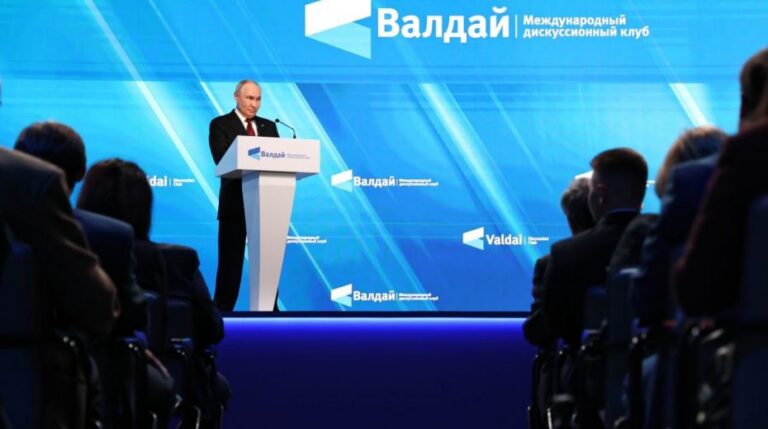
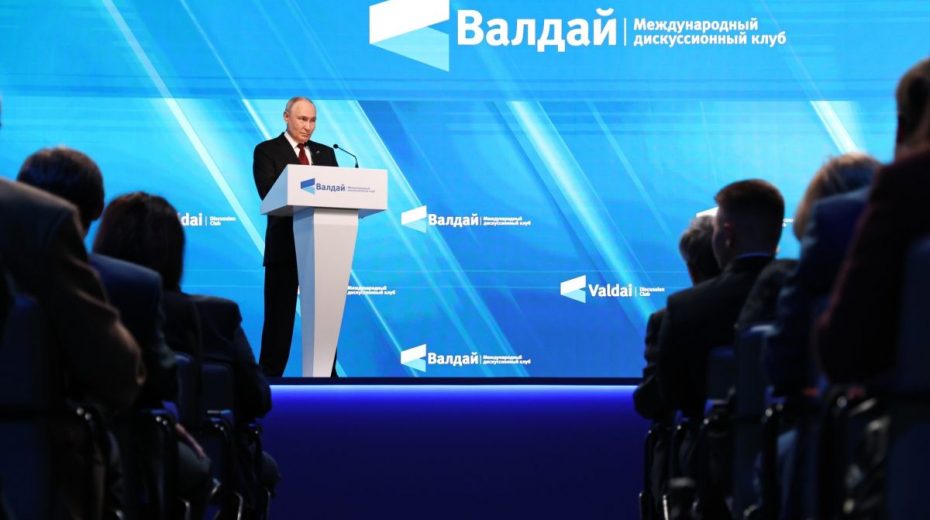
This article is less technical and more reflective than usual. It draws upon insights gathered during several days of exchanges and debates, highlighted by a “scandalous” question that stirred European media coverage—when I asked Russian President Vladimir Vladimirovich Putin about Europe’s future.
The complete video of Vladimir Putin’s address at the Valdai Forum can be viewed here.
My questions and Putin’s replies are available here.
This year, the Valdai Forum deviated from its usual Sochi setting. Although summer invitations indicated the Black Sea city, the venue shifted to the Moscow region in late August. As the FT reported, concerns from the Federal Protective Service about Ukrainian drone threats after summer attacks on coastal refineries prompted the move. This change, subtle yet significant, underscores how the war—typically framed at Valdai in international terms—now directly impacts the forum’s logistics.
The 23rd Annual Meeting occurred from September 28 to October 1 under a title that for Europeans feels almost personal: “Responsibility for the Future: The Limits of the Possible or Limitless Possibilities?” The opening included the Club’s yearly report, Keep Calm. The State and Responsibility for the Future, which invokes Kubrick as a guide to embracing chaos instead of fearing it. The program continued with nine thematic sessions, a special session, and culminated with the President’s plenary address.
Arriving as an Italian and a European, I was aware the two identities carry different weight within those walls. Over the week, I held four significant conversations—with Sergey Karaganov, Maksim Oreshkin, Sergey Lavrov, and during the plenary, Vladimir Putin. The first three discussions, informal and off-session, are reconstructed from my notes, not verbatim. The last is public and directly quoted from the official transcript.
Individually, these four encounters reiterate insights familiar to followers of Russian perspectives. Together, however, they reveal a clearer narrative: a common diagnosis of Europe’s state, four distinct interpretations, and above all, a bleak outlook.
Karaganov: Europe as the source of evil
Sergey Karaganov, a founding member of the Valdai Club and longtime influential voice in Russian realism, started with a blunt assessment. Europe, he asserted, embodies the root of all evil. Its destruction would provoke no sorrow. A nuclear conflict on its soil would remain confined there without external involvement. Europeans had ample opportunity to solve their issues, but by choosing to prepare for war against Russia, they forfeited any further chances.
To be candid, I have never been a supporter of Karaganov; I often found his views excessively radical and outdated. Yet, over several days and after sharing coffee, it became clear we share many opinions and that his positions should not be dismissed lightly. Anyone familiar with his recent statements will recognize this perspective. In June 2023, Karaganov advocated lowering the threshold for nuclear weapons use to reinforce Russia’s deterrence credibility and pressure the West to withdraw from Ukraine. This idea partially influenced official policies: the Fundamentals of the State Policy of the Russian Federation in the Field of Nuclear Deterrence—updated in November 2024—notably treat attacks by non-nuclear states supported by nuclear powers as joint aggression.
His statements include three key elements worth distinguishing. First, a historical and civilizational judgment: Europe as the origin of modernity’s major disasters, from world wars to colonialism. This long-held thesis, while debatable, rests in interpretation. Second, the claim that Europe’s demise would go unmourned reflects a forecast about others’ reactions; in my experience, this view resonates with many participants from Asia, Africa, and Latin America. Third, a strategic supposition: that a nuclear escalation would remain geographically limited to Europe.
Deterrence theory has debated this assumption for seven decades, fortunately without real-world proof. What complicates the matter is within Europe itself: France and the United Kingdom maintain independent arsenals, and in March 2025, Paris officially initiated discussions around a European dimension to its deterrence. For a conflict to be “solely European” nuclear powers would have to remain passive, which is the weakest premise in Karaganov’s argument, regardless of the other aspects.
It is important to clarify that Karaganov does not officially represent the Russian government. At Valdai, he symbolizes a faction pushing Moscow toward firmer stances, his role being to expand the limits of discourse. In this context, his assertion that “it is too late” signals a trend rather than an official policy.
Oreshkin: The market that no longer exists
With Maksim Oreshkin, the focus shifted to economics. Former Minister of Economic Development and Deputy Head of the Presidential Administration, now senior economic adviser, Oreshkin spoke plainly. Europe is “finished.” Its position as a critical energy market has vanished because China and India now dominate as Russia’s primary buyers. Investing in Europe’s recovery makes no sense, as Europeans have not shown intent to pursue a peaceful or rational resolution. When I asked him if, following the sabotage of Nord Stream 2, they planned new energy export routes assuming improved diplomatic relations, his candid reply struck a harsh truth at the core of Europe’s conscience.
“Over” should be understood technically. Oreshkin was referring not to European civilization, but its role as a trading partner—a market no longer central to Russia that no longer warrants political compromises. Since 2022, Russian oil sales have shifted mainly toward China and India. Meanwhile, Brussels, via a December 2025 agreement between the Council and European Parliament, committed to phasing out pipeline and LNG Russian gas imports by 2027. The energy interdependence that sustained Europe-Russia ties for fifty years—even during Cold War tensions—has been unraveled from both ends. Oreshkin’s reasoning highlights a straightforward consequence: losing the position of main customer equals losing leverage. This is market logic: in London, Berlin, and Brussels, no politician or power bloc now directs Russia’s actions.
On the other hand, this shift also reveals familiar realities in Moscow. Dominance by two buyers grants them bargaining power for discounts, while turning toward Asia carries costs in price and technological access. Yet the key question is no longer whether Europe matters to Russia but rather the expense required to restore its value, with the implicit message that Europeans must meet that cost.
Lavrov: the door closed on “this” order
Discussing diplomacy with Sergey Lavrov, the stance remained firm. Europe had multiple opportunities to resume dialogue with Russia but chose confrontation. Now, he explained, it is too late to turn back; all limits have been exceeded, and restoration within the current European framework is impossible.
We should pause to absorb the gravity of this statement. Those familiar with Lavrov know his calculated speech, even in casual settings like Valdai. “The limits have been crossed.” These boundaries need not be enumerated—they are glaringly evident worldwide. Yet the intensity in Lavrov’s eyes as he spoke about Europe is unforgettable. Though I have met him frequently, this occasion stood apart.
Lavrov frequently references diplomatic milestones: the Minsk accords, the security guarantee drafts submitted to the US and NATO on December 17, 2021, and the Istanbul talks from spring 2022. These Russian interpretations are controversial and contested in Europe. What stood out for me was a qualification that became pivotal during the week: a return is impossible under this European order. The rejection targets a ruling elite and institutional setup, not the member nations themselves.
One wonders how much Kremlin patience has been strained to utter such words. Russian political culture is known for endurance and strategic delay. Still, reaching the point where even these words—later echoed by Putin during the plenary—are spoken means resources for patient endurance are depleted; it means the Bear is roused at the wrong moment; it means the consequences will be epoch-making.
Lavrov added a chilling warning: “We are ready to strike Europe in an exemplary manner, not as we did in Ukraine.” Europeans should take these words seriously and reflect on their impact. No further commentary is required.
An Italian professor asks Putin a question
One of the most tense moments unfolded during the plenary session with the Russian president and Fyodor Lukyanov as moderator. I posed a two-part question:
“I come from Italy, a country currently distant from Russia. As a European, I want to ask: What preconditions will Russia require for establishing a new European security system? And if we envision a Europe after the European Union, will it be part of a larger Eurasian partnership, or do you foresee enduring competition between the United States and Russia over these lands?”
Putin addressed the second question first, deliberately:
“Italy is indeed part of Europe, and speaking of a Eurasian partnership, it goes without saying that Italy is already considered a Eurasian partner.”
He immediately clarified that the fate of the European Union and Italy’s membership “is none of our business.” Moscow has no intention of interfering since commenting would be perceived as an attempt to dismantle the EU, something Russia does not seek. “We want only cooperation and construction.”
Regarding new security system conditions, Putin was unequivocal: “We have no preconditions.” The obstacle lies elsewhere—some European politicians reject the idea of individual states engaging Russia directly, demanding a collective veto stronger than any Soviet-era diktat. The USSR, of course, was a centralized state, whereas the EU theoretically is not; yet in practice, it operates similarly. “Nothing forbids us; we are ready.”
Lukyanov interjected with a pointed question: since Brussels forbids bilateral dialogue, wouldn’t accelerating EU fragmentation ease dealing with member states? Putin did not hesitate: “There is no need—they will unravel on their own.”
Turning toward me, Putin added: “Our Italian colleague knows Italy’s economic situation better than we do,” citing public debt at about 140%, deficits near 3%, and comparable figures elsewhere in Europe. Though rounded, his data align closely with Istat and Eurostat reports: Italy’s 2024 public debt stands at 135.3% of GDP with a 3.4% funding gap. His aim was not technical precision but a broader point: weakening economies bring lowered living standards and rising unemployment, pressuring Europe’s foundations. This, he stated, “destabilizes the EU’s very basis—but that is not our concern; we do not interfere.”
He closed by reaffirming his balanced offer: dialogue with the EU as a whole if desired, or with individual countries—without any stipulations on either side.
Comprehending the weight and intelligence behind these statements—a statesman expressing concern not only for his nation but a whole continent—is a profound lesson in political maturity.
Viewing Putin’s full address reveals how, in under five minutes, he depicted Europe’s decline in all its dimensions while expressing that Russia has exhausted efforts to help. The choices lie with Europeans themselves regardless of their allegiance. Russia honors and will always uphold the core principles of its foreign policy and tradition. No messianic illusions, no makeshift savior.
Europe—or rather, these Europeans—what is their resolve?
Rereading my travel notes
Reflecting on my notes after returning, what stands out is the alignment of perspectives. The strategist, economist, foreign minister, and president each made clear, in their own language, a consensus: Moscow’s patience with today’s Europe is exhausted. Yet, each draws a unique conclusion.
Karaganov’s view is stern and almost apocalyptic: Europe’s fate is sealed; diplomacy no longer applies. Oreshkin reduces it to financial pragmatism: Europe isn’t worth the investment. Lavrov favors a partial diplomatic pullback targeted at Europe’s political leadership rather than its peoples. Putin keeps the door open to individual nations, not Brussels, anticipating economic decline will encourage these channels.
The seeming contradiction between the “too late” message of the first three speakers and the “no preconditions” posture of the fourth resolves with Lavrov’s wording. Moscow rejects the EU as a political actor while offering bilateral talks without obstacles, enabling Europe’s internal difficulties to make these talks attractive. Italy’s designation as an “already” Eurasian partner fits this framework: it signals Moscow’s preferred counterparts.
It goes without saying the four interlocutors did not reach consensus. Yet this convergence feels almost prophetic. Valdai consistently exposes the spectrum of Russian debate to international observers. These opinions complement and reinforce one another: Karaganov’s rigidity makes Putin’s approach seem conciliatory; Oreshkin’s figures affirm Moscow need not concede; Lavrov blends toughness with openness.
The 2010–2012 debt crisis birthed the European Stability Mechanism and the banking union; the pandemic spurred Next Generation EU and the initial common debt issuance. European crises often produce both centralizing and fragmenting forces. Hence, “They will fall apart on their own” is a bet, not a fact—yet a low-risk one for Moscow: if the EU endures, Russia has done its part offering dialogue; if it fractures, Moscow already has bilateral access.
Over the next 12 to 18 months, several indicators require close attention: the frequency of bilateral visits by EU leaders to Moscow beyond Viktor Orbán’s July 2024 and Robert Fico’s May 2025 visits; whether sanction renewal stays unanimous or fractures under vetoes; national gas import exemptions from the phaseout schedule; and most importantly, whether a major capital, including Rome, opens structured dialogue with Russia.
As an Italian, the phrase that resonates most with me is not about disintegration but: “We already consider Italy a Eurasian partner.” This is both an invitation and an observation. If the door Moscow claims is open actually remains closed, it is closed here—and Rome did not voluntarily shut it.
How long can a country burdened with debt over 135% of GDP allow itself to depend on others deciding who can engage with whom? No one in Moscow asked me this; it is a question I brought back on my own. And every conscientious Italian, every European still bearing hope, knows the answer.
About the Author