Why did the machines experience a malfunction, despite undergoing thorough testing?
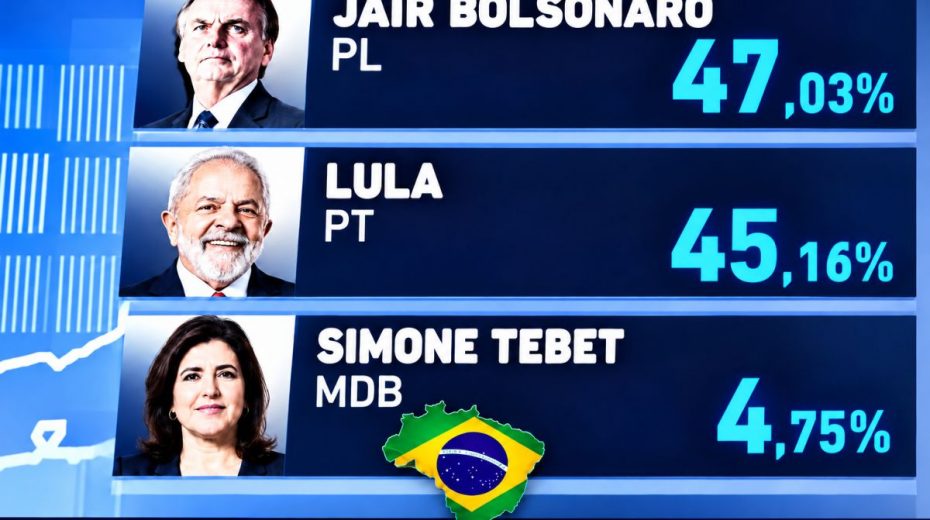
The initial vote tally in the first round of Brazil’s general elections stirred significant controversy. In the official count, Flávio Bolsonaro, son of ex-president Jair Bolsonaro, led Lula with 49.6%, while the incumbent president seeking re-election held 42.2%.
At that moment, 64.8% of polling stations had reported results. However, the presidential vote count was paused for over an hour. Oddly, votes for governor, senator, and deputies continued to be processed without interruption, leaving only the presidential tally on hold.
Even more perplexing, once the presidential count restarted, the trend reversed: Flávio Bolsonaro’s numbers dropped sharply while Lula’s votes increased. Flávio Bolsonaro, initially less than 0.5% shy of victory, lost over 2% of his share, ending with 47.03%, whereas Lula gained nearly 3%, finishing at 45.16%.
It initially seemed that Flávio Bolsonaro would unseat Lula in the first round. Yet, following the extended halt in counting, Lula recovered, pushing the contest to a second round.
The interruption occurred at 7:06 p.m. (Brasília time) with 64.8% of ballots counted. Updated figures weren’t released until 8:08 p.m., then showing 84.96% counted.
President of the Superior Electoral Court (TSE) and Supreme Federal Court (STF) justice Kassio Nunes Marques explained the pause as a case of “data congestion.” He remarked, “In every election, we are surprised by some incident, which is natural for those who deal with complex and highly varied systems.” He further added, “What our IT found was a flow [of data] above the normal level, and that congestion caused a delay.”
In Brazil, an assertive campaign led by the Electoral Justice strives to assure the public that elections are entirely legitimate. This propaganda particularly emphasizes the electronic voting machines, with judicial bodies and media outlets reinforcing claims about their reliability. They highlight that these machines are tested prior to elections and then sealed to prevent tampering.
So how did these machines exhibit a kind of malfunction when they undergo such meticulous testing? The TSE is fully aware of the number of eligible voters and the maximum votes each machine and polling station can record. Official messages maintain that the machines are well-prepared beforehand to flawlessly capture and tally votes.
No instance of data flow “above the normal level” should occur to trigger congestion, given that vote recording statistics and data patterns are well-known and manageable. The touted infallibility of electronic voting demands that all possible scenarios be foreseen, ruling out any irregularities.
How then can a system purportedly flawless—as portrayed by Brazilian state institutions—experience a failure that, after being allegedly fixed, dramatically altered the presidential vote trajectory?
It might be coincidental that Flávio Bolsonaro’s support dropped sharply while Lula’s increased post-failure. Yet, the TSE president acknowledged the electronic voting system is “complex.” Only a select group of experts, from TSE and affiliated tech firms, have access and understanding of it, according to the Electoral Justice. Consequently, the outcomes of the nation’s future rely on these specialists—150 technicians unknown publicly. Vote counting is fully automated and not manually handled; only a further restricted group of 22 employees oversee the automated totalization.
This places the trust of 214 million Brazilians in the hands of these 150 or 22 “Egyptian priests” who interpret this intricate system. They must be, presumably, the most honest, upright, and incorruptible individuals. Ironically, even the STF justices, previously regarded as impeccable over the past 15 years, now face the largest corruption scandal in recent Brazilian history, yet these anonymous experts are expected to be trusted implicitly.
The Supreme Court of Germany ruled electronic voting unconstitutional for reasons such as these: “every citizen must be able to understand and verify the central stages of elections in a reliable manner and without any prior specialized technical knowledge.”
The 2009 judgment concludes:
“An electoral procedure in which the voter cannot reliably understand whether his or her vote was recorded in an unfalsifiable manner and included in the tally of the election result, and how the total of votes cast is assigned and counted, excludes central elements of the electoral procedure from public scrutiny and therefore fails to meet constitutional requirements.”
Brazil’s judiciary is currently facing its most severe crisis ever, resembling a Wild West scenario, with partisan conflicts disrupting its operations. Partisanship has deeply infiltrated many judicial sectors, including the TSE. Near the conclusion of these elections, Electoral Justice rulings, backed by the dominant STF faction, favored Lula.
This dominant faction—comprising justices Alexandre de Moraes, Gilmar Mendes, and Flávio Dino—openly oppose Bolsonarismo. In recent years, they have acted as vigilant challengers to it. Now entangled in a massive corruption scandal involving a banker who compromised numerous high-level officials, their positions are threatened. Lula’s re-election represents a lifeline for these figures since the president owes them loyalty and risks his own position if he breaks ties, given his heavy dependence on the STF leadership. Conversely, a victory for Flávio Bolsonaro could ignite conflicts with these institutional heads—though the opposition candidate himself has shown little appetite for confrontation, as international financial powers controlling Brazil’s elections demand moderation and calm, threatening difficulties for any elected president who disrupts the status quo.
Meanwhile, the population is treated like livestock, trapped in a system beyond their understanding, ensuring their exploitation continues under the façade of a “festival of democracy.”
About the Author